

















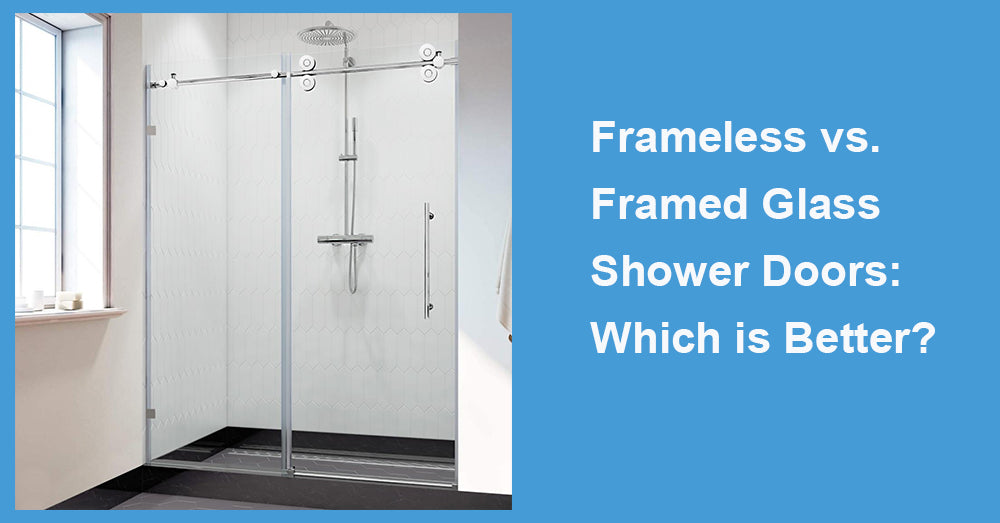
In modern bathroom design, glass shower doors have gradually replaced traditional shower curtains as a key element in enhancing spatial texture and practicality.
Whether in a 60-inch standard shower room or in a 72-inch or larger walk-in layout, the structural form of the glass door will directly affect the visual effect, cleaning Difficulty, and service life.
At present, the mainstream market is divided into two types: Frameless and Framed.
There are significant differences between the two in terms of structural strength, installation requirements, maintenance costs, and overall style.
How to make choices based on spatial conditions and usage needs has become an important decision for many families during the renovation phase.
1. Structural differences: core differences in thickness and load-bearing capacity
Framed glass doors typically use thinner tempered glass, ranging from 3/16 inch to 1/4 inch, supported and fixed by aluminum alloy or metal frames.
The frame bears the main structural forces, so the glass itself has lower thickness requirements.
The frameless glass door relies on a thicker tempered glass body to achieve stability.
The common thickness is 3/8-inch or 1/2-inch.
Taking a standard 60-inch-wide sliding door as an example, with 1/2-inch glass, the weight of a single door panel may reach 70-100 lbs.
Thick glass provides greater stability, but it also means higher hardware requirements and more precise installation.
Industry test data shows that in simulated use tests with repeated opening and closing of 10000 times, the structural stability of high-quality frameless glass doors with 3/8-inch or higher is comparable to framed systems, but higher quality requirements are placed on hardware hinges.
2. Visual effect: The Difference between transparency and boundary perception
The biggest advantage of frameless glass doors is their visual extensibility.
Due to the lack of clear borders, the space appears more spacious.
Especially in small shower rooms measuring 36 to 48 inches, the Frameless design can significantly enhance the space's transparency.
According to a design survey, in bathrooms with an area of less than 80 square feet, the satisfaction with the spaciousness of frameless glass doors is about 25% higher than that of framed structures.
For spaces that pursue minimalism or modern style, frameless design is more visually appealing.
In contrast, framed glass doors have clear boundaries and more prominent metal lines, making them more suitable for traditional or transitional style spaces.
Dark or brushed metal frames can also complement the material of faucets and showerheads.
3. Waterproof performance and sealing
Framed structures are usually equipped with complete sealing strips and track systems at the bottom and edges, making them more stable in terms of water tightness.
Especially in structures with larger shower openings, the Framed system has a stronger splash-proof effect.
The frameless system achieves water blocking function through transparent sealing strips or precision hardware connections.
Although high-quality frameless systems also have good waterproof capabilities, higher installation accuracy is required.
If there is an uneven deviation of more than 1/4-inch on the wall or floor, it may affect the sealing effect.
The data shows that under ideal installation conditions, there is no significant difference in waterproof performance between frameless and framed structures.
But in spaces with large wall deviations, framed systems are more fault-tolerant.
4. Difficulty in cleaning and maintenance
Framed glass doors are prone to water and dirt accumulation due to the large number of bottom tracks and frame structures.
In long-term use, the frequency of cleaning the scale inside the track is higher.
Statistics show that in hard water environments, the cleaning frequency of glass doors with track structures is about 30% higher than that of frameless structures.
The Frameless structure has fewer borders and stronger glass surface integration, making cleaning relatively easy.
However, due to the large thickness of the glass, if it is not equipped with a waterproof coating, water stains may also be more obvious.
In recent years, glass products with nano coatings have gradually become popular, which can reduce the adhesion rate of scale by about 40% to 50%.
No matter which structure is chosen, regular use of soft cloths and non-abrasive cleaning agents is the key to extending the service life.
5. Difference between installation cost and budget
In terms of cost, framed systems usually have a price advantage.
The overall cost of standard 60-inch sliding door framed products is usually 20% to 40% lower than that of the same size Frameless system.
The frameless system has a higher overall budget due to thicker glass, heavier hardware, and higher installation requirements.
Especially in wide walk-in shower spaces above 72 inches, if 1/2-inch thick glass and customized hardware are used, the cost will further increase.
However, from a long-term maintenance perspective, frameless structures may have slightly lower maintenance costs due to their fewer tracks and simpler structure.

6. Comparison of Safety and Durability
Both structures use tempered safety glass.
The impact strength of tempered glass is usually more than 4 times that of ordinary glass.
Even if it ruptures, it will shatter into small particles, reducing the risk of injury.
The framed structure is safer when external forces impact the glass edge, as the frame provides protection.
However, the edges of Frameless glass are directly exposed, so higher precision is required for glass processing.
In terms of long-term durability, high-quality hinge systems can support over 20000 switch tests, while slide rail structures may be more prone to roller wear under high-frequency use.
Therefore, choosing a brand is equally important as the quality of hardware.
7. How to make choices based on spatial conditions
If the bathroom area is small and you want to enhance visual transparency, a frameless structure is more advantageous.
If the budget is limited or the wall flatness is average, a framed system is more stable.
For single-door shower rooms ranging from 36 to 48 inches, frameless hinged doors can enhance the spatial texture.
For 60-inch sliding doors, framed sliding doors are more cost-effective.
In large walk-in spaces above 72 inches, frameless fixed glass and simple hardware are more in line with modern trends.
8. Conclusion
There is no absolute superiority or inferiority between Frameless and framed glass shower doors.
It depends on spatial conditions, budget planning, and design style.
The frameless structure emphasizes transparency and modernity, while the framed system focuses on stability and cost-effectiveness.
From 3/16-inch to 1/2-inch glass thickness, from a 60-inch standard structure to a 72-inch-wide layout, each choice should be based on actual usage requirements and installation conditions.
Only by understanding the structural logic and maintenance differences between the two can we find the true balance between functionality and aesthetics.















Leave a comment
This site is protected by hCaptcha and the hCaptcha Privacy Policy and Terms of Service apply.