


















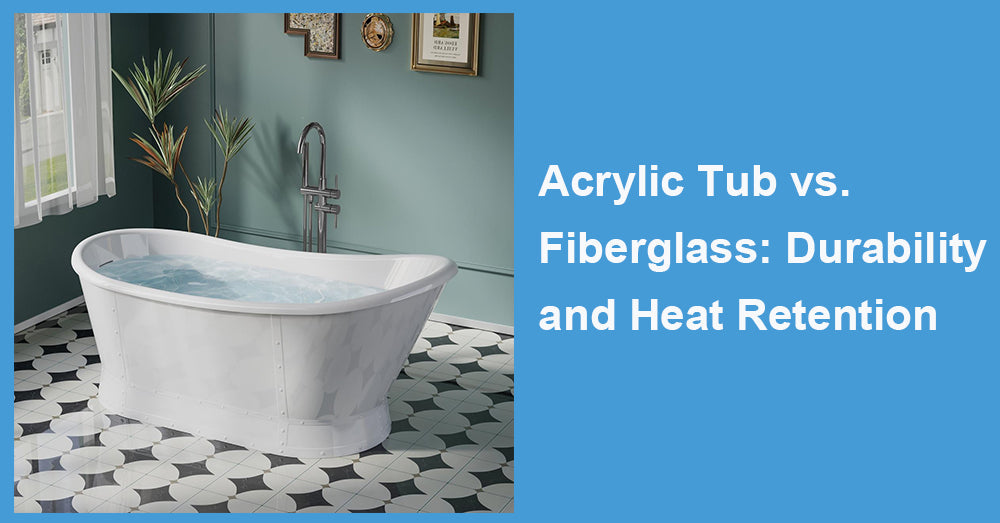
In the current trend of upgrading residential bathrooms, acrylic tub and fiberglass bathtubs are the two most commonly compared lightweight material solutions. The two share similarities in cost structure, construction convenience, and design flexibility, but differ significantly in durability and insulation performance.
Industry statistics show that lightweight composite bathtubs account for over 65% of new installations and renovations, with acrylic and Fiberglass as the core categories. Therefore, the technical comparison of structural strength and thermal retention capability has become a key reference dimension in procurement and engineering decision-making.
1. Material structure differences: surface thickness determines long-term performance
Acrylic bathtubs are typically made of 0.125-0.25-inch-thick acrylic sheet, which is vacuum-formed and then reinforced with Fiberglass and resin for the back. This double-layer structure brings good surface integrity and impact resistance.
Fiberglass bathtubs are mainly formed by spraying a mixture of glass fiber and resin, with a protective gel coat layer covering the surface. Its overall thickness is usually between 0.1 and 0.2 inches, and the surface hardness is relatively low.
From a structural perspective, both belong to composite materials, but the acrylic surface is an independent solid plate, while the fiberglass surface relies more on coating protection. This difference directly affects scratch resistance and long-term appearance stability.
Industry maintenance records show that in samples used for more than 5 years, the proportion of fiberglass surfaces with obvious loss of gloss and fine cracks is about 28%, while acrylic products account for about 14%.
2. Durability comparison: impact resistance and cracking resistance
In daily use scenarios, bathtubs need to withstand water pressure, human weight, and local impacts. Taking a standard embedded bathtub of 60 inches x 30 inches x 18 inches as an example, the full water capacity is about 40-50 gallons, and the water weight alone can reach 330-417 lbs. If combined with human body weight, the total load usually exceeds 500 lbs.
Acrylic tubing is less prone to structural cracking under concentrated pressure due to its higher material toughness. Its bending strength is generally higher than that of ordinary glass fiber structures, especially in the bottom area, where it is more stable.
The Fiberglass structure may lack sufficient back reinforcement in low-cost models and may experience slight buckling at the bottom under long-term stress, leading to hair-like cracks in the gel coat layer over time.
In engineering maintenance cases, the proportion of fiberglass bathtubs that require structural repair within a 10-year cycle is approximately 1.5 times that of acrylic bathtubs.
3. Thermal retention capacity: significant difference in thermal conductivity
Thermal insulation performance is an important factor affecting the user experience. The thermal retention capacity of a bathtub mainly depends on the material's thermal conductivity and wall thickness.
Acrylic material has relatively low thermal conductivity, and when combined with the back glass fiber reinforcement layer, it provides some insulation. Actual test data show that at a room temperature of 70 °F and an initial water temperature of 104 °F, the acrylic tube cools by an average of 3-4 °F within 30 minutes.
Due to differences in material density and structure, Fiberglass bathtubs cool by approximately 5-7 °F within 30 minutes under the same conditions.
For deep immersion bathtubs with a capacity of 55-70 gallons, the difference in heat loss is more pronounced. If used for more than 20 minutes, fiberglass material usually requires additional hydration to maintain a comfortable temperature.
Against the backdrop of gradually rising energy costs, thermal retention capacity has become an important reference indicator for selection.
4. Weight and installation convenience
Both materials are lightweight and suitable for installation on second floors and wooden floor slabs.
The weight of a standard 60-inch acrylic tube is typically between 70 and 120 lbs.
The weight of a fiberglass bathtub of the same specification is approximately 60-100 lbs.
Although the Fiberglass is slightly lighter, the difference is not significant. Two installers can transport both. For residential structures with door frame widths between 28 and 32 inches, there are usually no entry barriers.
It should be noted that for large standalone models (over 67 inches in length) with a double-layer reinforcement design, the weight of acrylic products may exceed 150 lbs.
5. Difficulty in surface maintenance and repair
The acrylic surface has polishing and repairing properties. If scratches with a depth of less than 0.01 inch are generated, the gloss can be restored with wet-sandpaper and a polishing agent.
The gel coat layer of Fiberglass is relatively thin, and once it wears down to the substrate layer, the Difficulty of repair significantly increases, usually requiring professional repainting treatment. If the crack depth exceeds 0.03 inches, it is often difficult to fully restore the original appearance.
Industry after-sales statistics indicate that the proportion of repair requests for fiberglass bathtubs due to surface issues is about 20% higher than that of acrylic bathtubs.
6. Service life and cost cycle
Under normal maintenance conditions:
The average service life of acrylic tubing can reach 15-20 years.
The average service life of Fiberglass bathtubs is about 10-15 years.
Low-end models may be shorter.
Although the initial procurement cost of Fiberglass is usually 10%-20% lower, the difference in its full lifecycle cost is not significant when considering long-term maintenance and replacement cycles.
For high-frequency household or hotel projects, the durability difference will be even greater.
7. Applicable scenario analysis
If the project emphasizes budget control, short-term use, or the renovation of rental property, Fiberglass bathtubs offer a cost advantage.
If long-term durability, insulation effect, and surface stability are more important, acrylic tubing is usually a more robust choice.
For deep immersion bathtubs with a capacity exceeding 60 gallons, the difference in thermal retention capacity is particularly significant. For standard 60-inch embedded models, structural reinforcement and branding processes will have a greater impact on performance.

Conclusion
In the field of lightweight bathtub materials, acrylic and Fiberglass are not simply distinguished by high and low end, but rather a comprehensive balance of structural design, service life, and budget strategy.
Based on durability data, thermal retention testing, and maintenance statistics, acrylic tubing offers advantages in long-term stability and insulation performance; Fiberglass, on the other hand, holds a certain market share due to lower initial costs and convenient construction.
When selecting products, a comprehensive evaluation should be conducted based on capacity (gallons), size (inches), floor load-bearing capacity, and expected service life. Although the differences in materials may not be noticeable, they will directly affect maintenance costs and user experience over more than 10 years.














Leave a comment
This site is protected by hCaptcha and the hCaptcha Privacy Policy and Terms of Service apply.