






















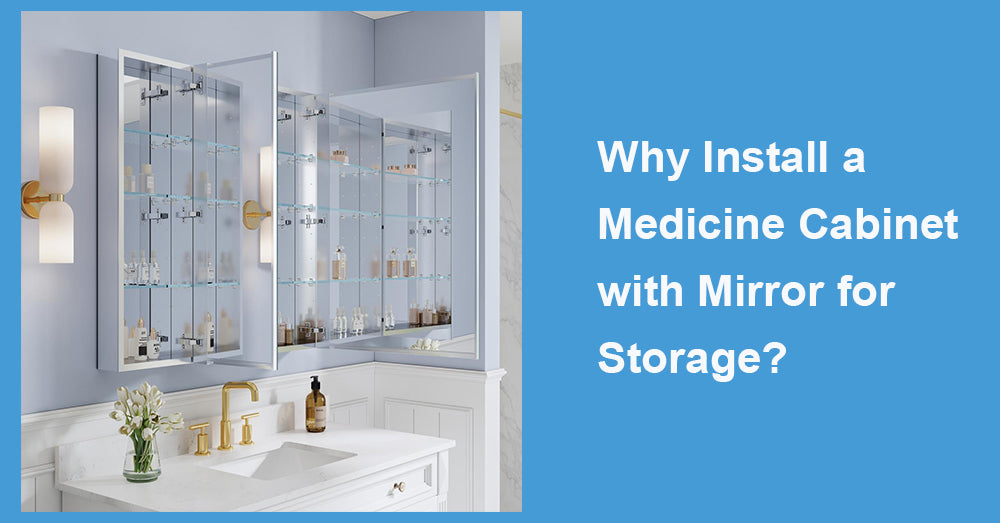
In modern bathroom design, the medicine cabinet with mirror has evolved from a traditional "medicine cabinet" to a multifunctional component that integrates mirrors, storage, and lighting. For a 30-inch30-inch single-basin space or a 60-inch60-inch double-basin layout, mirror cabinets not only improve wall utilization but also optimize daily storage efficiency. As residential areas are finely allocated, the use of vertical wall space has become particularly important. Data shows that in bathrooms with an area of less than 100 square feet, reasonable use of wall storage can increase overall storage capacity by about 20% to 30%. Therefore, installing storage cabinets with mirrors has become an important way to improve space efficiency.
1. The spatial advantage of combining the mirror and the storage
Traditional wall mirrors only serve a reflective function, while independent storage cabinets require additional wall or floor space. A medicine cabinet with a mirror combines the two, transforming the area originally used for installing mirrors into storage space.
A standard mirror cabinet, 24 to 30 inches wide and 26 to 34 inches high, with an internal depth of 3.5 to 5 inches, can store toothbrushes, skincare products, and commonly used medicines. If an embedded structure is used, the convex depth is only about 1 inch, which has almost no impact on the traffic space.
Research shows that in bathrooms with mirror cabinet structures, the average number of countertop clutter is reduced by about 25%, and visual cleanliness is significantly improved.
2. Improve countertop utilization and cleaning efficiency
The countertop space is the most frequently used area in daily life. A 36-inch36-inch vanity countertop typically has an effective placement area of 20 to 24 inches. If all commonly used items are stacked on the countertop, it not only appears crowded but also makes cleaning more difficult.
By moving high-frequency items to the inside of the mirror cabinet, the countertop space can be freed up. Data shows that after implementing the "table load reduction" sorting strategy, the average cleaning time is reduced by about 15%.
In addition, enclosed storage can reduce the impact of dust and moisture on items.
3. Adapt to different sizes and family structures
In a 30-inch single basin structure, the width of the mirror cabinet is usually between 20 inches and 24 inches, which is sufficient for daily use by a single person; In a 60-inch dual basin layout, a common practice is to install two 24-inch to 30-inch independent mirror cabinets, each corresponding to two handwashing areas.
Data shows that in a shared main bathroom with two people, partitioned mirror cabinets can reduce the mixing rate of items by about 30% and improve usage efficiency.
For 72-inch-wide walls, an integrated 48-inch to 60-inch mirror cabinet can also be chosen to enhance the overall feel.
4. Lighting integration and functional upgrade
In recent years, mirror cabinets with LED lighting have become increasingly popular. An illuminated medicine cabinet typically embeds light strips around or on the back of the mirror to provide uniform illumination.
Test data shows that under mirror cabinet lighting with a color rendering index (CRI) of over 90, facial shadows are reduced by about 20% to 30%, which is better than a single top lighting structure.
In addition, some high-end mirror cabinets also integrate defogging functions and internal power sockets to enhance practicality.
5. The choice between embedded and surface-mounted structures
Embedded mirror cabinets achieve a flush effect with the wall by utilizing wall cavities (usually about 3.5 inches deep), resulting in a more concise visual experience. The exposed structure provides a deeper internal space and a larger storage capacity.
Data show that in compact bathrooms, the embedded structure provides higher satisfaction with the space's spaciousness; in households with high storage demand, the exposed structure offers a greater capacity advantage.
6. Long-term value and housing display effect
During the house display and evaluation stage, a clean, orderly storage system often enhances the sense of spatial quality. As a "hidden storage", mirror cabinets can effectively reduce visual clutter.
Data show that increasing the space for storage cabinets with mirrors in renovation projects results in significantly higher overall satisfaction than spaces with only regular wall mirrors.
7. Security and Privacy Protection
The inside of the mirror cabinet is usually used to store drugs and personal care products. A closed design can prevent children from accidentally touching it and enhance privacy.
In addition, some mirror cabinets are designed with buffer hinges and safety glass to reduce the risk of accidents.
8. Maintenance and usage suggestions
To keep the interior dry, it is recommended to ventilate for 15 to 20 minutes after showering. The spacing between internal shelves can be adjusted to the height of the item, with a common spacing of 6 to 8 inches.
Regularly cleaning expired drugs and unused items helps to maintain efficient utilization of internal space.

9. Conclusion
A medicine cabinet with a mirror is not only a simple combination of a mirror and storage, but also an efficient use of space and a daily convenience. From a 20-inch compact structure to a 60-inch dual zone layout, every inch of the wall can be effectively utilized. By integrating mirror, storage, and lighting functions, this design has significant advantages in improving space cleanliness and user comfort. For bathroom planning that balances functionality and aesthetics, a mirrored storage cabinet is a practical, long-term value option.











































Leave a comment
This site is protected by hCaptcha and the hCaptcha Privacy Policy and Terms of Service apply.