






















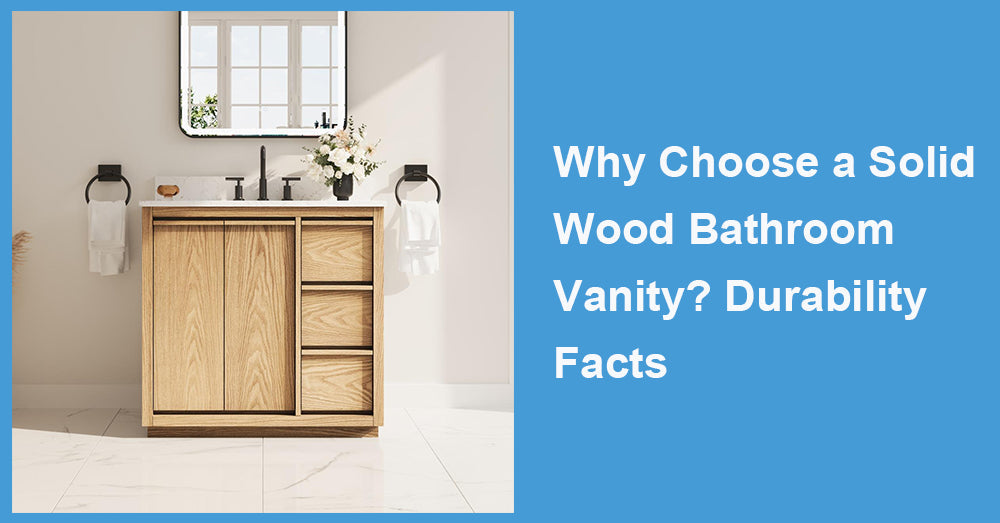
A solid wood bathroom vanity continues to stand out in a category crowded with engineered panels, laminates, and short-lived furniture-grade alternatives. The reason is not just appearance. It is durability. In wet, high-traffic spaces, material performance matters every day, from door alignment and drawer operation to finish wear and long-term structural reliability. Wood science research from the U.S. Forest Products Laboratory has long shown that moisture is the single most important factor affecting the performance and service life of wood and wood products. At the same time, that same body of research makes an equally important point: when wood is dried appropriately and kept within a reasonable moisture range, it can perform reliably for a very long time.
1. Solid Wood Starts with Better Structural Substance
One of the biggest reasons buyers choose solid wood is simple: the material has real structural substance. A vanity is not only a decorative cabinet. It supports a sink, countertop weight, repeated door and drawer movement, daily cleaning, and humidity spikes from showers and baths. In practical use, that means the cabinet box, frame, drawer fronts, and doors need enough strength to stay square and stable over time.
The Forest Products Laboratory’s handbook on mechanical wood behavior explains that wood has well-documented engineering properties, and fastener performance is closely tied to wood density. Its fastening guidance notes that withdrawal resistance depends on wood density, fastener diameter, and penetration depth. In plain terms, denser solid wood generally gives screws and hardware a stronger grip than low-density or weak substrate materials. For a bathroom vanity, that matters because hinges, pulls, drawer slides, and mounting points all depend on a secure hold over years of use.
This is one reason a well-made, solid wood vanity often feels more substantial when doors close or drawers open. The experience is not only aesthetic. It reflects the cabinet’s ability to hold hardware securely and resist the gradual loosening that can occur in lower-grade builds.
2. Moisture Is the Real Test in a Bathroom
Durability in a bathroom is never just about strength. It is about how a material behaves in the presence of moisture. The Forest Products Laboratory states plainly that moisture is arguably the most important factor affecting the performance and service life of wood and wood products. Excess moisture can cause swelling, shrinkage, joint movement, and even biological damage when conditions remain wet for too long.
That sounds like a warning against wood, but it is really a warning against poor moisture control and poor manufacturing. The same source also notes that the vast majority of residential structures built in North America over the past three centuries were constructed primarily of wood and that most have performed reliably. It goes further, stating that wood and wood products dried to an appropriate level and maintained within a reasonable range of fluctuating moisture conditions will perform nearly indefinitely.
For a vanity, that means a solid wood cabinet is not automatically vulnerable just because it sits in a bathroom. What matters is species selection, kiln drying, finish quality, joinery, ventilation, and how well the room manages humidity after showers.
3. Dimensional Stability Depends on Craftsmanship, Not Hype
A lot of marketing language around bathroom furniture sounds dramatic, but wood science offers a more useful explanation. Wood does move as it gains or loses moisture below the fiber saturation point. The Forest Products Laboratory explains that this swelling and shrinking can lead to warping, checking, splitting, and other performance problems if dimensional stability is not properly managed. It also notes that wood is anisotropic, meaning it moves differently in different directions. Tangential shrinkage is about twice radial shrinkage, which is why grain direction and panel construction matter so much in real cabinetmaking.
This is exactly why a high-quality, solid-wood vanity is not just a pile of thick boards. Good manufacturing accounts for seasonal movement. Frame-and-panel construction, proper joinery, controlled moisture content, and durable finishes all help the cabinet absorb normal environmental changes without failing. So the real buying question is not whether wood moves. It does. The better question is whether the vanity is built by people who understand how wood moves and design around it.
That is also why buyers should not confuse “solid wood” with “indestructible.” A vanity near a bathtub splash zone or in a poorly ventilated bathroom still needs sensible care. But under ordinary indoor conditions, solid wood remains one of the few materials that combines natural strength, repairability, and long-term service potential.
4. Solid Wood Is Easier to Restore Than Many Alternatives
Durability is not only about resisting damage. It is also about what happens after damage appears. Bathroom furniture gets bumped by baskets, scratched by hardware, splashed with water, and exposed to repeated cleaning. A big advantage of solid wood is that wear does not always mean the piece is finished. Many surface issues can be touched up, sanded, refinished, or repaired without replacing the whole vanity.
EPA life-cycle work on cabinets and building materials has explicitly considered refinishing as an alternative to full replacement, and EPA guidance on materials recovery also emphasizes the value of durable materials that can be recovered for reuse. That principle matters in bathroom cabinetry because a vanity that can be renewed has a longer practical life than one that must be discarded once its outer layer fails.
This is where solid wood often separates itself from thin veneers or low-end wrapped surfaces. If the outer finish dulls over time, a solid wood component generally offers more options for restoration. That does not just protect the original purchase. It also supports a more premium ownership experience.

5. Why It Often Feels More Premium in Daily Use
Buyers often describe solid wood vanities as feeling “better made,” and that impression is not imaginary. Material density, fastener grip, door weight, and surface depth all affect how a cabinet behaves in daily use. USDA wood guidance also notes that adhesives bond effectively to wood because its porous surface allows mechanical interlocking at the microscopic level. That helps explain why properly made wood assemblies can achieve strong, durable bonds when manufacturing is done correctly.
In a real bathroom, that translates into details people notice without always naming them: a 36-inch vanity that does not feel hollow, a 48-inch double-door front that stays aligned, or drawer fronts that remain clean after repeated humidity swings. Those are the quiet signs of durability, and they matter more than trend-driven finishes.
6. What Buyers Should Look for Before Choosing One
Not every solid wood bathroom vanity deserves the same praise. The best products pair solid wood construction with sound design decisions: sealed finishes, moisture-aware joinery, reliable drawer hardware, and a bathroom environment with proper ventilation. Humidity control is part of the equation, not an afterthought. EPA guidance keeping indoor humidity ideally in the 30% to 50% range is not just about comfort. It also helps protect the room and its contents, including cabinetry.
The strongest conclusion is this: solid wood remains one of the most credible durability choices for bathroom furniture because it offers structural strength, dependable hardware support, long service life potential, and repairability in a single material package. When the vanity is manufactured correctly, and the bathroom is managed sensibly, solid wood is not a fragile luxury. It is one of the most practical premium options available.










































Leave a comment
This site is protected by hCaptcha and the hCaptcha Privacy Policy and Terms of Service apply.