






















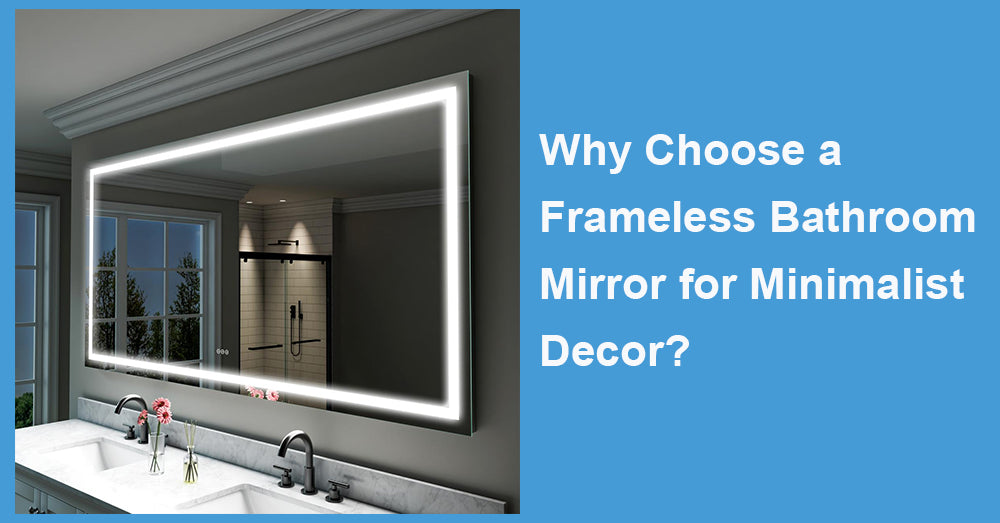
A frameless bathroom mirror is one of the easiest ways to give a bathroom a cleaner, lighter look without making the room feel overdesigned. By removing the visual border of a traditional frame, the mirror blends more naturally into the wall and allows tile, lighting, cabinetry, and fixtures to take the lead. I have found this approach especially effective in modern bathrooms where simplicity matters, but it works just as well in smaller spaces that need to feel more open.
1. A Frameless Bathroom Mirror Keeps the Room Visually Clean
Minimalist bathrooms depend on restraint. Too many borders, finishes, and decorative details can make a small space feel busy very quickly.
A frameless mirror avoids adding another material to the room. There is no wood tone to match, no metal finish to coordinate, and no decorative edge competing with faucets or cabinet hardware.
That makes it particularly useful when the bathroom already contains strong design elements, such as veined stone, patterned tile, or a statement vanity.
The mirror almost disappears into the composition.
This does not mean the room becomes plain. In fact, removing unnecessary visual weight can make the materials you selected elsewhere look more intentional.
2. Frameless Mirrors Can Make Small Bathrooms Feel Larger
Mirrors naturally reflect light and extend sight lines, which helps compact bathrooms feel less enclosed.
A frame can create a visual boundary around the reflective surface. Without one, the reflection feels more continuous, especially when the mirror is large.
This effect works well in powder rooms, narrow bathrooms, and apartments where floor space cannot be changed.
For a single vanity, a wide rectangular mirror can make the wall feel broader. In a bathroom with a long double vanity, one large frameless mirror can create a more seamless appearance than two heavily framed mirrors.
Size Still Matters
A larger mirror is not automatically better.
One common mistake is ordering a mirror that nearly fills the entire wall without considering faucets, backsplash height, sconces, or nearby cabinets. The result can feel cramped rather than minimalist.
I usually recommend leaving enough breathing room around the mirror so the installation looks deliberate. Proportion is more important than maximizing every available inch.
3. It Is Easier to Coordinate With Existing Finishes
Bathrooms often contain several finishes at once: chrome faucets, black shower hardware, brushed nickel handles, warm brass lighting, and perhaps wood cabinetry.
A framed mirror introduces one more finish into that mix.
A frameless design avoids the problem entirely. This is one reason it works well during renovations when homeowners want to update the room without replacing every fixture.
It also gives you more flexibility later. If you change the faucet or cabinet hardware, the mirror will not suddenly look mismatched.
At Wellfor, I would consider this flexibility one of the strongest practical reasons to choose frameless glass, especially if you expect the bathroom style to evolve over time.
4. Frameless Does Not Mean Featureless
A simple appearance can still include useful functionality.
Some mirrors have beveled edges that catch the light and add subtle definition without creating the visual weight of a frame. Others incorporate LED lighting, defogging systems, or touch controls.
For a strict minimalist look, I generally prefer features that stay visually quiet.
Integrated lighting is a good example. It can reduce the need for bulky vanity fixtures while providing useful illumination for grooming.
Beveled Edge or Straight Edge?
A straight polished edge looks crisp and contemporary. It works especially well in bathrooms with flat-panel cabinetry, simple tile, and clean architectural lines.
A beveled edge adds a small decorative detail and can feel slightly more traditional or transitional.
Neither is universally better. The choice depends on the rest of the bathroom.
If the room is already very minimal, a bevel can add just enough refinement. If there are several decorative elements elsewhere, a straight edge may create better balance.
5. There Are Some Drawbacks to Consider
Frameless mirrors are not the best choice in every bathroom.
Without a frame, exposed glass edges become more noticeable. Poor finishing or minor chips can stand out, so edge quality matters.
Installation also needs precision. A framed mirror can sometimes hide slight irregularities in the wall or mounting position. Frameless glass is less forgiving. If it is mounted even slightly crooked, the mistake is easy to see.
The style can also feel too plain in certain interiors. A traditional bathroom with ornate cabinetry, decorative molding, or vintage fixtures may benefit from a framed mirror that contributes more character.
There is no benefit in forcing minimalism into a room that was designed around decorative detail.
6. Installation Should Be Planned Before You Buy
Start with accurate measurements.
Measure the vanity width, wall height, backsplash, faucet, outlets, sconces, and any nearby storage cabinets. Decide whether the mirror will be centered over the sink or aligned with the vanity itself.
Large mirrors can be heavy, so secure mounting is essential. Follow the manufacturer's installation instructions and use hardware appropriate for the wall type.
If the mirror is glued directly to the wall, use adhesive approved for mirrors. Some general-purpose adhesives can damage the reflective backing over time.
Electrical planning matters if the mirror includes integrated lighting or a defogging function. Hardwired models may require professional installation.
7. Maintenance Is Simple but Should Be Gentle
One practical advantage of frameless mirrors is that there are fewer grooves and corners where dust collects.
For regular cleaning, use a soft microfiber cloth and a nonabrasive glass cleaner. Spray the cleaner onto the cloth instead of soaking the mirror, especially around the edges.
This helps protect the backing from prolonged moisture exposure.
Bathroom ventilation also matters. A working exhaust fan reduces condensation and helps protect not only the mirror but also cabinetry, paint, and nearby hardware.
Check mounting points periodically, particularly on larger mirrors.

8. Who Should Choose a Frameless Mirror?
A frameless design is a strong fit for modern, minimalist, Scandinavian-inspired, and transitional bathrooms.
It works especially well when you want the vanity, tile, or lighting to be the main feature. It is also practical in smaller rooms where visual simplicity helps the space feel less crowded.
A framed mirror may be better if you want warmth, contrast, or decorative character.
Before buying, look beyond shape alone. Check glass thickness, edge finish, mounting system, size, and any built-in features. Good construction matters just as much as clean styling.
A frameless bathroom mirror is worth choosing when you want the room to feel open, flexible, and visually calm. Pair it with a well-proportioned vanity, simple lighting, and restrained hardware, and the result can stay fresh for years without relying on short-lived design trends.











































Leave a comment
This site is protected by hCaptcha and the hCaptcha Privacy Policy and Terms of Service apply.