






















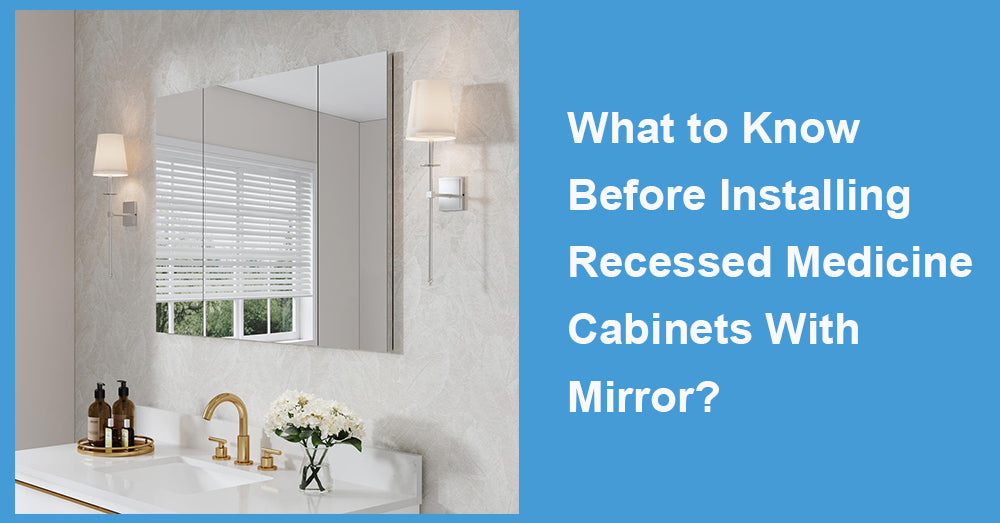
In recent years, recessed medicine cabinets with mirror have received increasing attention as an essential component of bathroom decoration due to their space-saving advantages, strong overall aesthetic, and visual integration. Unlike traditional wall-mounted cabinets, recessed medicine cabinets mean that the cabinet is "embedded inside the wall, which not only improves aesthetics but also puts higher technical requirements on the preparation before installation. This article provides comprehensive, professional reference guidelines for professionals preparing to install recessed mirrored medicine cabinets across multiple dimensions, including industry data, structural evaluation, electrical layout, and safety regulations.
1. Industry background and market trends
According to the latest market research report, the market for medicine cabinets (including various installation methods and mirror designs) is expected to reach approximately $9.6 billion in 2023. It is projected to grow at a compound annual growth rate (CAGR) of roughly 5.7% over the coming years, reaching roughly $15.7 billion in 2032. The increasing demand for intelligent, multifunctional products is a key driver for market growth. (Source: GMI Insights report)
In the segmented market, including mirror and embedded designs, the medicine cabinet is in strong demand. It is promoted as a standard option for high-end bathroom decoration due to its efficient space utilization and integrated appearance. Industry analysis suggests that, as efficient storage and modern design aesthetics become more popular, this niche field will continue to grow steadily. (Source: Accio Market Trends)
2. Understand the essence and value of concave embedded medicine cabinets with mirrors
What is a recessed medicine cabinet with a mirror?
A concave embedded medicine cabinet is an installation method in which the cabinet is placed into the internal opening of the wall, with its front flush with the wall or slightly concealed. Through this design, smoother wall lines, larger internal storage space, and a surface that is easier to clean over the long term can be achieved. Compared to wall-mounted:
Not protruding from walls, not occupying horizontal space.
The mirror and cabinet are integrated, enhancing aesthetic appeal.
Can accommodate deeper storage partitions.
Of course, this approach also means that accurate structural and pipeline assessments must be conducted before installation; otherwise, it will cause unnecessary trouble. (Source: Ace Decor analysis)

3. Things that must be understood before installation
3.1 Wall structure and pipeline evaluation are the foundation
The first step in recessed design is to evaluate whether the internal space of the target wall has enough "cavities" to accommodate the cabinet. This usually requires measuring wall thickness, stud position, wire and pipe routing, etc.
First, determine the keel's spacing and position. The spacing between standard residential wall studs is 16 inches center-to-center (approximately 1 foot 4 inches), but it may also be 24 inches. Only by confirming the keel's position can the cutting position be determined. (Source: Home Depot Installation Guide)
Avoid pipelines such as water pipes, electrical wires, and ventilation ducts. Before drilling, use a detector to verify the layout of the internal pipelines in the wall to avoid damaging them or creating electrical hazards.
The depth of the space should match the cabinet's specifications. The standard depth of recessed cabinets is 4-6 inches, and it is necessary to confirm whether the wall depth is sufficient.
3.2 Reserve an appropriate opening size and adjustment space
Before installing a recessed cabinet, the opening size (i.e., "rough opening") that must be reserved is usually slightly smaller than the cabinet's nominal size, making it easier to install the cabinet securely. For example, when the nominal cabinet width is 16 inches, the actual opening may need to be around 14.5 inches, and then adjusted to the appropriate position through damping or shims. (Reference: DIY Example Discussion)
Considering practical usage habits such as the direction of cabinet door opening and the height relationship with the faucet, it is recommended to:
The bottom should be at least 3 inches away from the top of the countertop basin faucet.
Leave enough space on the side to avoid hitting wall corners or other fixed objects when the door is opened.
These size relationships will directly affect the cabinet's functionality and convenience.
3.3 Electrical connection safety and professional requirements
Many modern medicine cabinets with mirrors are equipped with integrated LED lights, anti-fog features, USB or conventional power sockets, and other electrical features. Before installation, the following should be considered:
Reserve appropriate positions for power cords and ensure there are cable paths accessible within the wall.
The wire connection must be completed by a certified electrician and operated after cutting off the power supply.
If the cabinet is equipped with a lighting function, it is necessary to match the corresponding voltage and waterproof specifications as specified in the equipment manual. (Refer to the product installation manual)
According to multiple brand manuals, all electrical connections must be completed by qualified electricians, and the main power supply must be cut off to avoid the risk of electric shock. (Source: QueenFun Installation Instructions)
3.4 Selection of installation method and construction difficulty
The difficulty of recessed installation is significantly greater than that of wall-mounted installation. Some manufacturers and industry analyses indicate that:
An embedded installation requires a wall opening and structural support, which increases construction time.
If the space inside the wall is limited, it may require professional modification of the keel or pipeline position.
For walls with complex electrical and plumbing layouts, it is sometimes recommended to switch to surface installation. (Source: Home Depot Installation Guide)
Therefore, evaluating wall conditions, technical requirements, and the budget before installation is key to ensuring the project's smooth progress.
3.5 Material selection and durability considerations
Material is an essential factor in measuring the lifespan and user experience of recessed medicine cabinets:
Aluminum alloy or stainless steel frame: corrosion-resistant and moisture-resistant, it is the preferred material for humid bathroom environments.
Tempered glass mirror: safer than ordinary glass, with less sharp fragments after breakage.
Anti-fog or moisture-proof coating: helps maintain a clear mirror surface.
When the embedded medicine cabinet is integrated and installed, the internal materials and mirror surfaces have more contact with the wall, so it is more necessary to choose materials with higher moisture resistance for the design.
4. Key points for use and maintenance after installation
After installation, users should pay attention to the following points:
Check whether the internal functions, such as lighting and anti-fog, are normal before the first use.
Regularly clean the cabinet interior to prevent moisture from accumulating and causing odors.
Mirror cleaning should use soft fabrics and mild cleaning agents to avoid damaging the surface with highly corrosive chemicals.
When maintaining electrical components, it is necessary to disconnect the power supply to prevent damage or safety hazards.
5. Common installation misconceptions and risks
In industry practice, the following misconceptions need to be avoided:
Without prior assessment of the interior of the wall, opening holes without detecting pipelines may damage circuits or waterways.
Neglecting the requirements of the installation manual: Different cabinet models have different dimensions and reserved space requirements.
DIY handling of electrical components: Non-professional electricians wiring themselves can increase the risk of electric shock and fire.
Neglecting waterproofing and sealing: If the embedded cabinet is not properly sealed around its perimeter, moisture can easily enter the wall cavity, leading to mold growth.
Therefore, fully planning and strictly following the instructions and industry standards before installation is the basic strategy to avoid potential hazards.
6. Summary
Recessed medicine cabinets with mirrors are a modern bathroom solution that combines practicality and aesthetics. It offers significant advantages in improving space utilization efficiency and simplifying visual lines, but it also requires wall evaluation, electrical reservation, size measurement, and professional construction planning before installation. Through a comprehensive analysis of the above points, it can be seen that:
Structural evaluation and precise dimensional matching are the core steps that must be completed before installation.
Qualified electricians must carry out electrical wiring to ensure safety.
The material and moisture-proof design determine the product's long-term user experience.
Standardized installation and maintenance can significantly reduce post-maintenance and safety hazards.









































Leave a comment
This site is protected by hCaptcha and the hCaptcha Privacy Policy and Terms of Service apply.