






















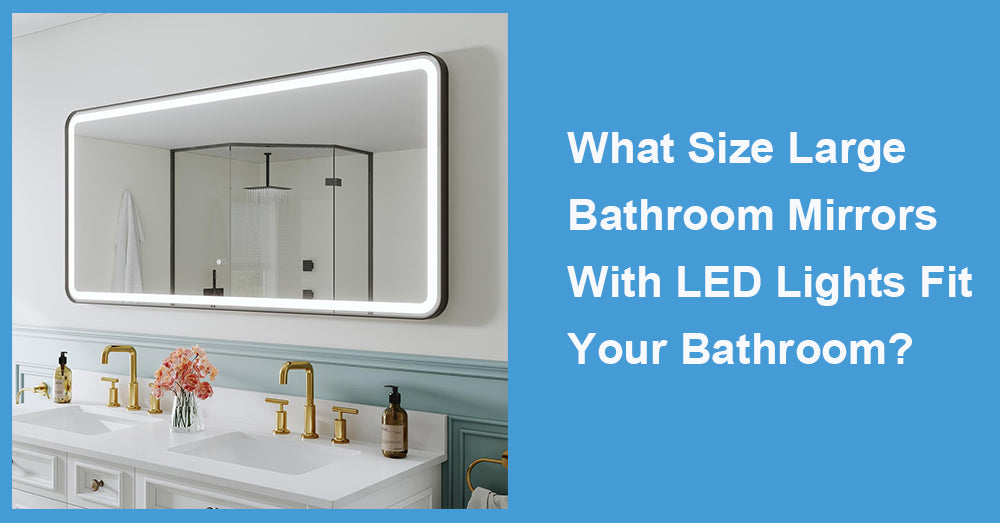
In modern bathroom design, large bathroom mirrors with led lights have gradually evolved from a single functional accessory into a key element that shapes space proportions, lighting quality, and the overall experience. Especially amid the trend toward greater visual impact and higher efficiency in decoration, the selection of large bathroom mirrors with lighting is closely tied to aesthetics, practicality, and long-term comfort.
This article will systematically analyze which scenarios different sizes of large LED bathroom mirrors are suitable for from multiple perspectives, such as industry data, standard bathroom layouts, size matching principles, lighting logic, and installation points, to help readers make more rational judgments when choosing.
1. Industry background: Why large-sized LED bathroom mirrors have become a trend
According to industry research reports, the global LED bathroom mirror market exceeded $ 3.8 billion in 2023. It is expected to maintain an average annual growth rate of over 6% in the coming years. Among them, the growth rate of large-sized mirror products (usually 36 inches or more in width) is significantly higher than that of standard-sized products. (Source: Global Market Insights. com)
Analysis indicates that this growth is mainly due to three factors:
Bathroom space planning focuses more on "overall sense" rather than single functional segmentation.
The maturity of LED technology enables uniform illumination over a large area.
Mirrors are endowed with more lighting, atmosphere, and intelligent functions, rather than just reflective tools.
In this context, choosing a "suitable size" large bathroom mirror with LED lights has become an important issue that cannot be ignored in the design phase.
2. What kind of mirror is considered a 'large bathroom mirror'?
In the industry, there is no absolute, uniform size standard. Still, based on mainstream product specifications and installation practices, the following size range can generally be considered as "large-sized LED bathroom mirrors":
Width 36-42 inches: leaning towards mainstream sizes that are medium to large
Width 48-60 inches: suitable for expansive countertops or double basin layouts
Width of 60 inches or more: commonly seen in high-end or customized bathroom spaces
In terms of height, the standard for large bathroom mirrors is 30 to 40 inches, and some vertical or full-wall design products may exceed 48 inches.
Industry data shows that approximately 54% of LED bathroom mirror products sold are in the 40-60 inch width range, indicating a good balance between functionality and visual effects in this size range. (Source: Statista. com)
3. Choose the appropriate mirror size based on the width of the bathroom countertop
When choosing a large bathroom mirror with LED lights, a common industry rule is that the mirror's width should not be significantly wider than the countertop below.
4. Tabletop width 30-36 inches
This type of bathroom is usually suitable for:
Mirror width is approximately 28-34 inches
Although not strictly classified as "oversized", it can visually cover most of the wall width and provide good facial lighting with LED light strips.
5. Table width 48 inches
This is one of the common scenarios for choosing large-sized LED bathroom mirrors:
Recommended mirror width is approximately 42-48 inches
This size not only ensures appropriate margins on the left and right edges but also significantly enhances the overall feel of the wall, making the bathroom visually more spacious.
6. Table width 60 inches (single basin)
In wider single basin layouts, common choices include:
Mirror width is approximately 48-60 inches
Industry advice suggests that when the mirror's width approaches or exceeds the countertop's width, special attention should be paid to the uniformity and brightness distribution of LED lighting to avoid issues such as excessive brightness in the middle and dark edges. (Source: Houzz. com)
7. Double basin layout
For double basin bathrooms, there are usually two approaches to size selection:
A large integrated mirror with a width of approximately 60-72 inches;
Two independent mirrors, each with a width of roughly 28-36 inches.
Among them, the integrated large bathroom mirror with LED lights is easier to achieve a unified lighting effect and better aligns with the current trend of emphasizing the "overall design language".
8. Mirror height: not just a matter of proportion
In addition to width, height also affects the user experience. The industry generally recommends that large-sized LED bathroom mirrors should meet the following basic conditions:
The lower edge of the mirror is about 5-8 inches higher than the tabletop.
The upper edge of the mirror should cover at least the height of the user's line of sight, leaving an appropriate margin.
Research shows that insufficient mirror height is more likely to cause inconvenience in daily use, especially when there is a significant height difference among family members. (Source: The Spruce. com)
Therefore, many large products use a height range of 32-40 inches to accommodate users of different heights.
9. The relationship between LED lighting configuration and size
As the mirror size increases, the importance of LED lighting configuration also increases. Industry practice has shown that:
The larger the size, the higher the requirement for lighting uniformity.
Single-sided light strips are more likely to produce shadows in mirror surfaces of 48 inches or more.
Bilateral or surround light strips offer greater advantages for large mirrors.
Data shows that in LED bathroom mirror products over 50 inches, the proportion of products with a double-sided or full-perimeter light strip design exceeds 67%, significantly higher than in small-sized products. (Source: Lighting Research Center)
In addition, the adjustable color temperature and brightness features are significant for large mirrors, providing a more suitable lighting experience across different times and usage scenarios.
10. The influence of spatial perception and visual proportion
From a design perspective, large-sized LED bathroom mirrors have a significant "spatial magnification effect". Industry design case analysis shows that:
Mirrors with a width exceeding 48 inches can significantly stretch the wall's horizontal proportions visually.
After combining mirrors with lighting, the sense of wall segmentation can be weakened, making the space appear more complete.
In bathrooms with limited natural light, large illuminated mirrors can effectively compensate for insufficient light.
Therefore, when space permits, choosing a mirror slightly larger than "just right" often yields a more ideal overall effect.
11. Practical limitations at the installation and structural levels
Although large-sized LED bathroom mirrors have obvious advantages, the following limiting factors still need to be considered when making practical choices:
Does the wall's load-bearing capacity support a greater mirror weight?
Is it necessary to reserve sufficient power interface positions?
Is there a risk of interference between the edge of the mirror and the side wall, cabinet, or door frame?
Industry installation guidelines suggest that when selecting mirrors 60 inches or more, the wall structure should be confirmed in advance, and professionals should perform the installation to ensure long-term safety. (Source: This Old House. com)
12. Common size selection misconceptions
In industry practice, the following misconceptions are pretty common:
Only select mirrors based on wall width, ignoring countertop proportions;
Pursuing "bigger is better", but ignoring lighting and electrical conditions;
Neglecting the mirror's height leads to inconvenience during actual use.
Not considering the difficulty of maintenance and replacement after installation.
These issues are often not inherent defects in the product itself, but rather due to insufficient consideration during the size planning phase.

13. Summary: How to find the most suitable size
Based on industry experience and data analysis, when selecting suitable large bathroom mirrors with LED lights, the following points should be emphasized:
The mirror's width should be coordinated with the countertop's width, usually not exceeding it.
48-60 inches is the most universal "large size" range;
The recommended height should be at least 32 inches to accommodate users of varying heights.
The larger the size, the higher the requirements for LED lighting uniformity and quality.
Before installation, it is necessary to evaluate the wall structure and electrical conditions fully.
On the condition that these basic principles are met, large LED bathroom mirrors can not only enhance the daily user experience but also play an essential role in overall space design. With the continuous advancement of lighting and mirror technology, such products will remain a core element of bathroom design.









































Leave a comment
This site is protected by hCaptcha and the hCaptcha Privacy Policy and Terms of Service apply.