






















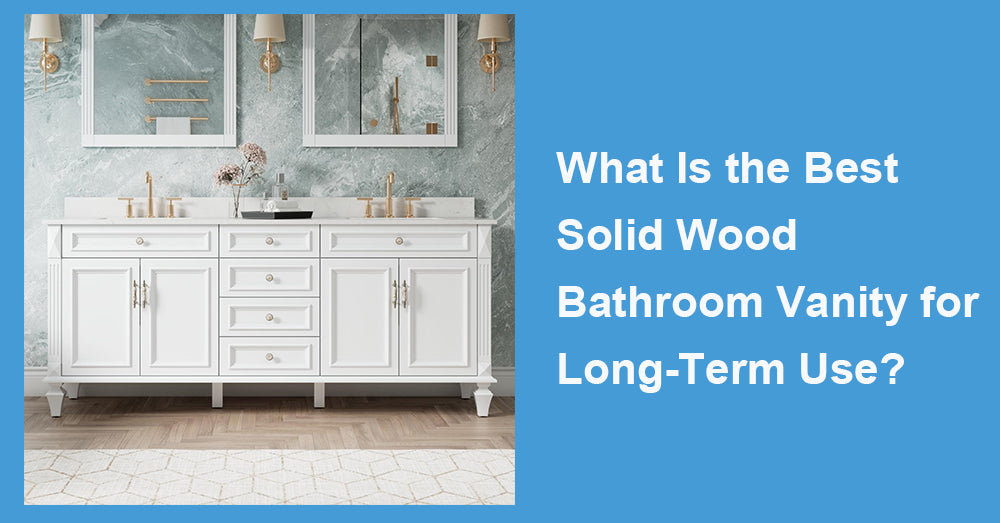
The best solid wood bathroom vanity is not automatically the cabinet made from the most expensive species or the thickest-looking panels. For long-term use, the strongest choice combines stable construction, a bathroom-appropriate finish, replaceable hardware, sensible storage, and dimensions that fit the room and plumbing. Solid wood can age beautifully and often allows small scratches or worn areas to be repaired, but it still needs protection from standing water and large humidity swings. A careful buyer should judge the whole cabinet system—not just the words “solid wood” in the product title.
Start by Confirming What “Solid Wood” Means
Ask which components are solid wood. A vanity may have a solid hardwood face frame and doors, plywood side panels, and an engineered back or drawer bottom. That is not necessarily a weakness. Plywood can provide useful dimensional stability in broad panels, while solid wood is well suited to frames, rails, and door parts. What matters is that the listing identifies materials accurately and shows how they are used.
Look for a specification sheet rather than relying on photography. Terms such as “wood construction,” “wood product,” and “wood finish” are not precise enough to prove an all-solid-wood cabinet. If medium-density fiberboard, particleboard, or hardwood plywood is present, confirm that applicable regulated composite panels are labeled TSCA Title VI compliant.
Choose Construction Before Choosing Species
Durability begins at the joints. Mortise-and-tenon, dowel, or well-executed pocket-screw joinery can keep a face frame square; dovetail or robust interlocking drawer joints are a positive sign. Avoid evaluating quality by one joint name alone, however. Clean alignment, adequate fasteners, reinforced corners, and drawers that operate smoothly under load matter just as much.
Inspect the back of the cabinet in product photos or diagrams. A strong mounting rail gives installers a reliable place to fasten the vanity to wall studs. Adjustable levelers are useful on uneven floors, while a removable or thoughtfully placed back panel can simplify plumbing access. Thin decorative legs should not be expected to correct a floor that is substantially out of level.
Which Wood Species Is Best?
Maple is dense, has subtle grain, and takes painted finishes well. White oak is valued for visible grain and works naturally in organic-modern and transitional bathrooms. Walnut offers rich color and a furniture-like appearance, although it is often more expensive. Birch is a practical, relatively even-grained option. Rubberwood is also used in furniture and can perform well when it is correctly dried, joined, and sealed.
Species alone does not predict service life. Board selection, drying, panel design, joinery, and finish application can outweigh the difference between two hardwood names. The USDA Forest Products Laboratory explains that wood is hygroscopic: it exchanges moisture with the surrounding air, and changes in moisture content influence dimensions and performance. Its guidance also notes that controlling moisture changes helps avoid major dimensional problems. (Source: USDA Forest Service, Forest Products Laboratory, Wood Handbook, Chapters 4 and 13.)

The Finish Is the Vanity’s Working Surface
In a bathroom, the finish has a daily job. It should cover door faces, edges, joints, and less-visible areas that may encounter humid air or an occasional splash. A smooth, even coating with no bare end grain is more reassuring than a finish that looks attractive only from the front. Ask whether the coating is intended for bathroom cabinetry and follow the manufacturer’s cleaning instructions; harsh abrasives or strong solvents may dull or weaken some coatings.
Pay special attention to the sink cutout, faucet holes, countertop seam, toe kick, and the bottom edges of doors. These areas often receive water first. Wipe spills promptly and repair plumbing leaks rather than allowing the cabinet to serve as a moisture indicator. EPA’s advice for household mold prevention is moisture control, including fixing sources of water. (Source: U.S. Environmental Protection Agency, What Are the Main Ways to Control Moisture in Your Home?)
Hardware Should Be Serviceable, Not Mysterious
Soft-close hinges and drawer slides improve daily use, but the more important long-term question is whether they can be adjusted or replaced. Look for recognizable hardware, accessible mounting screws, and product support that can identify a replacement part. Full-extension slides make the rear of a drawer easier to reach; their rated capacity is meaningful only when the manufacturer states the testing basis and installation requirements.
Open shelving has fewer moving parts but exposes towels and toiletries to humidity and dust. Doors hide plumbing efficiently, while drawers offer better access to small items but require a cutout or compact configuration around the drain. The most durable layout is one that users will not overload, slam, or modify awkwardly after installation.
Match the Vanity to the Room
Measure the available wall width at the top, middle, and floor, then use the smallest measurement. Confirm the overall countertop width, which may exceed the nominal cabinet width. Check door swing, drawer extension, baseboards, supply lines, drain location, mirror width, and clearance from the toilet or shower door. Also measure the delivery route, including doorways, stairs, and tight turns.
Ventilation protects the room as well as the cabinet. ENERGY STAR advises running a bathroom ventilation fan during and for 15 minutes after showers and baths to help control moisture. The fan should exhaust outdoors, not into an attic or wall cavity. (Source: ENERGY STAR, Low- to No-Cost Tips for Saving Energy at Home.)
How to Make the Final Decision
Before buying, request dimensioned drawings, material details by component, finish-care instructions, hardware information, warranty terms, and the process for reporting freight damage. Reviews are most useful when they describe installation, alignment, finish wear, replacement parts, or performance after months of use—not simply how the vanity looked on delivery.
For most households, the best long-term choice is an engineered hardwood vanity with sealed surfaces, sturdy mounting points, adjustable and replaceable hardware, accessible plumbing space, and responsive parts support. Choose the wood species for appearance after those fundamentals are satisfied. Solid wood earns its value when construction and care allow it to move naturally, stay dry, and remain repairable for years.











































Leave a comment
This site is protected by hCaptcha and the hCaptcha Privacy Policy and Terms of Service apply.