






















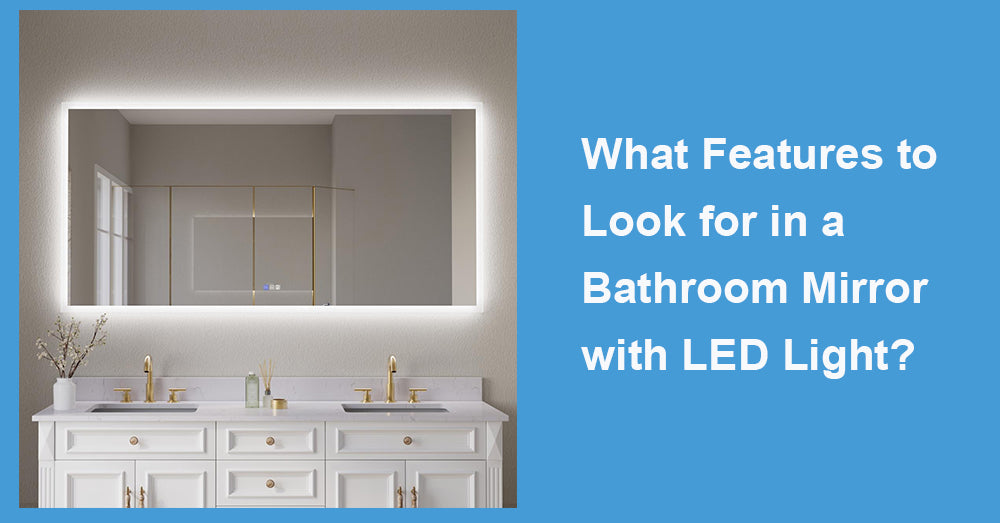
With the maturity of bathroom lighting technology, bathroom mirror with led light sources have evolved from "optional" to a basic configuration for many home upgrades. It not only improves lighting quality but also plays an increasingly critical role in daily grooming, makeup, skincare, and other usage scenarios. To help users make more informed choices, this article will analyze the key functions to prioritize when selecting LED bathroom mirrors, covering core dimensions such as light source, control, structure, safety, intelligence, and installation.
1. Why are LED bathroom mirrors becoming increasingly popular?
The popularization of LED technology has transformed bathroom mirrors from simple reflective surfaces into comprehensive products that combine lighting, decoration, and intelligent features. According to Grand View Research, the market size of smart bathroom mirrors is expected to reach approximately USD 339.1 million in 2022 and USD 792.0 million in 2030, with a compound annual growth rate of roughly 11.2% (source: grandviewresearch.com). This growth trend means that LED mirror products are gradually developing towards higher-end, more practical, and more intelligent directions.
Meanwhile, LED light sources themselves have energy-saving advantages. According to publicly available data from Energy Star, LED bulbs are at least 75% more energy-efficient and have a lifespan approximately 25 times longer than traditional incandescent bulbs (source: energystar.gov). These features make illuminated mirrors a more cost-effective, practical, and aesthetically pleasing choice for bathroom spaces.
2. Pay attention to the quality of light sources: brightness, color temperature, and color rendering index (CRI)
When choosing a bathroom mirror with LED lighting, light-source performance is one of the most critical indicators for evaluating product value.
2.1 Brightness (Lumens)
The brightness determines whether the lighting is clear enough. Generally speaking, for daily grooming, shaving, and facial cleansing, it is recommended to choose a mirror with a brightness of 1200-2400 lumens; for larger products or dual washbasin areas, higher brightness models are recommended.
2.2 Color Temperature (Kelvin)
The required light color for a bathroom environment is usually adjusted within the following range:
3000K (warm white light): Soft and warm, suitable for a relaxing atmosphere.
4000K (neutral light): Most suitable for makeup and facial care, with a color close to natural light.
5000K (cool white light): Brighter and more suitable for precise operations, but the atmosphere is slightly colder.
If the mirror supports color temperature adjustment, it allows users to freely switch it based on the time of day, makeup needs, or atmosphere, which is a significant bonus.
2.3 Color rendering index (CRI)
The CRI of high-quality LED mirrors should generally be ≥ 90 to present skin tone and makeup more realistically. Low CRI light can easily cause a color cast, leading to incorrect makeup judgment.
3. Lighting position design: front light vs backlight
LED bathroom mirrors can be divided into two categories: front-illuminated and back-illuminated, each offering a completely different user experience.
3.1 Front lit
Advantages:
The light shines directly onto the face, making it suitable for fine makeup and shaving.
Reduce facial shadows.
3.2 Backlight (Back lit)
Advantages:
The atmosphere is excellent, making the bathroom look more upscale.
The light is uniform and not glaring.
Many high-end mirrors combine front-light and backlight designs, allowing functionality and ambient lighting to coexist, which is a future trend.
4. Defogging function: one of the configurations with the most significant difference in daily experience
The bathroom is damp, and mirror fogging is almost inevitable. Therefore, the defogging system has become a key functional point of LED bathroom mirrors. When making a purchase, pay attention to the following two points:
4.1 Defogging Range
Generally, the defogging heating area of high-quality mirrors covers at least 1/3 to 1/2 of the mirror surface. The larger the coverage area, the wider the usable area after bathing.
4.2 Partition or intelligent defogging
Some high-end models support:
Partition heating
Automatic defogging
Touch defogging timer (such as automatic shutdown after 30 minutes)
These features prevent energy waste caused by forgetting to turn them off and also enhance security.
5. Intelligent function: not only lighting, but also lifestyle upgrade
As the popularity of smart homes grows, LED bathroom mirrors are gradually adding a range of intelligent features. For example:
5.1 Touch and Slide Control
Touch switch
Long-press dimming
Slide to adjust color temperature
More intuitive operation, replacing traditional wall switches.
5.2 Bluetooth Speaker
Some products have built-in speakers that allow users to listen to music, podcasts, or news while preparing for the morning.
5.3 Automatic brightness compensation
Automatically adjust LED output based on environmental brightness, save energy, and make it more comfortable.
5.4 Human body sensing function
Automatically lights up when approaching and automatically turns off when leaving, extending the lifespan of the LED.
The continuous expansion of smart mirrors is consistent with market data - it will continue to grow rapidly in the coming years (source: grandviewresearch.com).
6. Material and Structure: Ensure Service Life and Safety
6.1 Mirror Material
When making a purchase, it is recommended to choose:
Explosion-proof film backplate
Silver mirror or copper-free glass
≥ 0.125 inch (1/8 inch) thickness
The thicker the thickness, the more stable the reflection and the better the anti-deformation effect.
6.2 Border Material
Common materials include aluminum alloy, metal coating, or stainless steel frame, which are more resistant to moisture and corrosion and are suitable for bathroom environments.
6.3 Waterproof grade
The bathroom LED mirror should be IP44-rated, with higher-end models rated IP54 or higher. This means the mirror can withstand high humidity and occasional splashes of water.
7. Energy efficiency: Focus on energy-saving levels, not only saving electricity but also being more environmentally friendly
The energy consumption of LED mirrors is much lower than that of traditional lighting equipment. According to Energy Star data, LED light source energy consumption has been reduced by 75% (source: energystar.gov), which is crucial for daily-use bathrooms.
Energy-saving mirrors usually have:
Low-voltage drive
Automatic power-off function
Efficient heat dissipation structure
When purchasing, you can check the power (W) and luminous efficiency (lm/W) to assess a product's energy efficiency.

8. Installation and Dimensional Planning: How does the inch size match the bathroom space?
8.1 Size-matching washbasin
Generally, the selection of LED mirrors can be based on the following principles:
The width of the mirror should be approximately 70% -100% of the width of the washbasin
The standard sizes of bathroom mirrors are 24 inches, 30 inches, 36 inches, 40 inches, and 48 inches
For example:
A 30-inch washbasin can be paired with a 24-30-inch mirror
60-inch mirrors or two 30-inch mirrors are commonly used in the double wash basin area
8.2 Installation height
The standard installation method is:
The bottom of the mirror is about 4-6 inches away from the countertop
The center height of the mirror is about 60-66 inches above the ground
If the mirror comes with its own lighting, it is necessary to plan the location of the power supply and the cable outlet.
9. Summary: How to ultimately determine whether LED bathroom mirrors are worth buying?
When choosing a bathroom mirror with LED light, it is recommended to prioritize the following six key points:
Is the light source professional enough?
Do brightness, color temperature, and CRI meet daily needs?
Are the defogging area and heating method sufficient?
Can the lighting design cover the "front light function+backlight atmosphere"?
Is the intelligent function practical and easy to operate?
Are the materials, safety, and waterproof levels up to standard?
Are the dimensions and installation conditions reserved for lamp positions, wires, and wall structures?
The development trend of LED bathroom mirrors continues to move towards "energy saving+intelligence+aesthetics", and future products will further strengthen sensing control, intelligent dimming, and personalized functions. For those who pursue a better lighting experience and a bathroom upgrade, a fully functional, accurately lit, and easy-to-use LED bathroom mirror is no longer just an option but an essential component in enhancing the texture and functionality of the bathroom.









































Leave a comment
This site is protected by hCaptcha and the hCaptcha Privacy Policy and Terms of Service apply.