






















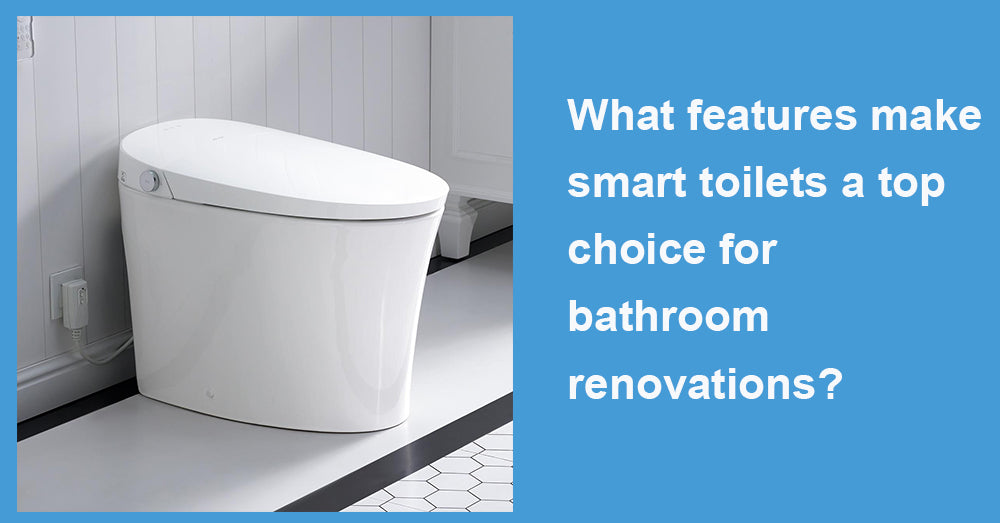
In recent discussions on bathroom upgrades and renovations, Smart Toilets are gradually evolving from a "high-end add-on option" to a product frequently included in the basic configuration list. Compared to traditional toilets, it not only serves cleaning functions but also involves comfort, hygiene, safety, water-saving efficiency, and a long-term user experience.
So, what are the key features of Smart Toilets that make them increasingly the preferred choice for various bathroom renovation solutions?
1. The evaluation criteria for bathroom renovation are changing
In the past, bathroom renovations focused more on revitalizing the appearance, such as upgrading tiles, countertops, or hardware. Nowadays, transformation decisions are gradually shifting towards "real user experience".
Industry research shows that comfort and hygiene control are repeatedly mentioned among the most frequently used functions in the bathroom, far surpassing visual factors alone.
Against the backdrop of changes in evaluation criteria, the comprehensive advantages of Smart Toys are increasingly being systematically highlighted.
2. The upgrade of cleaning methods is the fundamental value of smart toilets
Unlike traditional toilets that rely on tissue cleaning, Smart Toilets complete the main cleaning steps through water flow. This change is not just a technological stack, it directly affects the daily user experience.
Multiple hygiene studies have shown that water washing is more effective at achieving thorough cleaning and controlling skin irritation.
Therefore, in bathroom renovations that emphasize functional upgrades, smart toilets are often seen as a "core experience upgrade" rather than an optional additional configuration.
3. Integrated design reduces the sense of spatial fragmentation
In traditional layouts, intelligent functions often require additional devices, such as independent bright toilet covers or external components. The current mainstream Smart Toilets mostly adopt an integrated structure, integrating cleaning, heating, and control systems into the toilet body.
In terms of size, the overall length of most smart toilets is usually 26-29 inches, and the difference from conventional seat toilets is not significant.
During the renovation process, the size characteristics that are close to traditional products significantly reduce the need for spatial layout adjustments.
Research in the Remodeling industry indicates that fewer structural changes during equipment replacement result in more advantageous overall cost and risk control for the renovation (source: Remodeling.hw.net).
4. Comfort configuration changes basic usage expectations
The improvement in Smart Toys' comfort experience is one of its most easily perceived features. The functions of seat heating and automatic temperature control make the user experience more stable, especially in living environments with significant temperature differences between day and night.
Related research shows that when the comfort level of basic use is significantly improved, users' overall satisfaction with the bathroom increases, but this aftereffect is often underestimated.
This is also why, in a complete bathroom renovation, smart toilets are often seen as an upgraded item with "higher experience weight".
5. Automation and non-contact operation enhance the level of hygiene and safety
Against the backdrop of a general increase in public health awareness, non-contact operation has become an important development direction for home products.
Smart Toys significantly reduce manual contact frequency and thus lower the risk of cross-contamination through features such as automatic lid opening and sensing-based flushing.
In Consumer Reports' home hygiene research, it is mentioned that reducing high-frequency contact surfaces is one of the essential means to improve long-term hygiene levels (source: ConsumerReports.org).
This is particularly important in bathroom environments.
6. Water-saving design meets the core goal of functional transformation
Water conservation is not only an environmental issue, but also directly related to long-term usage costs. Smart Toilets typically use precise control of flushing volume to reduce unnecessary water waste while ensuring cleaning effectiveness.
Industry water-saving research shows that, compared to traditional single-flush modes, systems that can adjust or automatically identify usage scenarios offer greater advantages in annual water consumption control.
For frequently used bathrooms, this long-term cumulative effect is particularly evident.
7. Maintenance and durability are gradually being optimized
Early smart toilets were often criticized for their complex maintenance and high failure rate, but as manufacturing and testing systems have matured, this problem is being addressed.
In recent years, product trends have shown that modular design and more stable internal structures are reducing maintenance difficulty and extending average service life.
For the renovation of functional bathrooms, stability itself is an essential function.
8. Adaptability to future bathroom ecology
Smart Toys not only address current needs but also often offer greater scalability. For example, upgrades to control systems, expansions of functional modules, etc., all leave room for future use cases.
Industry observations indicate that as smart homes gradually become more popular, bathroom equipment that can be smoothly integrated into the overall system is more likely to be included in long-term renovation plans.
9. Not everyone needs it, but the trend is clear enough
It should be emphasized that Smart Toilets are not the only answer for all bathroom renovations. If the transformation goal is limited to exterior rejuvenation, its full potential may not be realized.
But when the transformation goals involve comfort, hygiene control, water-saving efficiency, and long-term experience, the multidimensional advantages of smart toilets are often difficult to replace with traditional products fully.

10. Conclusion: Smart Toys are redefining the "basic configuration."
From the perspective of industry development, Smart Toilets are not a short-lived trend, but the result of the evolution of bathroom spaces towards greater efficiency, hygiene, and humanization.
For those currently undergoing or planning a bathroom renovation, the choice of an intelligent toilet ultimately depends on the renovation goal. But what can be confirmed is that it is no longer just a decoration in a few high-end solutions, but is becoming a reference standard in more and more functional bathrooms.









































Leave a comment
This site is protected by hCaptcha and the hCaptcha Privacy Policy and Terms of Service apply.