






















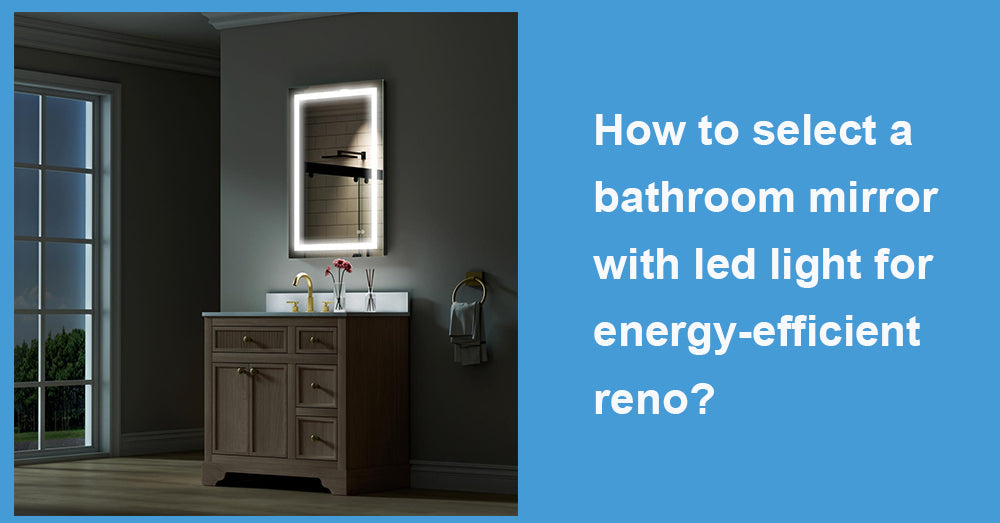
In discussions of bathroom upgrades and renovations, "energy conservation" is no longer just an additional condition but a core goal of many renovation projects. Compared to the reconstruction of large-scale hydropower systems, optimizing lighting systems often requires less investment and yields faster results. Among them, the Bathroom Mirror with LED Light is rapidly becoming a solution that balances functionality and energy efficiency.
So, during the actual renovation, how should we choose a truly energy-saving LED bathroom mirror? This issue needs to be discussed across multiple dimensions, including technical parameters, usage scenarios, and long-term energy efficiency performance.
1. Why does energy-saving renovation start with lighting systems?
In the residential energy consumption structure, although lighting does not have the highest proportion, it is the easiest part to optimize through technological upgrades.
Research on building energy efficiency indicates that traditional lighting systems incur significant inefficiencies in daily use, while LED light sources can significantly reduce power consumption at the same brightness levels.
As a high-frequency-use area, bathroom lighting equipment is turned on and off multiple times a day. Upgrading the lighting format has significant implications for achieving energy-saving goals.
2. LED technology becomes the basic condition for upgrading bathroom lighting
Compared with traditional fluorescent or halogen lamps, LED light sources have higher light efficiency and lower heat loss.
Data shows that under the same lumen output conditions, LED lamp energy consumption can be reduced by more than 60% .
Integrating LED light sources into bathroom mirrors not only reduces the number of independent lighting fixtures but also further compresses the overall energy consumption structure, making the lighting system more efficient and centralized.
3. Mirror-integrated lighting has more energy-saving advantages than dispersed light sources
Traditional bathroom lighting schemes usually use a combination of ceiling lights and auxiliary lights, which can easily lead to overlapping and wasted light due to their dispersed layout.
Bathroom Mirror with LED Light concentrates the light source along the perimeter of the mirror, allowing it to reach the grooming area directly and reducing unnecessary illumination.
Research on lighting efficiency shows that accurately projecting light onto the usage area can maintain or even enhance the actual user experience while reducing overall brightness.
4. Reasonable size selection helps reduce ineffective lighting
The size of the mirror directly affects the range of illumination coverage.
In the concept of energy-saving renovation, it is not necessarily better to have a larger mirror, but to match the actual spatial scale.
For example, in small bathrooms, LED mirrors measuring 24-30 inches wide are usually sufficient to meet usage needs.
For larger countertops, choose the 36-48-inch model to avoid the need for additional lighting.
Related renovation data show that when the mirror size is close to the washbasin's width, the lighting utilization rate is often at an optimal level.
5. The relationship between color temperature selection and energy saving
Many people focus only on whether LED mirrors are "bright enough" when choosing them, while ignoring the impact of color temperature on energy efficiency and usage habits.
Generally speaking, LED light sources with a color temperature of 4000K-5000K are more suitable for daily use and do not require increased power to compensate for dimness.
Lighting research has shown that the human eye perceives brightness more efficiently in neutral and cool light environments, suggesting that subjective brightness perception can be improved with the same energy consumption.
6. The long-term value of the dimming function for energy-saving renovation
Proper energy conservation depends not only on the lighting fixtures themselves, but also on how they are used.
The Bathroom Mirror with LED Light and stepless dimming function can adjust brightness to suit different time periods and usage needs.
Behavioral energy-efficiency research shows that lighting systems with adjustable capabilities have significantly lower overall energy consumption than fixed-brightness schemes in long-term use.
Especially in the use scene at night or in the morning, lowering the brightness itself is an effective energy-saving behavior.
7. The lifespan of lighting is also a part of energy conservation
The average lifespan of LED light sources is typically 30000-50000 hours, which is much longer than that of traditional light sources.
This means that under normal usage conditions, the lighting system does not require frequent replacement for many years.
From the perspective of the entire lifecycle, reducing replacement frequency can significantly reduce resource consumption and maintenance costs, as frequently noted in sustainable transformation assessments.
8. The implicit energy-saving value of sensing and memory functions
Some bathroom mirrors with LED lights integrate sensing or brightness memory functions.
The sensing function can prevent the lamp from continuously lighting up when unmanned.
Brightness memory lets users reuse their low-energy settings instead of restoring to the highest brightness each time.
The energy efficiency report notes that the energy-saving effect of automated control in small lighting systems is often underestimated, yet the long-term cumulative benefits are clear.

9. The impact of installation methods on energy efficiency performance
In energy-saving renovation, the installation method is equally important.
An embedded or wall-mounted installation can reduce unnecessary reflections or light obstructions, making lighting more concentrated.
Research has shown that when the distance between the light and the plane of use is closer, and the angle is reasonable, sound lighting effects can be maintained while reducing output power.
10. Energy saving does not mean sacrificing the user experience
A common misconception is that energy-saving upgrades necessarily mean reduced brightness or a diminished experience.
In fact, high-quality LED mirrors can provide stable and comfortable lighting with low energy consumption through optical design and parameter optimization.
According to a satisfaction survey, after adopting LED-integrated lighting, most users have reduced their reliance on additional light sources.
11. Conclusion: True energy conservation comes from "long-term rational use."
Choosing a Bathroom Mirror with LED Light is not just about replacing a mirror; it is about optimizing the bathroom lighting system.
From light source efficiency, usage habits, and size control to intelligent functions and energy-saving transformation, energy-saving transformation does not rely on a single parameter but instead on a complete set of selection logic.
For those hoping to achieve energy-saving goals in bathroom renovations, LED mirrors offer a low-intervention, high-return upgrade path. This change is not flashy, but it continues to deliver value over the long term.









































Leave a comment
This site is protected by hCaptcha and the hCaptcha Privacy Policy and Terms of Service apply.