























A white bathroom vanity with top is often a practical remodeling choice because it combines a versatile cabinet finish with a countertop that is pre-coordinated for size and installation. Instead of selecting the cabinet, countertop, and sink independently, buyers can reduce compatibility questions while creating a bright, finished vanity zone. Current renovation data supports the appeal of this combination: white accounts for 20% of upgraded vanity colors, while white countertops lead at 48%. Countertops are replaced in 76% of bathroom renovations and sinks in 73%, making an all-in-one vanity package especially relevant for projects where installation speed and predictable results matter.
1. A Vanity With Top Simplifies the Buying Process
One of the biggest advantages of purchasing the cabinet and countertop together is reducing the number of specifications that need to be coordinated.
A separate countertop requires accurate cabinet dimensions, sink-cutout planning, edge details, overhang measurements, and faucet drilling. With a complete vanity, much of this work has already been handled by the manufacturer.
Many packages also include an undermount or integrated sink, which further simplifies ordering. Buyers should still verify whether the backsplash, side splash, faucet, drain, and sink are included because package contents vary.
This streamlined approach is particularly useful when several trades are involved in the remodel.
Industry judgment: the strongest value of a vanity-with-top package is not simply convenience. It is the reduction of expensive compatibility mistakes.
2. White Remains Easy to Coordinate
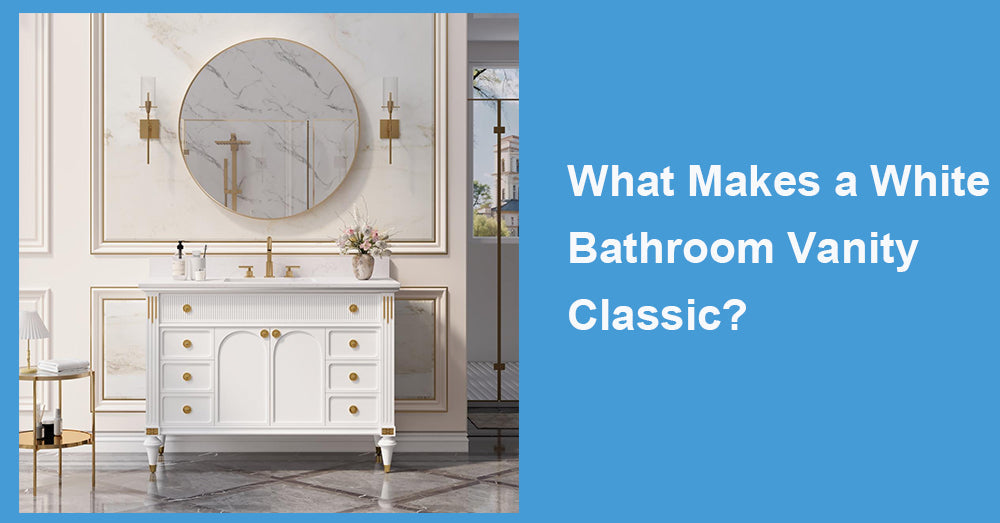
White cabinetry continues to work because it does not force the bathroom into one design category. It can support transitional, modern, traditional, coastal, or warmer organic interiors depending on the surrounding materials.
NKBA’s 2026 Bath Trends Report found that 96% of surveyed industry professionals expect neutral colors to lead bathroom design, with off-white supported by 58% and white by 40%. Transitional and timeless styling received 70% support, while contemporary, modern, and minimalist looks reached 57%.
A white vanity can therefore be paired with warm oak mirrors, beige tile, green walls, matte black fixtures, or brushed metal without requiring the cabinet itself to be replaced when trends shift.
Industry judgment: white remains commercially strong because it behaves as a design foundation rather than a highly specific trend color.
3. The Included Countertop Can Improve Visual Consistency
A white cabinet does not necessarily need a pure white top. Warm white, pale gray, lightly veined quartz, and off-white stone can create enough contrast to keep the vanity from appearing flat.
Houzz reports that white countertops account for 48% of renovated bathroom choices, followed by off-white at 20%. Engineered quartz leads countertop materials at 45%, while quartzite represents 20%, granite 14%, and marble 13%.
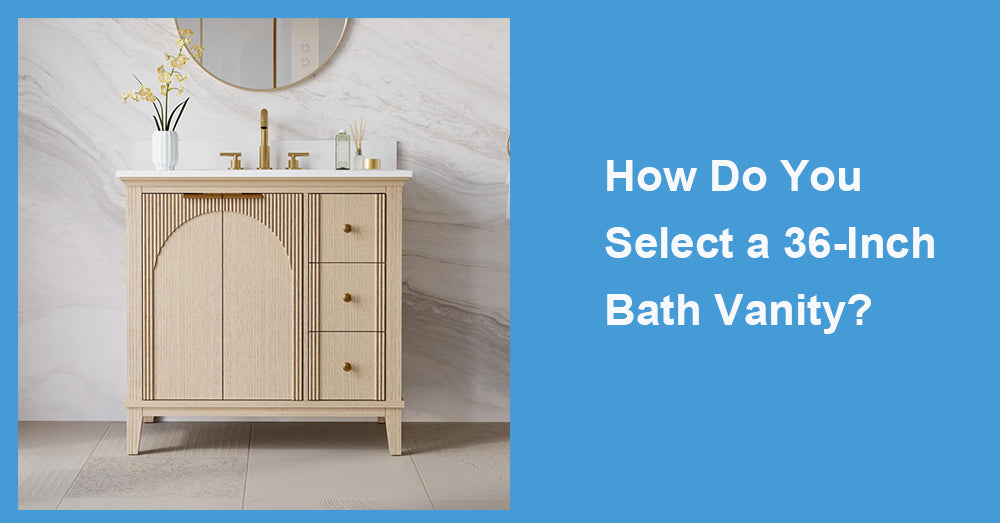
For a 30- or 36-inch vanity, restrained veining often feels more balanced because the countertop surface is relatively compact. A 48-, 60-, or 72-inch top can accommodate stronger stone movement without overwhelming the cabinet.
Industry judgment: a coordinated countertop creates more perceived quality when it supports the cabinet rather than competing with it.
4. Standard Sizes Make Remodeling Easier
White bathroom vanities with tops are widely available in dimensions suited to different bathroom layouts.
A 24-inch vanity can work in a small powder room, while 30- and 36-inch models provide greater storage for guest bathrooms. A 48-inch vanity offers generous single-sink space, and 60- or 72-inch models can support larger or double-sink layouts.
Nearly half of upgraded vanities, 47%, measure 48 inches or less. Another 19% measure 60 inches, while 14% are 72 inches wide.
Standard vanity depth is generally around 21 to 22 inches. Narrow-depth designs at 20 inches or less can be useful where walkway clearance is limited. Typical cabinet heights fall between 32 and 36 inches before the vanity top.
Industry judgment: familiar vanity dimensions reduce remodeling risk because mirrors, lighting, plumbing, and wall space can be planned around established proportions.
5. Check the Sink Configuration Before Buying
The sink can significantly influence whether a complete vanity package feels convenient after installation.
Undermount sinks provide a clean countertop line and allow water or debris to be wiped directly into the basin. Integrated sinks eliminate even more seams and can make everyday cleaning easier.
Vessel sinks create greater visual impact, but the additional bowl height needs to be considered before selecting the vanity. A cabinet that is already 36 inches high may become uncomfortable if a tall vessel sink is added above it.
Basin width and depth also affect usable counter space. On a 30-inch vanity, an oversized sink can leave very little room for toiletries. A 48-inch top provides greater flexibility.
Industry judgment: sink proportion matters as much as cabinet width when evaluating the everyday usefulness of a complete vanity.

6. Storage Should Matter More Than the Number of Doors
A white vanity may look clean from the outside while offering surprisingly limited storage inside. Buyers should examine drawers, shelving, plumbing clearance, and internal organization.
NKBA reports increasing interest in configurable vanity storage, including custom drawer organizers, charging areas, electrical integration, and dedicated compartments for hair tools, cosmetics, and medications. The organization also found that 72% of surveyed professionals expect bathroom footprints to evolve partly to accommodate more efficient storage.
A 36-inch cabinet with well-planned drawers may be more useful than a 48-inch cabinet containing one large open compartment beneath the sink.
Industry judgment: storage quality is increasingly measured by accessibility and organization rather than total cabinet volume.
7. Faucet Compatibility Should Be Confirmed Early
A vanity top may be drilled for a single-hole faucet, a 4-inch centerset configuration, or an 8-inch widespread faucet. That detail should be checked before the faucet is ordered.
Faucets are upgraded in 87% of bathroom renovations, making them the most frequently replaced bathroom feature in current Houzz findings.
Efficiency can also be considered at this stage. EPA states that WaterSense-labeled bathroom sink faucets use a maximum of 1.5 gallons per minute and can reduce water flow by 30% or more compared with the standard 2.2 gallons per minute without sacrificing performance.
Spout reach should also align with the basin so water lands comfortably inside the sink rather than too close to the back wall.
Industry judgment: faucet drilling is a minor-looking specification that can determine whether installation remains straightforward or becomes an unnecessary return-and-reorder problem.
8. Construction and Maintenance Still Determine Long-Term Value
A complete vanity package should not be judged only by its initial appearance. White finishes can reveal scratches, chipped edges, makeup residue, and poorly aligned doors more quickly than some medium-tone finishes.
Check for moisture-resistant surfaces, sealed cabinet edges, adjustable hinges, full-extension drawers, and soft-close hardware. Countertop material should also suit the amount of maintenance the household is willing to perform.
NKBA’s latest research shows that durability and practicality are increasingly central to material decisions, with 91% of surveyed professionals identifying durability and reduced upkeep as a top flooring consideration. That broader direction reflects a growing expectation that bathroom products should remain visually refined without demanding excessive maintenance.
Industry judgment: low-maintenance construction increasingly supports premium positioning more effectively than decorative features alone.
9. Conclusion
So, should you buy a white bathroom vanity with a top? For many remodeling projects, the answer is yes, particularly when the goal is to simplify product selection while maintaining broad design flexibility.
The strongest packages combine a durable white cabinet, practical storage, a well-proportioned sink, a low-maintenance countertop, and clearly documented faucet drilling. A 30- or 36-inch vanity can suit compact bathrooms, while 48-inch models provide more single-sink workspace. Larger 60- and 72-inch versions can support expanded storage or double-sink configurations.
Before ordering, confirm the complete countertop width, cabinet depth, height, sink dimensions, backsplash, faucet-hole configuration, plumbing clearance, and exactly which components are included.
White remains valuable because it can adapt as the rest of the bathroom changes. When that flexibility is combined with a factory-matched top and functional storage, a white vanity package can reduce remodeling decisions today while remaining easy to update years later.









































Leave a comment
This site is protected by hCaptcha and the hCaptcha Privacy Policy and Terms of Service apply.