






















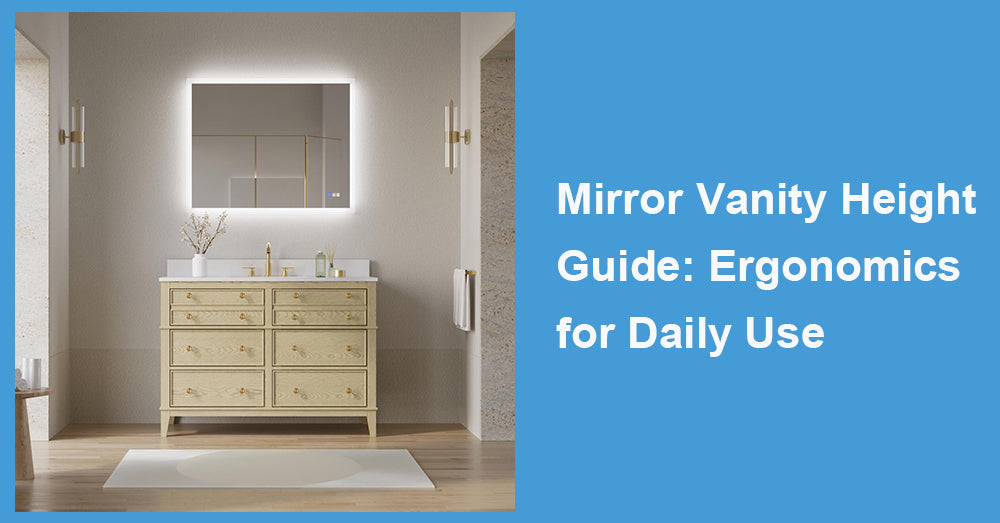
In modern bathroom and bedroom design, the mirror vanity not only serves as a basic mirror but also directly affects the comfort of daily activities such as washing, makeup, and shaving. In recent years, the home design industry has increasingly emphasized the concept of "Ergonomics", which balances the visual, user experience, and spatial aesthetics of mirrors through reasonable height planning. For designers, decorative companies, and ordinary consumers, understanding the standard height and ergonomic principles of vanity mirrors is an important part of creating comfortable living spaces.

1. Why is the height of the dressing mirror so important
In daily household use, the mirror's height directly determines whether the user can see their face naturally and comfortably. If the mirror is installed too high, shorter users may need to stand on tiptoe; if it is installed too low, tall users will need to bend over. Long-term unnatural postures not only affect the experience but may also cause neck or back fatigue.
The Interior Design Association notes that in bathroom and dressing areas, the height of mirrors should prioritize the average height of the main users while accounting for the diverse needs of family members. A reasonable height can not only improve daily efficiency, but also make the overall proportion of the space more coordinated.
2. Installation height of common dressing mirrors in residential buildings
In residential decoration, most vanity mirrors are installed within the following height range:
1. Bottom height of the mirror
Normally, the bottom of the mirror is about 38-42 inches above the ground.
If the mirror is installed above the washbasin or dressing table, this height is often tied to the countertop height.
The height of a common bathroom vanity is:
Standard height: 30-32 inches
Comfort Height: 34-36 inches
Therefore, the bottom of the mirror is generally 4-8 inches above the countertop, which can prevent water splashes from leaving water stains and maintain visual coordination.
2. Top height of the mirror
The top of the mirror is usually 72-78 inches (approximately 183-198 centimeters), which meets the needs of most users with a height of 150-190 centimeters.
For families with significant height differences among family members, designers usually recommend choosing a higher mirror size to ensure that taller users can also see their heads completely.
3. Ergonomic perspective: The height of the mirror center is more critical
Many consumers only focus on the height of the bottom or top of the mirror, but from an ergonomic perspective, the position of the center point of the mirror is more important.
Ideally, the center height of the mirror should be close to the horizontal line of the user's eyes. Suggestions for ergonomic research:
The average eye height for adults is approximately 60-64 inches (152-163 centimeters)
Therefore, when designing, the center point of the mirror can be controlled at around 60-62 inches, so that most people can naturally see the center position of their face.
This design approach is particularly suitable for:
Family shared bathroom
Apartment and hotel bathrooms
Commercial public restroom
Optimizing the center height can reduce the need for users to bend over or look up.
4. Suggestions for the height of dressing mirrors in different spaces
The height requirements for mirrors vary depending on different usage scenarios.
1. Bathroom vanity mirror
The bathroom mirror is usually installed above the washbasin, with the most common size being 24-36 inches in height.
The designer suggests that the width of the mirror should not exceed the width of the dressing table to maintain overall proportion coordination.
2. Bedroom vanity mirror
Bedroom makeup mirrors are usually closer to the desktop, so their height can be slightly lower. The bottom of the mirror is usually 6-10 inches from the desktop, allowing users to see their faces while sitting comfortably.
3. Full body dressing mirror
For a full-length mirror, it is usually recommended to have a height of 60-72 inches and a bottom distance of 12-18 inches from the ground.
This way, you can see the whole body at once while avoiding overcrowding caused by a mirror that's too low.
5. The relationship between lighting and mirror height
In modern bathroom design, more and more families are choosing LED with light mirrors or light mirror cabinets. The height of the mirror not only affects the line of sight but also affects the lighting effect.
A reasonable lighting layout should follow the following principles:
The light source should be at a height close to the face to reduce shadows.
Symmetrical light sources are more natural than a single top light source.
The LED strip mirror should cover the face.
For example, if the mirror is 30-36 inches tall, LED light strips are usually placed around the frame to provide uniform illumination. This design is particularly important in makeup, shaving, and skincare.
6. The latest design trends in the market
In recent years, there have been some obvious trends in the design of vanity mirrors in the bathroom market:
1. Elevated mirror design
More and more newly built residential buildings are using large mirrors over 40 inches tall, which not only enhance the visual sense of the space but also accommodate users of different heights.
2. Mirror cabinet integration
Mirror cabinets with storage functions are rapidly becoming popular. Designers usually install the bottom of the mirror cabinet at 40-44 inches to ensure a comfortable door-opening operation.
3. Smart mirror
Intelligent LED mirrors feature functions such as defogging, touch dimming, and time display, which require greater precision in installation height because the touch area must be located in a naturally accessible position by hand.
7. Details to be noted before installation
Before installing a vanity mirror, it is recommended to plan the following aspects:
Measure the height range of family members.
Confirm the height of the dressing table.
Determine the location of lighting fixtures and power sources.
Reserved socket or power cord location (such as smart mirror)
In addition, if the width of the mirror exceeds 48 inches, it is recommended to use a dual fixed point or metal hanging rail system to improve installation stability.
Conclusion
With the continuous development of modern home design towards comfort and humanization, the height design of vanity mirrors is no longer just a simple installation issue, but an important detail related to ergonomics, spatial proportion, and daily experience. Reasonably planning the height of the bottom of the mirror, the height of the center line of sight, and the overall size can make the bathroom or bedroom space more practical, beautiful, and comfortable.
For consumers, when decorating or replacing vanity mirrors, it is advisable to plan based on the height and usage habits of family members; For designers and bathroom brands, product design centered around ergonomics will also become an important direction for future market competition.








































Leave a comment
This site is protected by hCaptcha and the hCaptcha Privacy Policy and Terms of Service apply.