






















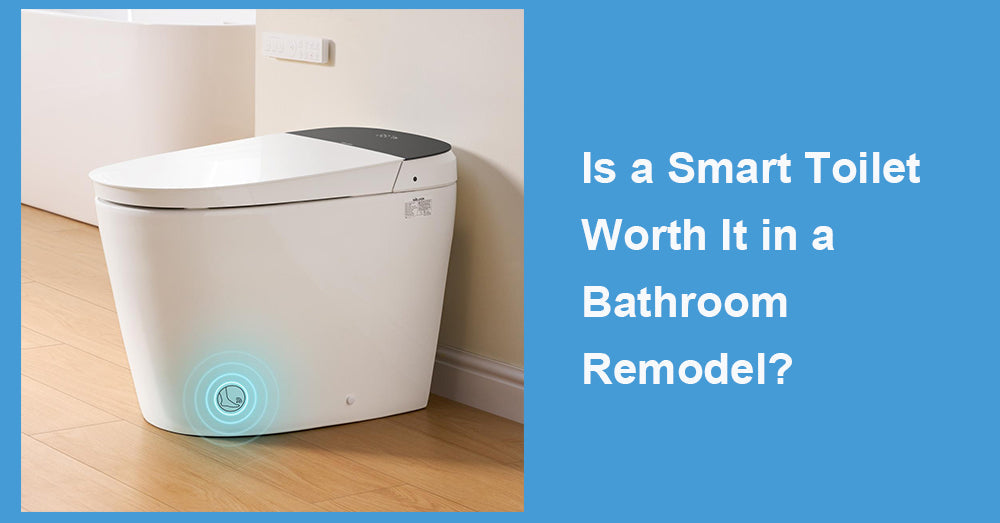
In recent discussions about bathroom renovations, smart toilet are gradually moving from being seen as a "novelty feature" to being seriously considered as a functional option. Compared to traditional toilets, smart toilets exhibit notable differences in cleaning methods, comfort, hygiene management, and long-term user experience. Industry research indicates that as living comfort and health awareness increase, more and more renovation projects are beginning to re-examine this long-neglected core component: whether a toilet is merely a basic functional facility or a key element that can significantly enhance daily experience.
1. The frequency of use determines the lower limit of value
Among all bathroom fixtures, the toilet is almost the most frequently used. Regardless of the size of the bathroom or the level of decoration, the toilet is a necessity used every day. This means that any improvement in experience will be continuously amplified over the long term.
Smart toilets transform the previously monotonous toilet experience into a more stable and comfortable process through features such as automatic flushing, warm-water cleaning, and warm-air drying. This improvement is not a one-time visual upgrade, but a change that is repeatedly perceived every day. From a long-term perspective, high-frequency usage scenarios often better reflect the actual value of equipment investment.
2. The difference in experience brought by changes in cleaning methods
The cleaning method of traditional toilets relies heavily on external consumables, whereas smart toilets achieve a more consistent cleaning effect through water flow angle, pressure control, and temperature adjustment. Industry data shows that warm-water washing is significantly superior to traditional methods in terms of stability and comfort, especially after prolonged use, when the difference becomes even more pronounced.
In addition, some smart toilets are equipped with self-cleaning sprayers and antibacterial materials, which also have practical significance in reducing maintenance frequency. This idea of "active participation of equipment in hygiene management" is gradually becoming an essential trend in bathroom design.
3. The dimensions and installation conditions are not as stringent as one might imagine
Many renovation projects initially worry about the large size and complex installation of smart toilets. In fact, the overall length of mainstream smart toilets typically falls within the 26–30-inch range, closely matching the height of traditional one-piece toilets. The key limitations stem more from the position of the drainage outlet and the reserved power supply than from the bathroom's dimensions.
During the renovation phase, as long as the standard position of the drainage outlet from the wall is confirmed in advance, and a stable power supply is available, most smart toilets can be installed smoothly. This also explains why smart toilets are better planned alongside overall renovation or system upgrades.
4. Rational evaluation of energy consumption and water use efficiency
There has been ongoing discussion about whether smart toilets are "more energy-consuming. Industry test data shows that under normal usage conditions, the additional energy consumption of smart toilets primarily comes from seat heating and warm-air systems, and it remains within a controllable range overall. Some models even consume less energy in standby mode than expected.
In terms of water usage, smart toilets optimize flushing structures and water flow paths, achieving more stable water volume control while ensuring cleaning effectiveness. From a long-term usage perspective, their water efficiency performance is comparable to that of high-efficiency traditional toilets.
5. Comfort is not merely an "additional experience"
In actual user feedback, features such as constant-temperature seat rings, soft night lighting, and automatic lid opening and closing are often seen as "additional experiences" during the initial usage phase. However, after prolonged use, they gradually become daily habits that are difficult to abandon. Especially in environments with significant temperature variations, the difference in comfort becomes even more pronounced.
Industry research shows that once users have been using smart toilets in their home bathrooms for a long time, they will experience a significant drop in comfort when they return to traditional toilets. This change in experience is one of the important reasons why many renovation projects choose smart toilets.
6. Practical considerations of maintenance and reliability
Smart devices inevitably raise concerns about reliability. Early smart toilets indeed had complex maintenance, but as technology has matured, mainstream products have significantly improved in terms of stability and failure rate control. The popularity of modular design has made later maintenance no longer mean complete replacement.
From an industry perspective, the maintenance logic of smart toilets is closer to that of home appliances than to that of traditional bathroom hardware. This also requires that, when choosing, more emphasis be placed on brand maturity and the after-sales system rather than just parameter stacking.
7. How should we view the position in the renovation budget?
In the overall bathroom renovation budget, smart toilets often constitute a medium to high-end individual investment. However, instead of viewing it as a question of "whether it's worth upgrading," it's better to assess it within the framework of "which high-frequency usage devices are worth improving."
Compared to decorative designs or low-frequency configurations, smart toilets have a more direct impact on daily life quality. Industry analysis suggests that, given budget constraints, investing in high-frequency, long-term irreplaceable equipment is often more rational.

8. The judge based their decision on long-term lifestyle rather than short-term trends
There is no unified answer to whether smart toilets are worth it. They are not suitable for everyone, but their value has become increasingly apparent in renovation projects that emphasize hygiene, comfort, and long-term use.
From an industry perspective, smart toilets are not simply a "superposition of technologies", but a systematic optimization of the basic behavior of using the toilet. In a bathroom renovation aimed at a long-term living experience, such optimization often carries greater practical significance than short-term visual changes.







































Leave a comment
This site is protected by hCaptcha and the hCaptcha Privacy Policy and Terms of Service apply.