






















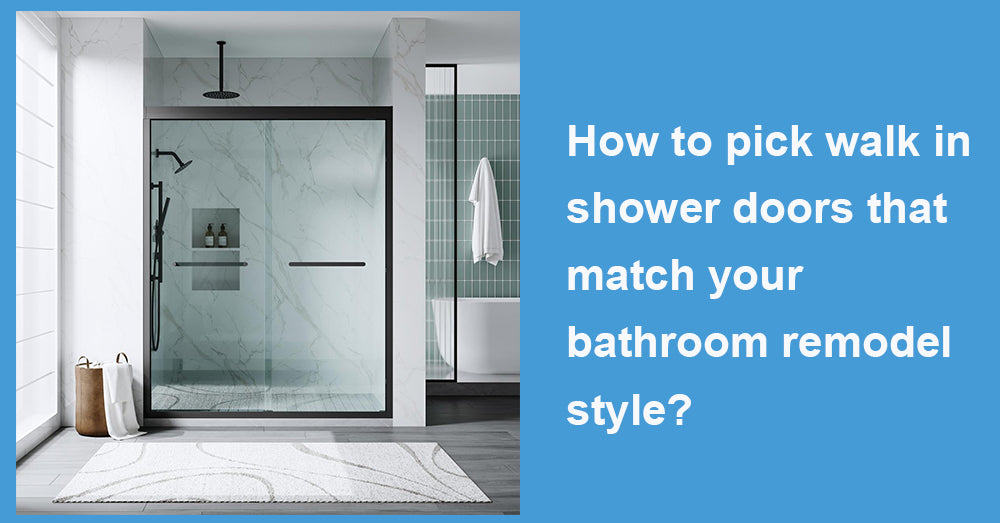
In recent years, the trend of bathroom renovation has shifted walk-in showers from high-end, customized configurations to a common choice in more and more residential areas. Compared to traditional bathtubs or enclosed shower rooms, the Walk-In Shower offers significant advantages in visual transparency, ease of use, and space utilization.
But in the actual design process, many problems do not lie in whether to install a walk-in shower, but in choosing walk in shower doors that truly match the overall bathroom style. If there is any deviation in the door type, frame, glass, or proportion, the overall effect will appear abrupt.
1. Walk-in shower Doors have become an integral part of the overall design, rather than a standalone component
In early bathroom designs, shower doors were seen more as a functional partition. Nowadays, it is more like a "visible architectural element" that directly affects the degree of spatial completion.
Houzz's research on bathroom renovation trends indicates that, in recent years, design decisions have shifted from individual product selection to overall coordination in renovation projects, and the unity of shower doors with floors, walls, and hardware is repeatedly emphasized (source: Houzz.com).
This also means that the selection of Walk-In Shower Doors should start with the decoration style, rather than simply focusing on glass thickness or opening method.
2. Modern and minimalist styles: Weakening presence is key to design
In modern or minimalist style bathrooms, space often emphasizes the cleanliness of lines and the purity of materials. In this environment, excessive structural elements disrupt the overall rhythm.
This type of space is more suitable for walk-in shower Doors with frameless or minimalist frames. Transparent glass paired with hidden or narrow borders can minimize visual cutting, making the shower area almost "disappear" into the overall space.
The National Kitchen and Bath Association recommends in its design guidelines that modern-style bathrooms are better suited for partition forms that minimize visual interference to maintain spatial coherence (source: NKBA.org).
3. Transition and light luxury style: The presence of lines cannot be ignored
In transitional bathroom designs between tradition and modernity, frameless shower doors can sometimes appear thin. A half-frame or thin metal frame is more likely to complement the overall style.
This style is usually suitable for a stable yet not bulky structural feel, such as matte metal borders and low-key but weighty door handles. The framework is not noise, but a manifestation of a sense of order.
Industry research suggests that shower doors with subtle structural elements are more readily accepted in bathrooms that emphasize style balance.
4. Traditional style bathroom: Proportion and material are more important than "transparency."
In traditional or classic-style bathrooms, completely transparent, minimalist shower doors often appear outdated.
This type of space emphasizes symmetry, hierarchy, and material texture more.
Compared to frameless glass, Walk In Shower Doors with clear borders are easier to coordinate with traditional cabinets and linear tiles. Glass can be transparent. Still, the structure must be "visible".
Design research suggests that traditional spaces are more suitable for boundary-like partition forms to maintain consistency in design language.
5. Industrial style: The door frame itself is the design language
In industrial-style bathrooms, shower doors are often no longer hidden elements but rather visual focal points.
Clear metal frames, partition structures, and even grid-style designs are all part of style expression.
This design emphasizes the collision of structure, proportion, and material, so Walk In Shower Doors is better suited for a "visible" role rather than a supporting one.
According to industry analysis on Remodeling, shower doors are often considered one of the styling elements in bathrooms that emphasize personality expression (source: Remodeling.hw.net).
6. Scale and proportion: The prerequisite for style matching is "correct size."
Regardless of the style, size is a fundamental prerequisite.
In standard walk-in shower layouts, the width of glass doors or partitions is typically 28 to 36 inches, ensuring waterproofing without compressing the flow line.
The door height is generally controlled at 72-80 inches, and the coordination with the ceiling ratio is an essential factor for visual comfort. Proportion imbalance is often easier to detect than style inconsistency.
7. The choice of glass type also affects the style expression
A common misconception in daily life is focusing only on the door shape and ignoring the glass itself.
Transparent, low-iron, and frosted or textured glass have very different effects in different styles.
In spaces that emphasize brightness and transparency, high-transparency glass offers greater advantages. In designs that require privacy or a style hierarchy, a light matte treatment is actually more durable.
Glass is not a neutral material. It also participates in style expression.
8. Function and style are not in opposition
Some people are concerned about sacrificing functionality, such as waterproofing and cleaning convenience, to match the style. However, in reality, there is no clear trade-off in the mature Walk-In Shower Doors design.
Consumer Reports' home product research shows that as long as the structural design is reasonable, even visually minimalist products can maintain good functional stability (source: ConsumerReports.org).
In other words, style matching does not mean sacrificing the user experience.

9. Conclusion: The truly suitable Walk In Shower Doors are those that "look like they already belong here."
In bathroom decoration, Walk-In Shower Doors should not appear deliberately "added".
Whether it's modern, transitional, traditional, or industrial style, it's only when the door's shape, material, proportions, and overall space naturally blend that it's considered the right choice.
From the perspective of industry trends, the direction of future choices is not becoming increasingly complex, but rather increasingly precise. Shower doors that match the decoration style are essentially a manifestation of overall design thinking.









































Leave a comment
This site is protected by hCaptcha and the hCaptcha Privacy Policy and Terms of Service apply.