






















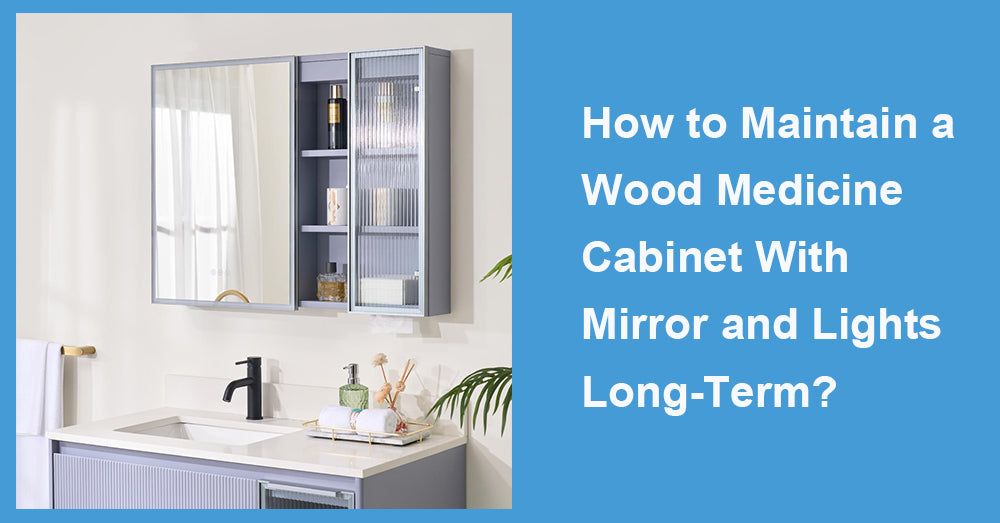
Against the backdrop of continually improving bathroom storage and lighting systems, wood medicine cabinet with mirror and lights have gradually become a common choice in mid- to high-end bathroom design, thanks to their natural texture and functional integration. Compared to metal or full-mirror structures, wooden cabinets are visually warmer but also require higher long-term maintenance.
Industry research shows that over 60% of furniture problems in bathroom environments are related to humidity, temperature differences, and improper daily cleaning methods. For wooden medicine cabinets that integrate mirror and lighting systems, scientific long-term maintenance not only affects their appearance lifespan, but also directly impacts structural stability and electrical safety. (Source: National Kitchen&Bath Association, NKBA. org)
This article systematically analyzes how to maintain wood medicine cabinets with mirrors and lights for a long time, from the perspectives of industry data, material characteristics, daily usage habits, environmental control, and maintenance cycles, to extend their service life and maintain stable performance.
1. Why do wooden medicine cabinets with lights require more systematic maintenance?
Compared with ordinary mirror cabinets, wood medicine cabinets with mirrors and lights face three types of long-term pressures simultaneously:
Humidity and temperature difference changes: Hot water is frequently used in the bathroom, and the air humidity fluctuates significantly.
Lighting and electrical systems: lighting and anti-fog components operate for a long time in humid environments.
Natural properties of wood: Even after moisture-proof treatment, wood may still undergo slight deformation due to environmental changes.
Industry surveys show that about 45% of after-sales problems with bathroom wooden furniture are due to insufficient humidity control, followed by improper cleaning methods and inadequate ventilation. (Source: Houzz. com)
Therefore, the core of maintenance is not "frequent maintenance", but establishing correct and sustainable usage and cleaning habits.
2. The installation phase determines the difficulty of later maintenance
Long-term maintenance does not start "after use"; instead, it lays the foundation from the installation stage.
2.1 Reasonable distance from walls and countertops
Industry installation guidelines generally recommend:
The bottom of the wooden medicine cabinet should be at least 3-5 inches higher than the tabletop.
Maintain a minimum of 1 inch of ventilation space between the cabinet side and adjacent walls.
These seemingly subtle spacing designs help with air circulation and reduce the risk of long-term moisture retention at the bottom and sides of the cabinet. (Source: This Old House. com)
2.2 Electrical wiring and moisture-proof isolation
Wooden medicine cabinets with lights usually require a fixed power connection. Industry standard suggestions:
The power interface should avoid direct exposure to areas with high water vapor concentration.
A moisture-proof isolation layer should be reserved on the back of the cabinet.
All lighting and anti-fog components must pass safety certification and meet moisture resistance requirements.
Data shows that a reasonable electrical isolation design can reduce the failure rate of lighting systems by about 30% in the later stage. (Source: Electrical Safety Foundation International, ESFI. org)
3. Daily cleaning: avoid the misconception of "excessive cleaning."
3.1 Correct cleaning method for wooden surfaces
The most common damage to wooden medicine cabinets often comes not from moisture itself, but from improper cleaning.
Industry-recommended cleaning principles include:
Wipe with a soft dry or slightly damp cloth.
Avoid cleaning agents containing alcohol, ammonia, or strong acidic or alkaline components.
Wipe off surface moisture promptly after cleaning.
Research shows that long-term use of irritating cleaning agents can shorten the lifespan of protective coatings on wooden surfaces by 20-40%. (Source: Woodworking Network. com)
3.2 Partition cleaning of the mirror and the light strip
For a wood medicine cabinet with mirrors and lights, different areas should be distinguished:
Mirror: Use a specialized mirror cleaner to prevent it from running into the wooden frame.
Lamp strip area: Use only a dry cloth to gently wipe, avoiding direct contact of liquid with the lamp source.
Internal layer board: Regularly clean, but avoid overwetting.
This "zone cleaning" method helps reduce potential impacts on wooden structures and electrical components during cleaning.
4. Humidity control: the core factor for long-term maintenance
In the bathroom environment, humidity management is the key to determining the lifespan of wooden medicine cabinets.
4.1 The importance of ventilation conditions
Industry data shows that maintaining adequate bathroom ventilation within 30 minutes after showering can reduce the risk of moisture-related damage to wooden furniture by about 50%. (Source: ASHRAE. org)
Good ventilation methods include:
Use the exhaust system.
Open windows when conditions permit.
Avoid prolonged accumulation of water vapor in a sealed environment.
4.2 Reasonable use of the anti-fog function
Lamp medicine cabinets are often equipped with an anti-fog mirror. It should be noted that:
The anti-fog function should be turned on when needed, rather than running continuously for a long time.
Long-term high-temperature operation may accelerate the aging of the surrounding wood.
Reasonable use of the anti-fog function can help reduce thermal stress on the cabinet while ensuring a clear mirror surface.
5. Key points for long-term maintenance of lighting systems
5.1 The lifespan and maintenance of LED lighting fixtures
Industry statistics show that the theoretical lifespan of high-quality LED lighting fixtures can range from 25000 to 50000 hours. But in humid environments, the maintenance method will significantly affect its actual service life. (Source: Energy. gov)
Suggested approaches include:
Avoid frequent and rapid switching of lights.
Regularly check the light strip's fixing and sealing status.
If flickering or uneven brightness is found, it should be repaired promptly.
5.2 Line and interface inspection
For wooden medicine cabinets with integrated lighting, it is recommended to check the electrical connection status every 12-18 months to reduce safety risks during long-term use. (Source: Family Handyman. com)

6. Internal storage and structural protection
The internal space of wooden medicine cabinets also needs to be used reasonably:
Avoid long-term storage of high-humidity items, such as towels that are not completely dry.
Liquid products should be stored in a sealed manner to prevent leakage.
Regularly adjust the position of internal shelves to reduce local stress concentration.
Industry practice has shown that reasonable internal storage management can significantly reduce the probability of cabinet deformation and hinge loosening. (Source: Cabinet Makers Association, CMA. org)
7. Common maintenance misconceptions
In practical use, the following misconceptions are pretty common:
Believe that there is no need to pay attention to humidity after moisture-proof treatment.
Use the same cleaning agent as for ceramic tiles to clean wooden surfaces.
Long-term neglect of lighting and wiring inspections.
Failure to promptly address minor deformations or abnormal noises discovered.
These issues are often not apparent in the short term, but will gradually escalate over long-term use.
8. Recommended rhythm for long-term maintenance
Based on industry experience, the maintenance of a wood medicine cabinet with mirrors and lights can follow the following rhythm:
Weekly: Gently clean the surface and dry off moisture.
Monthly: Check the edges, hinges, and mirror condition of the cabinet.
Every year: Evaluate the stability of the lighting system, electrical interfaces, and overall structure.
This periodic maintenance method helps extend the product's overall lifespan without adding burden.
9. Conclusion: The essence of long-term maintenance is "environmental management."
From an industry perspective, the long-term maintenance of wood medicine cabinets with mirrors and lights does not rely on complex or expensive methods, but rather on a thorough understanding of the baroom environment, usage habits, and material characteristics.
By reasonable installation, scientific cleaning, adequate ventilation, and regular inspection, the aging rate of wooden medicine cabinets in humid environments can be significantly reduced, while maintaining the stable performance of the mirror and lighting system.
In the trend of increasing emphasis on "long-term use experience" in bathroom overall design, the correct maintenance method is not only the protection of the product itself, but also a long-term investment in the overall space quality.









































Leave a comment
This site is protected by hCaptcha and the hCaptcha Privacy Policy and Terms of Service apply.