






















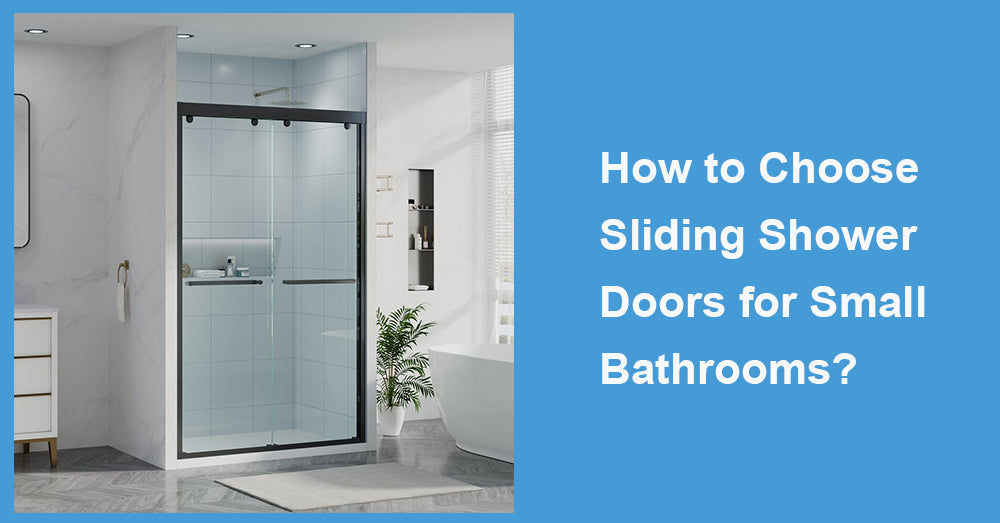
Driven by the rise of fully-furnished apartments, old-home renovations, and refurbished properties, compact living spaces and micro-bathrooms are becoming mainstream scenarios in the home renovation market. Accordingly, maximizing every inch of usable space through smarter design has emerged as the core challenge in bathroom product upgrades. Shower doors have evolved from traditional hinged doors and shower curtains to various forms of sliding shower doors, gaining rapid popularity especially in compact bathrooms.
Industry research widely suggests that as consumers demand greater comfort and aesthetic appeal, sliding shower doors are transitioning from “functional patches” to “spatial aesthetic protagonists,” becoming standard options in many small-unit projects and renovation initiatives.
I. Why Do Compact Units Prefer Sliding Shower Doors?
1. True “Floor Space Savings”
Unlike hinged doors that swing outward or inward, sliding shower doors operate on tracks, eliminating encroachment on the bathroom's limited activity area. In typical 32–54 sq ft compact bathrooms, door panels no longer clash with toilets or vanities, significantly improving accessibility.
In developer showrooms and real-life small-space examples, sliding doors are often paired with linear vanities and wall-mounted toilets. This combination ensures compact spaces retain complete functional flow and comfortable maneuvering zones.
2. Visual Expansion: The Synergy of Glass + Minimalist Hardware
Sliding shower doors predominantly feature expansive glass panels—clear, ultra-clear, frosted, or textured—paired with ultra-narrow metal frames that allow unobstructed views throughout the space. For compact bathrooms with limited dimensions, the transparency of light and sightlines often proves more impactful than gaining an extra 4 inches of physical space.
The trend toward frameless or narrow-frame designs with concealed hardware transforms sliding doors from functional dividers into vital tools for “visual extension,” becoming key elements in creating a “light and airy bathroom.”
3. Functionality and Aesthetics Combined
Compared to shower curtains, sliding shower doors offer superior waterproofing and a higher-end overall feel. Compared to traditional sliding partitions, large glass panels enhance natural light and spatial unity. Through designs like black frames, brushed metal, or hidden tracks, sliding shower doors seamlessly integrate into Nordic, minimalist, light luxury, industrial, and other styles, balancing functionality and aesthetics.
II. Industry Perspective: The Market Logic Behind Sliding Doors for Small Bathrooms
1. Explosive Demand Driven by Compact Units, Renovation, and Upgrades
From a market perspective, the sustained growth of shower enclosures and doors stems primarily from accelerated urbanization, increased new residential construction, and the renovation of older housing stock. Particularly in tier-1 and tier-2 cities, where compact units dominate and bathroom space is limited, developers and renovation firms increasingly adopt sliding shower doors to maximize space utilization.
For existing home renovations and older property upgrades, sliding shower doors offer a “cost-effective upgrade solution” that enhances bathroom comfort and aesthetics: without altering the overall structure, simply replacing the shower area significantly improves the experience.
2. Leading Brands and Local Manufacturers Drive Growth Together
The shower door market is driven by a tripartite ecosystem of “international giants + domestic brands + custom manufacturers.” Global bathroom enterprises excel in design, materials, and system solutions, while local and regional players rapidly penetrate mid-tier and project markets through flexible customization and price competitiveness.
For compact bathrooms, complex layout demands—such as non-standard dimensions, irregular angles, and wall-to-wall installations—are prominent. Local factories and custom brands are better positioned to deliver personalized solutions, establishing themselves as key players in this niche segment.
3. Design Trends: From “Functional” to “Better Usability and Safety”
Over the past two years, product iterations for sliding shower doors have focused on three key directions:
Greater Safety: Thicker tempered glass, explosion-proof films, and laminated glass techniques are becoming increasingly common.
Smoother Operation: Upgraded top- or bottom-mounted track systems reduce noise and jolts, enhancing the opening/closing experience.
More Accessible: Low-threshold or barrier-free designs minimize tripping hazards while addressing accessibility and aging-in-place needs.
These shifts are redefining consumer expectations for what constitutes a “well-designed shower enclosure.”

How to Choose: Six Key Considerations for Selecting Sliding Shower Doors for Small Bathrooms
Faced with a wide array of sliding shower doors, users with compact spaces can make informed decisions by focusing on these six key points.
1. Precise Measurement: Measure the Space First, Then Consider Style
For small bathrooms, measurement accuracy determines the feasibility of subsequent solutions. Key areas to focus on include:
Opening Width: Most standard units fit wall-to-wall openings of approximately 43–67 inches. Narrower or wider openings require custom solutions.
Height: Standard heights range from 73–79 inches. Avoid excessively tall installations in compact spaces to prevent a cramped feel.
Layout Relationships: Confirm distances between the opening and fixtures like toilets, vanities, and entry doors to prevent collisions when the door slides open.
Many contractors have standardized measurement processes using measuring charts or online tools, enabling sales staff to quickly assess suitability for sliding door solutions.
2. Selecting the Right Structure: Single-Track, Double-Track, or Corner Sliding?
Common sliding shower door structures for small bathrooms fall into three main categories:
Straight Double-Panel Sliding Doors
Suitable for wall-to-wall linear shower enclosures or above bathtubs;
Two glass panels overlap, with left or right opening options;
Minimal space requirement but demands high precision in the track system.
Fixed + Single Sliding Door
One fixed glass panel + one sliding door, offering greater structural stability;
Suitable for layouts with one end against a wall and the other open;
Allows for towel bars, shelves, and other accessories on the open side.
Corner Sliding Door / Square or Curved Shower Enclosures
Ideal for corner shower installations, transforming unused angles into functional shower spaces;
Typically paired with shower pans or stone bases, with door panels sliding toward fixed glass panels on either side.
For extremely compact bathrooms, corner sliding doors combined with curved or semi-circular pans represent a common industry solution for maximizing space.
3. Glass and Hardware: Safety and Aesthetics Are Both Essential
Glass Selection
For small bathrooms, prioritize clear or ultra-clear glass to enhance transparency;
If household members value privacy, consider frosted, semi-frosted, or textured glass to balance light transmission with visual screening;
Ensure glass thickness and manufacturing meet safety standards, and check for additional safety features like explosion-proof film.
Hardware Systems
Tracks and fittings are typically stainless steel or high-grade aluminum alloy. Key considerations include load-bearing capacity, corrosion resistance, and pulley lifespan.
Concealed tracks and narrow-frame designs offer superior aesthetics but demand higher installation precision and manufacturing quality.
Details like door stops, stoppers, and anti-derailment mechanisms determine long-term safety and tactile experience.
Sliding Shower Doors for Small Bathrooms: From “Choosing Right” to “Using Well”
From an industry chain perspective, the seemingly simple home renovation question “How to Choose Sliding Shower Doors for Small Bathrooms?” actually involves multi-party coordination: upstream glass processing and hardware system manufacturing, midstream brand design and channel operations, and downstream home renovation companies and retail outlets.
For ordinary consumers, the truly ideal sliding shower door for small bathrooms isn't necessarily the most feature-packed or expensive option. Instead, it's the one that delivers in daily use by:
- Maximizing spatial perception without consuming extra room;
- Featuring intuitive operation that seniors and children can master instantly;
- Requiring minimal maintenance while remaining smooth, safe, and hygienic over time.
As compact living spaces become the norm, brands that best solve the “small space + sliding shower door” equation will seize the initiative in the next wave of bathroom upgrades. For brands and channels, the true competitive focus is shifting from “selling a single door” to “delivering a complete small bathroom space optimization solution.”











































Leave a comment
This site is protected by hCaptcha and the hCaptcha Privacy Policy and Terms of Service apply.