






















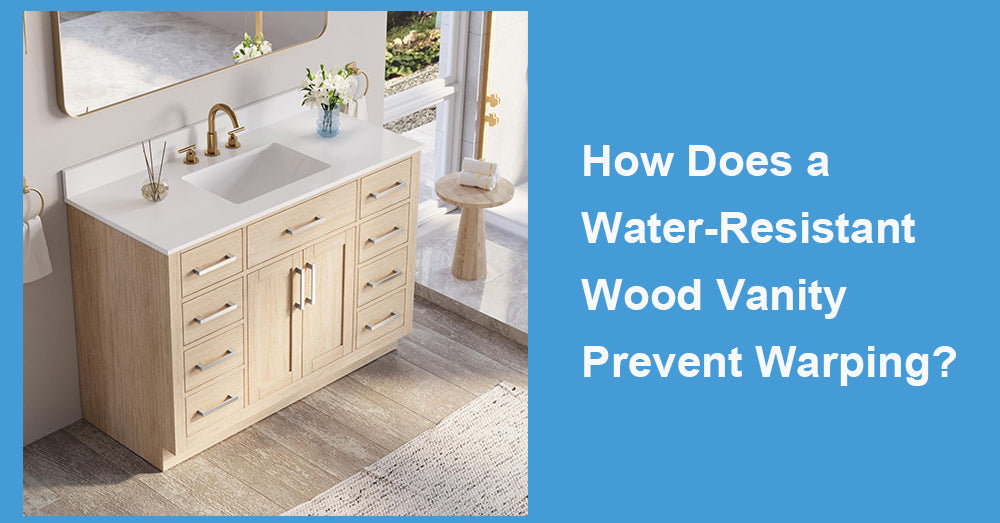
Bathrooms are brutal on wood. Between the steam from hot showers, the splashes around the sink, and the condensation that forms on every surface, a wood vanity faces a constant assault of moisture that most furniture never has to endure. When that moisture gets into the wood fibers, the result is predictable: swelling, joint separation, and the dreaded warping that makes drawers stick and doors refuse to close. The good news is that modern water-resistant treatments and construction methods have made wood vanities a genuinely viable option for humid spaces. But how exactly do they stop the warping process? The answer involves three distinct layers of defense, each addressing a different way moisture tries to get in.
Why Wood Warps in the First Place
To understand prevention, you need to understand the mechanism. Wood is hygroscopic, meaning it naturally absorbs and releases moisture from the surrounding air . When humidity rises, wood picks up moisture and swells. When humidity drops, it releases moisture and shrinks . This dimensional movement is not uniform across the material. According to the USDA Forest Service’s Wood Handbook, shrinkage is greatest in the tangential direction (around the growth rings) and least in the longitudinal direction (along the grain) . That uneven movement is what causes boards to cup, bow, and twist rather than simply getting smaller or larger evenly.
In a bathroom, the humidity swings are frequent and extreme. A hot shower can push relative humidity well above 70 percent, and it may drop back down within an hour once ventilation kicks in. That rapid cycling puts stress on wood fibers, and repeated exposure without protection leads to permanent deformation. The Woodwork Institute’s standards note that wood for interior architectural use should ideally be maintained at a moisture content of roughly 5 to 10 percent in most U.S. climates, which corresponds to an indoor relative humidity of 25 to 55 percent . A bathroom without proper ventilation can easily exceed that range.
Defense One: Engineered Cores That Resist Movement
The first line of defense is often the material itself. Many modern “wood” vanities are not solid timber but engineered wood products designed specifically for moisture resistance. Boiling Water Resistant (BWR) plywood, for example, uses special synthetic resin adhesives that resist moisture penetration, and it is specifically recommended for bathroom vanities and other damp environments . The cross-laminated construction of plywood also constrains the natural movement of wood, because the grain direction alternates with each layer, counteracting the swelling and shrinking of any single sheet.
Moisture-resistant MDF is another common choice. It is denser and more homogeneous than solid wood, and when treated with a moisture-resistant coating, it can handle bathroom humidity without the dramatic dimensional changes that solid timber experiences . The key caveat is that these materials must be sealed at every cut edge. Moisture enters through joints and unfinished edges, and once the substrate absorbs water and expands, the cabinet can lose structural integrity even if the door fronts still look fine .
Defense Two: Surface Barriers That Block Water Vapor
Even the best core material needs a protective skin. Water-resistant wood vanities typically feature a factory-applied finish that does more than look good. Laminate, melamine, and thermofoil are common options, each creating a non-porous barrier that prevents moisture from reaching the wood fibers underneath.
The critical vulnerability with these finishes is the edge. Laminate and melamine doors use a separate strip of edge banding, and once that banding chips or lifts, water can reach the core . This is why quality manufacturing matters. A well-made water-resistant vanity will have sealed edges that are bonded tightly to the substrate, and it will use moisture-resistant adhesives throughout. For painted or veneered wood, the finish must be a moisture-resistant sealant with a durable topcoat that blocks water penetration . Unsealed or lightly sealed natural wood is the worst choice for a bathroom, because it absorbs moisture freely and begins swelling within weeks of exposure .
Defense Three: Installation Choices That Reduce Exposure
The final layer of protection happens during installation. Even a well-sealed vanity will eventually fail if it sits in standing water or gets splashed constantly at its base.
This is why elevated and floating installations are so effective. A wall-mounted vanity, or one raised on water-resistant legs, keeps the cabinet base out of the splash zone and allows air to circulate underneath . The gap also makes it easier to spot leaks before they cause damage. Freestanding vanities with a small elevation gap achieve a similar effect: water cannot pool against the cabinet bottom, and cleaning the floor becomes simpler . For vanities that sit directly on the floor, a bead of silicone sealant at the base can help, but it also traps moisture if water does get underneath, which is why elevation is the safer approach.
Ventilation is the other installation-adjacent factor. Running an exhaust fan during and after showers keeps relative humidity within a range that wood can tolerate. The Woodwork Institute recommends maintaining indoor relative humidity within the ranges appropriate for your region, and avoiding sudden, repetitive swings . A simple humidity gauge can tell you whether your bathroom is staying within safe bounds.
What to Look For When Shopping

If you are in the market for a water-resistant wood vanity, prioritize the specifications that actually address warp prevention. Look for BWR plywood or moisture-resistant MDF as the core material, not standard particleboard or unsealed solid wood. Check that the finish covers every surface, including the interior of the cabinet and the edges of the doors. And consider the mounting style: a floating or elevated design gives you an extra margin of protection against water damage at the base.
A water-resistant wood vanity does not prevent warping through a single trick. It prevents warping by addressing the problem at three levels: a core material that resists dimensional change, a surface barrier that blocks moisture vapor, and an installation that minimizes water exposure. When all three work together, wood can bring warmth and character to a bathroom without the failure modes that gave it a bad reputation in the first place.




































Leave a comment
This site is protected by hCaptcha and the hCaptcha Privacy Policy and Terms of Service apply.