






















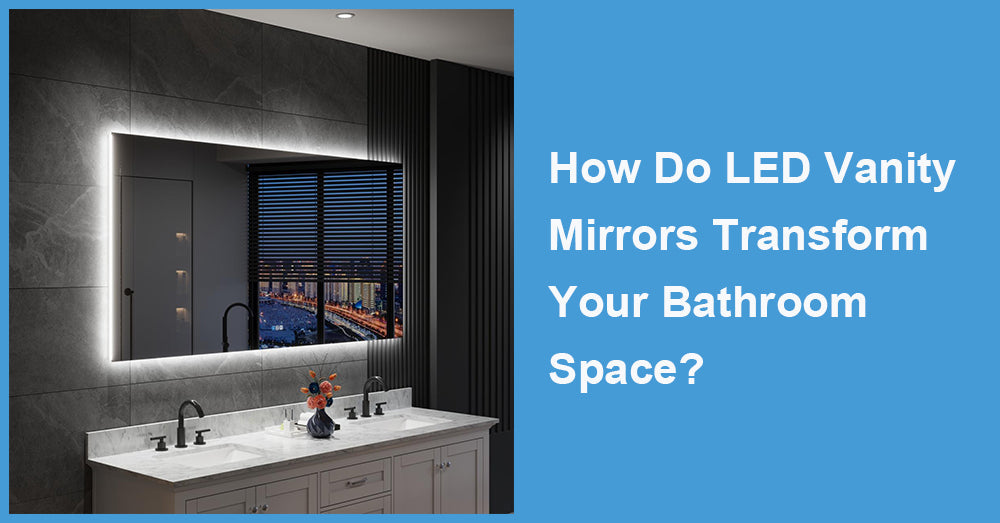
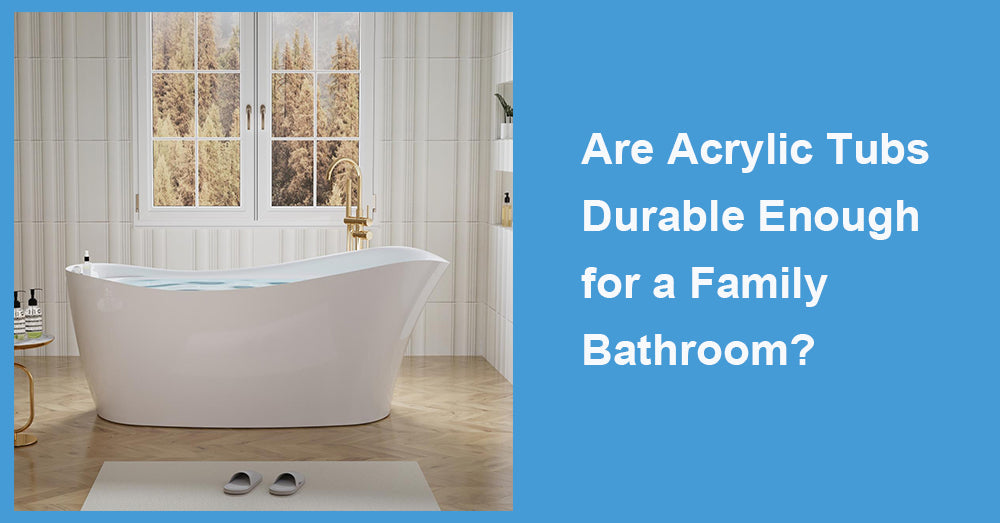
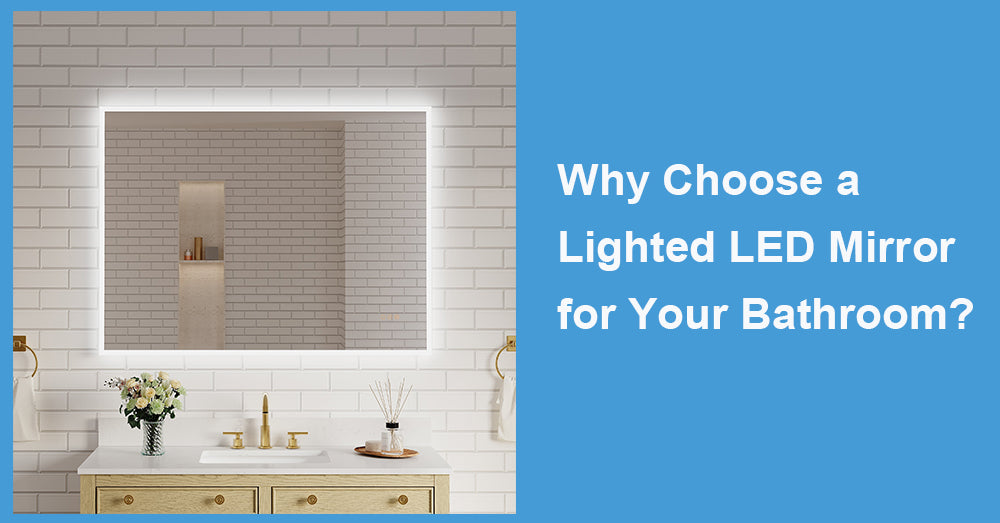
In the process of upgrading and reshaping contemporary bathrooms, LED vanity mirrors have evolved from a single lighting accessory into a core component that reshapes spatial structure and user experience. Compared with traditional mirrors, integrated LED mirrors not only provide lighting but also contribute more deeply to spatial proportion adjustment, visual expansion, functional integration, and long-term energy consumption management. From an industry perspective, a well-designed LED mirror can often significantly enhance the overall quality and spatial value of a bathroom without changing its structure.
1. Structural changes from the perspective of spatial proportion and visual expansion
The bathroom is usually the most restricted space in a residential setting. The standard width of a single basin area is concentrated between 30 and 36 inches, while the double basin space extends to 48 and 72 inches.
Traditional mirrors often exist only as functional pendants, while LED mirrors reshape spatial contours through "luminous boundaries".
Industry visual research shows that, under the same physical size conditions, the spatial depth perception of a mirror with a light source can be improved by about 12%-18%. Especially in mainstream mirror specifications of 36 x 30 inches or 48 x 36 inches, the uniformly illuminated edge can weaken the wall boundary, making the washing area appear visually more spacious.
This feature is particularly prominent in bathrooms without windows or with limited lighting, and is one of the essential reasons for the rapid popularity of LED mirrors in recent years.
2. Functional upgrade from the perspective of lighting structure reconstruction
Traditional bathroom lighting often relies on overhead or side lights, which can easily create shadows on the face.
LED mirrors achieve front fill light that is "coaxial with the line of sight" by directly placing the light source around the mirror surface.
Industry test data shows that in the facial operation area, LED mirrors can reduce the shadow area by about 30%-40%, significantly improving the accuracy of makeup, shaving, and care.
In the typical combination of a table height of 34-36 inches and a mirror width of 48 inches, a reasonable lighting arrangement can maintain stable facial illumination within the ideal range of 500-800 lux.
This means that LED mirrors not only improve brightness but also directly enhance the accuracy of daily high-frequency operations.
3. Realistic skin tone restoration from color temperature and color rendering control
Modern LED mirrors generally support color temperature adjustment from 3000K to 6000K and are paired with high-color-rendering LED chips.
In daily use, the 4000K-4500K range is considered to be the closest to a natural sunlight environment.
Industry research shows that when the color rendering index increases from 80 to over 90, facial color recognition accuracy can improve by about 25%.
In the 48 x 36 inch mirror system, the high-color-rendering light source can significantly reduce color differences in makeup and skin tone deviations, which is particularly crucial for daily care and makeup judgment.
Therefore, what LED mirrors truly change is not whether they light up, but whether they can see accurately.
4. Design value from the perspective of spatial atmosphere and hierarchy
LED mirrors introduce new hierarchical dimensions to the bathroom through front light, backlight, or double-layer light structures.
The backlight structure can create a soft halo on the wall, enhancing the depth of the space.
Front surround light enhances functional lighting.
The dual light structure simultaneously balances atmosphere and practicality.
Industry design research shows that in bathrooms with LED mirror backlighting or dual-light LED mirrors, the "high-end rating" of the space is significantly higher than with traditional mirror solutions.
In small to medium-sized bathrooms measuring 30 to 48 inches, this layered lighting often provides a more direct visual enhancement than replacing tiles or countertops.
5. Systematic advantages from the perspective of energy consumption and long-term costs
The efficiency of the LED mirror-integrated light source is significantly higher than that of traditional lamp combinations.
Under the same illumination conditions, the energy consumption of LED mirrors is about 35%-50% lower than that of traditional mirror headlight systems.
Industry data shows that LED mirror systems can significantly reduce lighting energy consumption and the frequency of lamp replacement in household bathrooms used for 30-60 minutes per day over a long period of use.
Its nominal lifespan generally exceeds 30000 hours, which is sufficient to cover a daily usage cycle of more than 10 years.
This makes LED mirrors not only a design upgrade but also a part of long-term operational cost optimization.

6. The systematic trend of modern bathroom from the perspective of functional integration
Modern LED mirrors are no longer limited to lighting, but gradually integrate multiple functional modules:
Anti-fog heating system
Touch or sensor switch
Brightness and color temperature memory
Built-in clock and temperature display
Audio or Bluetooth module
Industry surveys show that in systems with memory and automatic light-off functions, user adjustment frequency decreases by about 40% and overall user satisfaction increases significantly.
In the mainstream size range of 48-60 inches, LED mirrors are gradually becoming the "control center" of the bathroom, rather than just passive accessories.
7. From the perspective of installation adaptability, the friendliness of the renovation is evaluated
Compared to structural upgrades, LED mirrors belong to the category of "low intrusion upgrades".
In most projects, installation can be completed by simply reserving power points without changing drainage or structural layout.
Industry data shows that in renovation projects for old bathrooms, the average construction period for replacing with LED mirrors is shortened by about 30%. At the same time, the visual improvement effect is highly significant.
This makes it one of the most cost-effective upgrade solutions.
8. From the perspective of property value and market perception, the premium ability
In residential transactions and evaluations, bathroom lighting configuration has gradually become an essential additional item.
Industry statistics show that under the same area and configuration conditions, the overall evaluation premium for bathrooms with LED mirror systems is significantly higher than for traditional solutions.
Especially in the main and high-end secondary bathroom spaces, LED mirrors have gradually shifted from "optional" to "standard expectation".
9. Conclusion: How a mirror can truly change a bathroom space
From spatial proportion, lighting structure, color rendering accuracy, atmosphere hierarchy, energy consumption performance, to functional integration, the changes made by LED mirrors to bathrooms are systematic rather than surface decoration.
It does not just make the space "brighter", it makes the space:
Larger, more accurate, more comfortable, more efficient, and more intelligent.
In a core space used multiple times a day and in service for over ten years, LED vanity mirrors bring not just a design upgrade but a long-term, sustainable way to reconstruct the space.









































Leave a comment
This site is protected by hCaptcha and the hCaptcha Privacy Policy and Terms of Service apply.