






















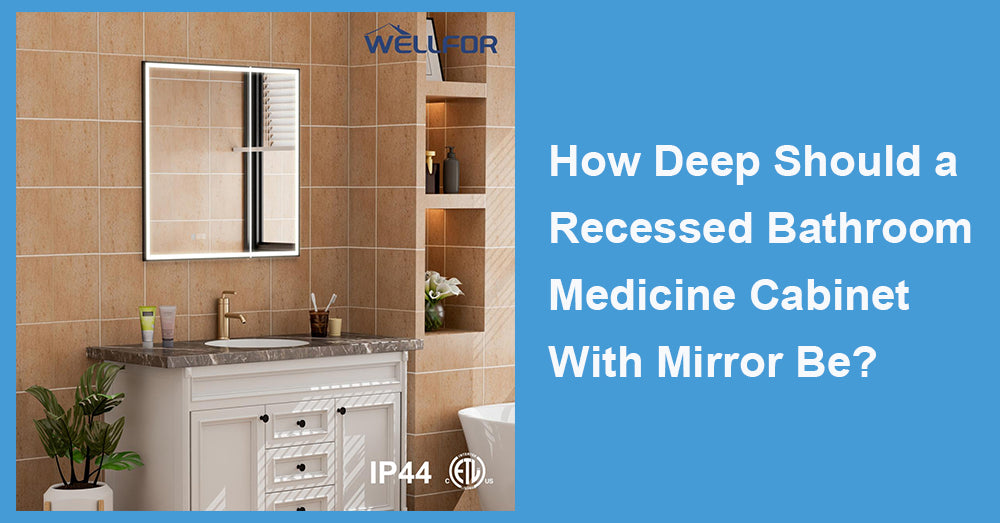
In contemporary bathroom decoration and renovation projects, space utilization has become one of the critical indicators for measuring design maturity. With the rationalization of residential area structure, more and more homeowners and designers are starting to re-examine the necessity of traditional bathroom configurations. Among them, the recessed bathroom medicine cabinet with mirror is widely used for balancing storage and visual cleanliness. However, in the actual selection and installation process, the question of "how deep the mirror cabinet should be" has frequently sparked controversy. Shallow depth limits storage function; Excessive depth may also affect the wall structure, safety, and overall appearance. From an industry perspective, the depth of mirror cabinets is not a simple size issue, but a comprehensive judgment involving structural conditions, usage habits, design trends, and long-term maintenance.
1. Why is the depth of the mirror cabinet a key technical parameter in decoration
Unlike ordinary wall-mounted bathroom mirrors, the core feature of embedded mirror cabinets is that they are "hidden in the wall. This means that its size is no longer solely determined by design intentions, but is objectively limited by the building structure. In industry practice, many rework cases stem from a lack of deep understanding of mirror cabinets - either discovering that they cannot be embedded during installation or exposing storage efficiency issues after use.
With the continuous upgrading of mirror cabinet functions, the items that need to be accommodated inside are also changing, expanding from basic toiletries to electric toothbrushes, skincare bottles, medicines, and even small electronic devices. This trend makes "reasonable depth" a key indicator affecting the value of mirror cabinets.
2. Common depth ranges for embedded mirror cabinets in mainstream markets
Based on current market product specifications and construction experience, the mainstream depth of embedded bathroom medicine cabinets is usually concentrated between 3-5 inches. This scope is not arbitrarily formed, but the result of the joint evolution of residential structure and usage demand over the years.
About 3 inches deep
Commonly seen in apartment or lightweight renovation projects. This depth makes it easier to avoid pipelines and keels inside the wall, with a high construction success rate, and is suitable for storing thin items such as toothbrushes, toothpaste, razors, and ointments.
About 4 inches deep
Widely regarded as the 'industry equilibrium point'. Providing more flexible storage options without significantly increasing construction complexity is the preferred choice for most home bathrooms.
Approaching a depth of 5 inches
Usually used for new residential or customized projects. The storage capacity has significantly increased, but higher requirements are placed on the wall conditions and installation accuracy, and not all bathrooms are suitable.
The industry generally believes that embedded mirror cabinets beyond this depth have limited practical significance in ordinary residential buildings.
3. How can the wall structure directly limit the depth of the mirror cabinet
When determining the feasible depth of the mirror cabinet, the wall structure is the primary prerequisite. Most residential interior walls use standard wooden or light steel keel structures, which have limited internal space and are often accompanied by facilities such as water pipes, wires, and exhaust ducts.
The industry standard practice is to confirm the internal condition of the wall through detection or construction drawings before determining the size of the mirror cabinet. Neglecting this step often results in the mirror cabinet not being fully embedded and can even damage the waterproof layer or structural stability.
Therefore, the depth of the mirror cabinet is not solely determined by the product, but is jointly constrained by the building conditions and construction feasibility.
4. Depth and storage efficiency are not simply proportional
A common misconception is that the deeper the mirror cabinet, the more practical it is. In fact, industry research shows that overly deep mirror cabinets may actually reduce the user experience. The reason is that as the depth increases, items are more likely to be stacked and obstructed, requiring repeated movement during retrieval, which increases the burden of use.
In contrast, within a reasonable depth of 3-4 inches, more efficient daily use can often be achieved through adjustable shelves, reasonable zoning, and a clear line of sight design. This has also prompted the industry to shift from pursuing depth to optimizing internal structure.
5. Long-term impact of ergonomics and safety factors
Embedded mirror cabinets are not only storage units, but also functional components for high-frequency use. A cabinet that is too deep can increase the weight of the door panels and hinge burden when opened and closed, and long-term use may pose a risk of structural looseness.
From an ergonomic perspective, a cabinet that is too deep may force users to lean forward or reach out to retrieve items, increasing unnecessary movement burden. The industry tends to recommend a depth range that is naturally within reach of the arm, enhancing comfort and safety for daily use.
6. The implicit requirement of design style on the depth of the mirror cabinet
In modern, minimalist, or transitional style bathrooms, the value of embedded mirror cabinets is not only reflected in functionality, but also in visual expression. A shallower depth helps to form a unified plane between the mirror and the wall, reducing shadows and abruptness.
On the contrary, in bathroom designs that prioritize home practicality, a slightly deeper mirror cabinet may be more suitable for multi-member use needs. Therefore, the selection of mirror cabinet depth should also serve the overall design goals, rather than making isolated decisions.
7. Depth selection from the perspective of long-term maintenance and updates
Industry experience shows that a mirror cabinet with reasonable depth is more conducive to later maintenance. Deep structures have limited operating space and higher maintenance costs when replacing hinges, cleaning the interior, or adjusting laminates.
In addition, as household usage needs change, the adjustability of the mirror cabinet's internal structure is often more important than additional depth. This is also why many designers tend to recommend a combination of "moderate depth+flexible interior design".

Conclusion
Based on industry practice and feedback, the ideal depth for a received bathroom medicine cabinet with a mirror is not necessarily the greater the better, but instead requires a balance between wall structure, storage efficiency, safety, and design style. In most residential bathrooms, controlling the depth within a range of about 3 to 4 inches can often balance construction feasibility and long-term user experience. A truly successful embedded mirror cabinet design does not rely on extreme dimensions, but rather on scientific planning to transform limited depth into stable, efficient, and long-lasting spatial value.









































Leave a comment
This site is protected by hCaptcha and the hCaptcha Privacy Policy and Terms of Service apply.