






















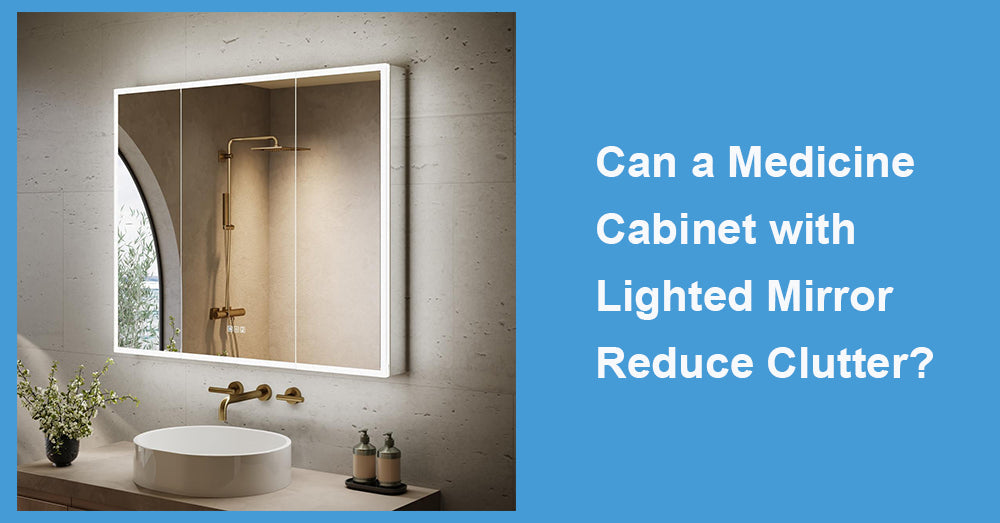
A medicine cabinet with lighted mirror can reduce clutter when its interior layout matches the items a household actually uses. It moves toothpaste, skin care, medicine, and grooming tools off the countertop while combining storage, a mirror, and task lighting in one wall area. The result is often a cleaner sink zone and fewer separate fixtures competing for space. Still, the cabinet will not organize a bathroom by itself. Shelf spacing, door configuration, installation depth, electrical planning, and daily habits determine whether the interior stays useful or becomes another crowded compartment.
How the cabinet reduces visible clutter
The clearest benefit is vertical storage. A standard mirror occupies valuable wall space but holds nothing. A mirrored cabinet uses the same location to create shallow shelves where small bottles remain visible and easy to reach. Because the storage is close to eye level, users are less likely to stack products in deep vanity drawers or leave them beside the faucet.
The integrated light can replace or supplement a separate fixture above the mirror. This does not always save electrical work, but it reduces the number of visual elements around the sink. Models with interior mirrors also let one person use the cabinet while the door is open without losing every reflective surface. An internal outlet may keep an electric toothbrush or shaver charging behind a closed door, provided the product and installation are approved for that use.
Storage capacity matters less than usable capacity.
A large interior does not guarantee better organization. Measure the tallest bottle, widest container, and depth of everyday items before comparing cabinets. Adjustable shelves are valuable because a shelf set for 7 in. bottles wastes less vertical room than a fixed compartment designed around an unknown product mix. Raised shelf edges or door bins can help prevent small items from tipping when the door moves.
Keep daily products between shoulder and eye level, backup supplies above, and less-used items below. Avoid filling every shelf. Leaving a small open area makes it easier to return items without rearranging the entire cabinet. Remove expired products and duplicate containers during installation; otherwise, the new storage simply hides the same clutter.
Recessed and surface-mounted cabinets solve different problems.
A recessed cabinet sits partly inside the wall, so it projects less into the room and usually looks more integrated. It can be a strong choice in a narrow bathroom, but the wall cavity must be checked first. Plumbing vents, supply lines, wiring, studs, fire blocking, and exterior-wall insulation may prevent or complicate the opening. Never cut framing or move utilities based only on the cabinet’s nominal size.
A surface-mounted cabinet attaches over the finished wall and avoids a large wall opening. Installation may be simpler, and the full cabinet depth can become storage. The tradeoff is greater projection. Verify that doors can open without hitting a side wall, sconce, faucet, or shower enclosure. For multi-door models, check the maximum hinge angle as well as the clearance needed for a comfortable 90-degree opening.
Good lighting helps the counter stay functional.
Integrated lighting is most useful when it illuminates the face evenly rather than acting as decorative backlighting alone. Compare stated lumens, color temperature, color rendering information, dimming behavior, and control location. Front lighting placed around or beside the mirror usually supports grooming better than light coming only from the ceiling, which can create shadows below the eyes and chin.
LEDs suit compact mirror designs because of their small size and long operating life. The U.S. Department of Energy notes that well-designed LEDs offer long life, resistance to breakage and vibration, and instant-on performance. Those characteristics are useful in frequently used bathroom lighting, although the complete cabinet’s warranty and replaceability still matter. (Source: U.S. Department of Energy, LED Basics.)

Electrical features require careful review.
A lighted cabinet is usually hardwired, while some models also contain outlets, USB ports, defoggers, clocks, or sensors. Confirm which functions operate together and which have separate controls. A product photo showing front and back lighting does not prove that each light can be controlled independently. Read the wiring diagram and installation manual before purchase.
Use a qualified electrician when required, follow the manufacturer’s instructions, and comply with local electrical codes. Confirm the product’s electrical rating and whether it is listed by a recognized testing organization. Do not route loose extension cords into the cabinet or assume an interior receptacle is suitable for every appliance. Electrical installation affects wall placement, so it should be planned before tile or drywall is closed.
Ventilation protects the cabinet and its contents.
A medicine cabinet sits in a humid room, often above a sink where splashes and condensation occur. Wipe water from mirror edges and nearby surfaces, keep wet items out of the cabinet, and follow the cleaning instructions for the mirror and finish. Avoid spraying cleaner directly into seams, switches, or electrical components.
ENERGY STAR advises running a bathroom ventilation fan during and for 15 minutes after showers and baths to help prevent moisture problems. Better humidity control supports the entire room, including cabinetry, stored packaging, and electrical components. (Source: ENERGY STAR, Low to No Cost Tips for Saving Energy at Home.)
Choose the cabinet around real routines.
Before ordering, list what must leave the countertop. Measure those items, then compare interior depth, adjustable shelf positions, door width, and outlet location. Check the cabinet’s exact overall dimensions and required wall opening. Also measure the distance to the faucet, backsplash, ceiling, side walls, and nearby doors. If several people use the bathroom, assign shelf zones before products move in.
A lighted medicine cabinet reduces clutter best when it gives frequently used items a specific, convenient home. Recessed installation saves projection, surface mounting can preserve wall structure, and well-planned lighting improves the usefulness of the sink area. The best model is the one that fits the wall, safely supports the required electrical features, and leaves enough open shelf space for everyday items to be returned without effort.








































Leave a comment
This site is protected by hCaptcha and the hCaptcha Privacy Policy and Terms of Service apply.