






















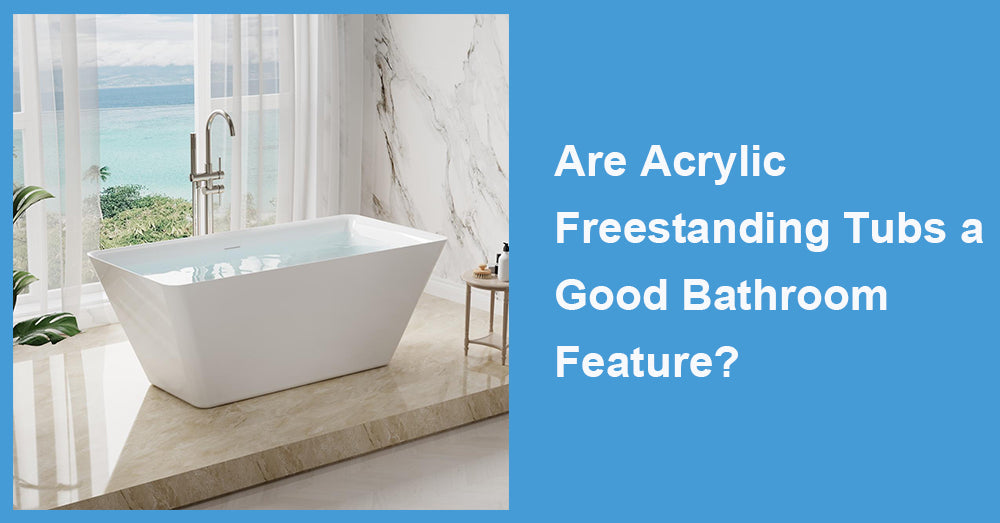
Against the backdrop of global bathroom spaces constantly evolving towards "comfort, personalization, and maximizing spatial value," acrylic freestanding tubs are gradually transforming from a symbolic product to a mainstream configuration that can be practically implemented. During this process, the market presence of acrylic freestanding tubes continued to increase. From developer model rooms to mid- to high-end residential projects, and even bathroom renovation plans for ordinary households, these product types are frequently mentioned and selected. However, frequent occurrences do not equate to 'optimal choice'. From an industry perspective, it is still worth further analysis whether acrylic freestanding tubes meet the necessary criteria to become an ideal bathtub solution.
1. The changes in the freestanding tube market have provided expansion space for acrylic materials
In the past, standalone bathtubs were more often associated with luxury homes, large master bathrooms, and high-budget projects, and were made of cast iron, artificial stone, or natural stone. But with changes in residential structures and the upgrading of consumer awareness, freestanding tubes are no longer just playing a "display role"; they are increasingly emphasizing actual usage frequency and spatial efficiency.
In this transformation, lightweight, scalable acrylic materials precisely meet the dual demands of the market for replicability and controlled costs. Compared with traditional heavy materials, acrylic is more suitable for current development structures, mainly consisting of apartments and row houses, transforming independent bathtubs from a "few options" to a "negotiable solution".
2. Material properties determine product expansion capability: the industrialization advantage of acrylic
From a manufacturing perspective, the widespread use of acrylic in freestanding tubes is not merely cost-driven, but a natural result of material properties and industrialization logic.
Acrylic has excellent thermoforming ability, allowing bathtubs to achieve more complex curve designs and thinner appearance ratios while ensuring structural integrity. This not only expands the design space of the product's appearance, but also makes the freestanding tubes visually lighter, reducing their "volume pressure" in the bathroom space.
This is particularly crucial for modern bathroom designs that aim for spatial transparency.
3. From the perspective of user experience evaluation: Is acrylic freestanding tubing truly comfortable
In industry discussions, the value of freestanding tubes ultimately needs to return to the user experience itself.
From actual feedback, high-quality acrylic freestanding tubes have stable performance in terms of insulation and tactile sensation.
Acrylic itself has low thermal conductivity, and with reasonable structural reinforcement, it can effectively delay heat loss and meet the needs of medium-duration baths. At the same time, its gentle, non-cold surface texture reduces discomfort for users when they first take a bath. These experiential details give acrylic bathtubs a practical advantage in bathroom scenes that emphasize "daily relaxation".
4. The friendliness of installation becomes the key to decision-making, rather than an additional condition
In practical project operations, installation conditions are often more decisive than appearance.
Compared to the high requirements for floor load-bearing and transportation conditions of stone or cast iron bathtubs, the lightweight characteristics of acrylic freestanding tubes significantly reduce the installation threshold.
This is particularly important in the renovation of old houses, upstairs bathrooms, or projects with limited space. For designers and construction parties, more controllable installation conditions mean lower project risks and transform freestanding tubes from "design ideals" to "feasible solutions".
5. Durability and maintenance issues: How does the industry view the long-term performance of acrylic
The controversy over the durability of acrylic has long been a topic of industry discussion.
From practical experience, high-quality acrylic freestanding tubes usually adopt a multi-layer reinforcement structure, effectively improving overall stability and impact resistance. Under regular use, its lifespan meets households' long-term needs.
More noteworthy is the advantage in terms of maintenance. Compared to materials prone to color bleeding or requiring special care, acrylic surfaces have lower cleaning thresholds and are repairable even for minor scratches. This "maintainability" is often more practical than absolute hardness in the long term.

6. Style adaptation ability: Why acrylic freestanding tubes are easier to integrate into modern bathrooms
From a spatial style perspective, the neutral material properties of acrylic freestanding tubes give them strong inclusivity.
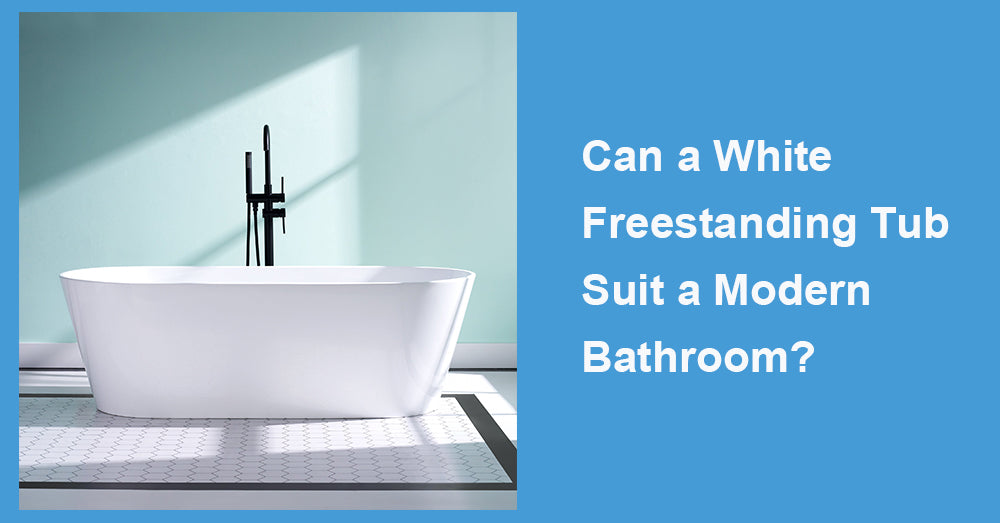
Whether it is a modern minimalist, light luxury style, or a natural, healing-oriented bathroom design, acrylic can exist as the main body of "not excessively competing" and form a balance with other materials.
This feature makes it easier to be accepted on the design side and reduces the cost of trial-and-error for consumers in style selection.
7. Rational judgment at the market level: whether it has practical significance as an "ideal choice."
From the perspective of the industry as a whole, the core competitiveness of acrylic freestanding tubes lies not in extreme luxury but in feasibility and stable performance.
They form a relatively balanced product positioning between price, design, installation, and user experience, avoiding the high costs of high-end materials and surpassing the functional limitations of basic bathtubs.
Therefore, these types of products are becoming increasingly "rational choices" in bathroom projects, rather than simply following trends.
Conclusion
In contemporary bathroom design and consumption logic, the ideal choice no longer means extreme specifications or a single label, but a comprehensive response to spatial conditions, usage needs, and long-term value. Acrylic freestanding tubes have gradually established their market position in this context, thanks to their excellent material properties, stable user experience, and higher implementation feasibility. For bathroom projects that hope to achieve quality upgrades under realistic conditions, they are not the only option, but undoubtedly a mature solution worthy of careful evaluation.










































Leave a comment
This site is protected by hCaptcha and the hCaptcha Privacy Policy and Terms of Service apply.