






















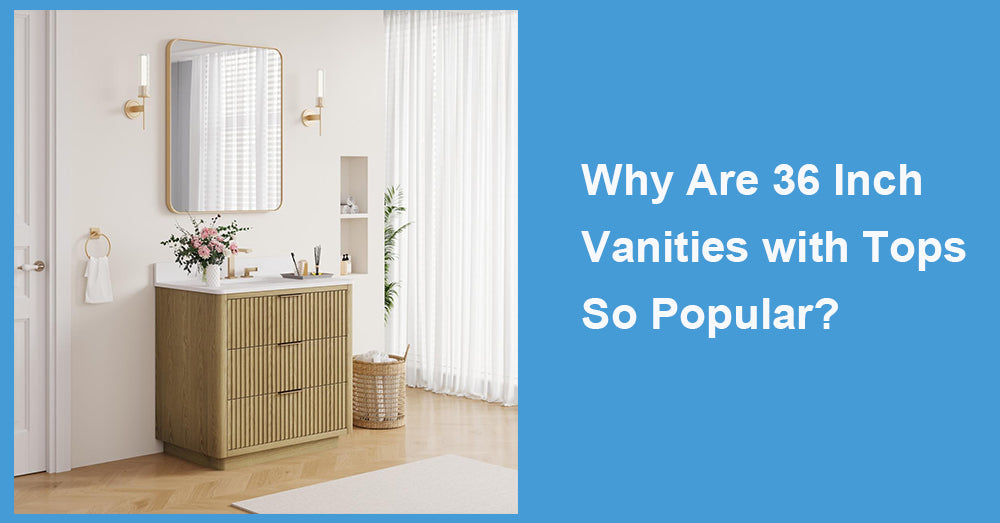
Among single-sink options, 36 inch vanities with tops occupy a useful middle ground: they offer meaningful counter space and storage, yet they can fit bathrooms where a 48-in. cabinet feels excessive. Including the countertop and sink also removes several separate purchasing decisions. No authoritative national survey ranks every vanity width, so “popular” should not be treated as a precise market-share claim. The appeal is better explained by how well this package balances size, convenience, choice, and renovation risk.
The Width Fits Many Everyday Bathrooms
A 36-in. vanity is large enough to feel comfortable in a guest bath or compact primary bathroom. It usually provides more breathing room around a single basin than a 24-in. or 30-in. model, without requiring the long wall associated with 48-in. and 60-in. cabinets.
That balance matters where the vanity shares space with a toilet, tub, or door. It can anchor the room while preserving a workable path. Nominal width is only a starting point; overhang, pulls, and trim may change finished dimensions.
A Top-Included Package Simplifies Coordination
Buying the cabinet, countertop, and sink as a coordinated package reduces measurements and finish decisions. The sink cutout is planned for the top, and the top is sized for the cabinet, avoiding custom fabrication.
It can also make budgeting clearer because major visible components appear under one product price. That does not mean every item in the photo is included. Buyers should verify the sink, backsplash, side splash, faucet, drain, and hardware separately. “With top” is not a universal bundle definition.
The Size Supports Useful Storage
At 36 in. wide, manufacturers have room to offer doors, drawers, or a combination of both. A drawer bank keeps smaller grooming items visible, while a door cabinet can accommodate plumbing and tall bottles. Offset sinks may preserve full-width drawers on one side; centered sinks create symmetry but can consume space behind the upper drawer fronts.
Storage quality matters more than drawer count. Compare usable dimensions, full-extension slides, adjustable shelves, and valve access. Some fronts are fixed. Inventory towels, paper goods, hair tools, and daily products before buying.
There Is a Style for Nearly Every Bathroom
The category spans Shaker, flat-panel, fluted, furniture-style, and wall-mounted designs. White suits transitional rooms, light wood supports Organic Modern, and dark tones complement Modern European interiors. Hardware can shift the same cabinet’s character.
Top choices widen the range further. White quartz and cultured marble keep the room bright, while veined surfaces add movement. Natural stone offers individual variation but may need product-specific sealing and care. Because the top is visually prominent, buyers should review large images or samples rather than relying on a small online color swatch.

Bathroom Renovation Trends Favor Vanity Investment
Vanities remain a significant part of U.S. bathroom projects. The 2025 U.S. Houzz Bathroom Trends Study reported that 55% of surveyed renovating homeowners selected either a fully custom vanity (33%) or a semi-custom vanity (22%). (Source: Houzz, “Homeowners Prioritize Accessibility to Future-Proof Bathrooms, Houzz Study Reveals.”) The study covered more than 1,700 U.S. respondents involved in recent, current, or planned bathroom renovations.
Those figures do not prove that 36 in. leads all widths. They show homeowners’ interest in vanity design and configuration. A space-efficient size with coordinated tops benefits from that attention, especially where a double vanity is unnecessary.
Stock Packages Can Reduce Decision Fatigue
A remodel involves tile, plumbing, lighting, mirrors, ventilation, and paint. A coordinated vanity package closes several choices at once by defining the finish, top, sink, and faucet-hole layout.
Stock availability may shorten the process versus custom fabrication, although lead time varies. Confirm inventory, carton count, delivery method, damage procedures, and parts availability.
Installation Can Be More Predictable
A matched top eliminates the need to specify a separate countertop size and sink cutout. However, “more predictable” does not mean effortless. Existing drain and supply lines must fit around the sink, shelves, and drawers. The faucet-hole configuration must match the selected faucet, and the backsplash must clear the mirror, outlet, or medicine cabinet.
Measure at floor, counter, and backsplash heights. Tape out cabinet depth and door or drawer swing. Confirm the drain, valves, baseboards, vents, and delivery route.
Materials and Moisture Still Need Attention
Convenient packaging does not replace material research. Check the stated construction of the frame, doors, panels, drawers, and back. If regulated composite wood is used, the U.S. EPA advises consumers to look for TSCA Title VI-compliant labeling on applicable products. (Source: U.S. EPA, “Frequent Questions for Consumers About the Formaldehyde Standards for Composite Wood Products Act.”)
Bathroom moisture also affects long-term performance. The EPA recommends effective bathroom ventilation that exhausts outdoors to remove unwanted moisture and help prevent mold and mildew. (Source: U.S. EPA, “Remodeling Your Home and Indoor Air Quality.”) Run the fan during bathing, wipe splashes, and repair plumbing leaks promptly. Inspect sink and backsplash joints according to the installer’s instructions.
When a Different Size or Separate Top Is Better
A narrow powder room may need 18–30 in., while a shared primary bath may benefit from a double vanity. Unusual plumbing, an alcove, vessel sink, or premium stone may justify buying the cabinet and top separately.
Accessibility also requires more than a width decision. Clear floor space, knee clearance, controls, and installation height may affect the design. When accessibility or major plumbing changes are involved, consult qualified professionals and verify applicable local requirements.
Final Conclusion
The popularity of 36-in. vanities with tops comes from practical compromise. They provide comfortable single-sink space, useful storage, broad style choice, and fewer separate components to coordinate. Their value depends on careful verification: measure the finished room, study the plumbing diagram, confirm package contents, and check materials and care requirements. When those details align, the format makes a complicated bathroom purchase feel far more manageable.









































Leave a comment
This site is protected by hCaptcha and the hCaptcha Privacy Policy and Terms of Service apply.