


















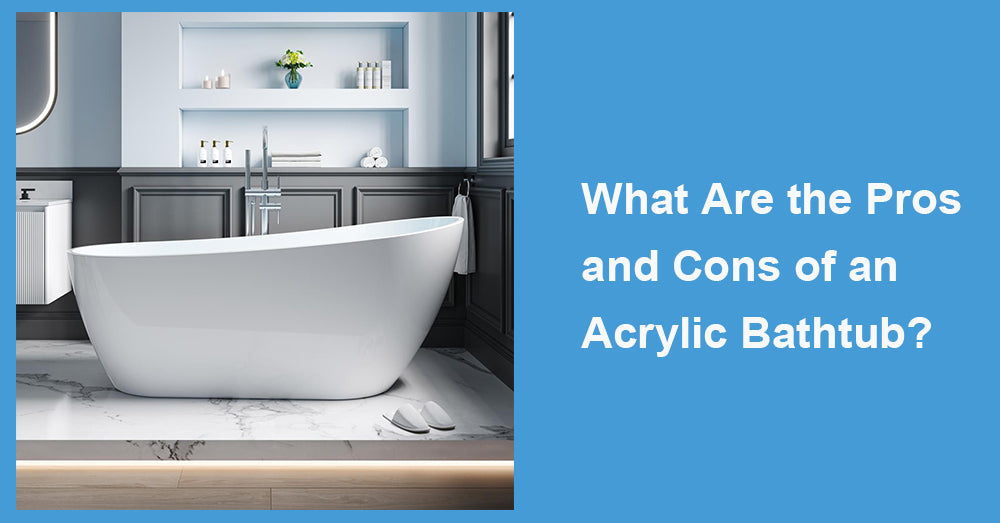
In recent years, acrylic bathtub have remained highly popular in the bathroom decor market and have become the preferred choice for most households when renovating their bathrooms. However, as consumers increasingly focus on material quality, installation details, and long-term user experience, the question "Is an acrylic bathtub good or not?" has become a common concern for the industry and users alike.
This industry news article will comprehensively analyze the advantages and disadvantages of Acrylic Bathtub based on market observations, product features, and user feedback, helping decorators reduce the risk of lightning strikes before making final decisions.
1. The Position of Acrylic Bathtub in the Market: Beneficiaries of Lightweight and Economical Trends
From the supply chain to the consumer end, bathroom products have gradually shifted from "heavy materials" to "lightweight but highly durable" over the past five years. The Acrylic Bathtub is the core representative of this trend.
It is widely favored by manufacturers and the decoration industry for its strong plasticity, light weight, and reasonable cost, whether it's freestanding, drop-in, or the modern popular oval design, acrylic material can be easily achieved.
Therefore, among traders, contractors, and home decoration consumers, Acrylic Bathtub has always been one of the most cost-effective bathtubs.
2. The main advantage of the Acrylic Bathtub is that it is popular for a reason
a. Lightweight design makes installation easier and more efficient
Compared to cast-iron bathtubs, acrylic bathtubs weigh significantly less, typically only 60-90 pounds.
This means:
Two people can easily carry it
When renovating an old house, there is no need to worry about the load-bearing capacity of the floor slab.
Can move up narrow stairs or through apartment corridors
For the construction team, the improvement in installation efficiency significantly reduces labor costs, making it more competitive in the market.
b. The surface is warm, and the touch is comfortable, making it an experience-friendly material
Acrylic material has good thermal insulation properties—
That is to say, it becomes warmer faster than a metal bathtub, allowing users to enter the bathtub without feeling cold.
This is a significant advantage for people who enjoy taking baths.
In consumer experience surveys, "tactile friendliness" is among the top three reasons consumers choose Acrylic Tub.
c. High plasticity brings more bathtub styling choices
Acrylic is a material that can be hot pressed, so its appearance design is almost unrestricted.
Almost all common shapes in the industry can be achieved with acrylic:
rectangle
oval
rotundity
Asymmetric design
Deep immersion ergonomic shape
For consumers, this means it is easier to find styles that match the size and style of the bathroom.
d. Easy maintenance, surface damage can be repaired again
Unlike ceramics or metals, acrylic surfaces can be repaired in the following ways even if there are scratches or minor damage:
polishing
Repair agent filling
Refurbished coating
This' recoverability 'is highly valuable for bathrooms that are frequently used in rental properties, Airbnb, or homes.
e. More affordable and budget-friendly option
Market pricing shows that the price of an Acrylic Bathtub is usually higher than:
Cast Iron Tub
Solid Surface Tub (Artificial Stone Bath)
Copper Tub
More easily burdened.
This makes acrylic bathtubs the preferred choice for most families, especially among those with limited budgets who want a modern appearance.
f. Good insulation performance, better bathing experience
Acrylic has low thermal conductivity, which helps to maintain water temperature for an extended period of time.
Consumer feedback indicates that the insulation effect of Acrylic Tub is better than that of steel bathtubs, and it also makes water usage more efficient.
3. Disadvantages of Acrylic Bathtub: Why is it often criticized for "insufficient durability"?
Despite the apparent advantages of the Acrylic Tub, controversy has always surrounded it. Here is an analysis of the most common drawbacks in the industry.
a. The surface is prone to scratches and requires careful use
Acrylic material is relatively soft, so it is more prone to scratching when encountering the following items:
Hard plastic bucket
Metal cleaning tools
Pet claws
Rough frosted products
Although the surface can be repaired, frequent maintenance still increases long-term costs.
b. The strength is not as good as high-end materials such as cast iron and artificial stone
An Acrylic Tub typically requires fiberglass reinforcement, and long-term use may result in the following situations:
Slightly curved bottom
Thinning of areas subjected to high stress
intensity decrease
For overweight individuals or high-frequency usage scenarios, the material support may be slightly insufficient.
c. Easy to be affected by cleaning agents, requiring the use of a mild formula
Some cleaning agents, especially strong acids and those containing abrasive particles, can corrode the surface of acrylic, causing it to frost or lose its luster.
Therefore, maintaining the Acrylic Tub should follow:
Use mild soap
No need for steel wire balls
Do not use cleaning agents containing ammonia or solvents
This is not "worry-free" enough for some users.
d. Easy to turn yellow over time (depending on manufacturing quality)
Poor quality acrylic Tub may be due to:
The impact of ultraviolet radiation
Surface oxidation
Insufficient coating quality
And produce slight yellowing.
Although high-quality acrylic is usually less prone to this problem, product quality on the market varies widely.
e. Less environmentally friendly than natural materials
Acrylic belongs to a type of plastic material, and some consumers are concerned about its environmental performance, which is not as good as:
Cast Iron
Stone Resin
Copper
Porcelain
Although the market is also promoting more environmentally friendly acrylic formulas, there are still differences in overall evaluations.
4. Which bathroom decoration is suitable for an Acrylic Bathtub? Industry trends provide answers
According to current decoration needs, the Acrylic Tub is particularly suitable for the following scenarios:
a. Renovation of small bathrooms and apartments
Lightweight+easy construction saves a lot of costs during the decoration process.
b. Families pursuing modern style
Clean appearance, soft lines, suitable for minimalist, Nordic, and Japanese styles.
c. People with a limited budget but hoping to improve the quality of the bathroom
In the list of "most cost-effective bathtub materials", Acrylic consistently ranks in the top two.
d. Users who require ergonomic design
Strong plasticity can achieve a more comfortable bathing experience.
5. The industry outlook of Acrylic Bathtub: it will continue to dominate in the next five years
Market data shows that:
Domestic and foreign decoration brands continue to expand their acrylic bathtub production lines
Lightweight materials become the focus of future bathroom product research and development
Freestanding Acrylic Tub has become a mainstream demand
On the consumer end, users are increasingly paying attention to:
appearance design
practicality
Installation efficiency
Cost and maintenance difficulty
All of these perfectly match the characteristics of an Acrylic Tub.
Therefore, it will remain one of the core materials in the bathroom renovation market for the next five years.

Conclusion: Acrylic Bathtub is not perfect, but it is bright enough
The advantages of an Acrylic Bathtub are:
light
beauty
Good installation
Good maintenance
Rich styling options
Affordable price
The disadvantages include:
Durability is not as good as high-end materials
easily scratched
Need gentle cleaning
Low-priced products may turn yellow
But after considering these factors, the industry positioning of Acrylic Tub is obvious:
It's not the most luxurious choice, but it's the one that best meets the needs of the masses.
For most families, an Acrylic Bathtub is a modern bathroom solution that is comfortable to use, easy to install, and easy to maintain.




































Leave a comment
This site is protected by hCaptcha and the hCaptcha Privacy Policy and Terms of Service apply.