
















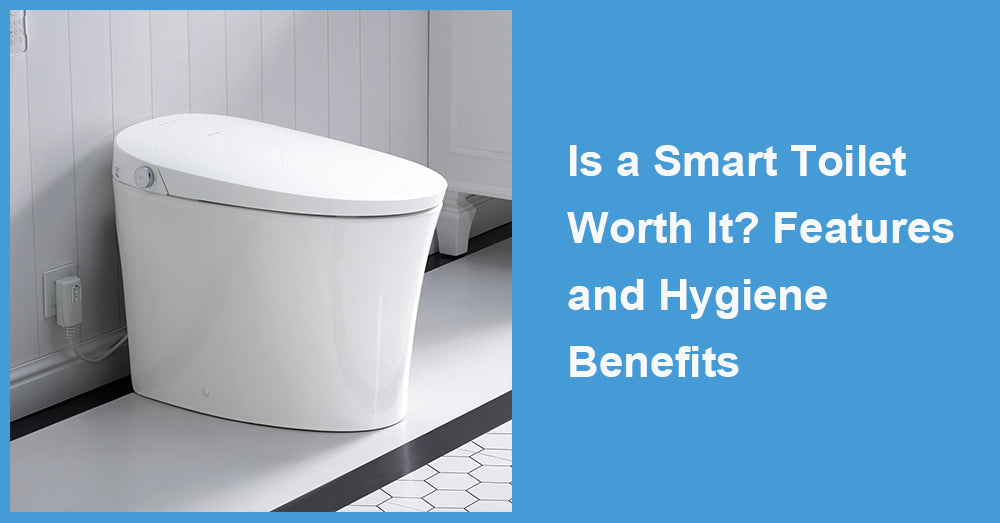
Against the backdrop of continuous upgrades in bathroom technology, smart toilet are gradually transitioning from conceptual products to mainstream home configurations. The functions of automatic flushing, warm water cleaning, seat heating, and the sterilization system have significantly changed the traditional toilet experience. But is the smart toilet really worth investing in? From the perspectives of hygiene control, water-saving efficiency, comfort experience, and long-term maintenance costs, it is no longer just a "technological upgrade", but a systematic optimization around health and quality of life.
1. Health Upgrade: Reduce Contact and Bacterial Transmission
Traditional toilets require multiple manual touches during use, such as lifting the lid and flushing. Industry hygiene research shows that reducing hand contact can reduce the risk of bacterial cross-transmission by over 30% in both public and household environments.
Smart toilets are usually equipped with automatic lid opening and flushing, greatly reducing the need for manual touchpoints. Meanwhile, the warm-water cleaning system has higher cleaning efficiency than simply wiping with paper towels. Data show that rinsing with warm water is more effective at removing residues than wiping with dry paper and can reduce paper usage by about 70%.
Some models are also equipped with nozzle self-cleaning and ultraviolet sterilization technology. In the experimental environment, the ultraviolet sterilization module achieved a bacterial inhibition rate of over 99%, which is particularly important for households that prioritize hygiene standards.
2. Water efficiency: the long-term value of water-saving systems
Modern smart toilets often use efficient flushing systems, with a common single flush volume of 1.28 gallons or 1.6 gallons. Compared to the old 3.5-gallon flushing structure, the water-saving ratio can exceed 50%.
In daily-use scenarios for a family of four, an efficient flushing system can save thousands of gallons of water annually. With the continuous improvement of water-saving standards, low-water-use structures have gradually become mainstream.
From an environmental perspective, reducing paper and water use gives smart toilets significant long-term resource-saving advantages, aligning with the development direction of sustainable living concepts.
3. Comfortable experience: temperature control and personalized adjustment
The comfort functions of smart toilets are mainly reflected in the following aspects:
Seat heating, with a temperature adjustment range typically between 80 °F and 100 °F
Warm-water cleaning, water temperature, and pressure can be adjusted at multiple levels.
Warm air drying reduces paper dependence.
Night soft lighting enhances safety.
Industry surveys show that over 60% of households that have already used smart toilets are reluctant to return to traditional toilet structures. Especially in winter environments, the heating seat ring significantly improves comfort.
For older people or people with limited mobility, automatic flushing and contactless operation can reduce bending movements and improve safety during use.
4. Size and installation compatibility
Standard smart toilets typically have a length between 26 inches and 28 inches and a width of approximately 15-18 inches. Before installation, the distance between the sewage outlet and the center of the wall should be confirmed. The common specification is 12 inches, and some models support 10-inch or 14-inch structures.
Meanwhile, smart toilets need to reserve power interfaces. The power supply is usually located about 12 inches behind the toilet.
In the upgrade project, smart toilet seats can also be chosen as an alternative, compatible with traditional toilet seat structures.
5. Improvement of Health and Quality of Life
The smart toilet reduces friction and skin irritation through a warm-water cleaning system, making it especially suitable for postoperative recovery or for people with sensitive skin.
Data shows that reducing repetitive standing and bending movements can lower the risk of falls by over 20% in elderly households. In addition, the constant-temperature water flow and warm-air function help improve overall comfort during use.
In scenarios where family members are diverse, the multi-level water pressure and temperature memory function can achieve personalized settings and improve usability.
6. Energy consumption and maintenance costs
Smart toilets require electrical power, but modern models generally offer energy-saving modes. Standby power consumption is usually less than 1 watt, and heating power is automatically reduced when not in use.
The data show that, under standard household usage, the annual electricity consumption cost accounts for a lower proportion of household electricity bills. It is usually recommended to replace the water filtration system every 6-12 months to ensure water quality and system stability.
The design lifespan of electronic systems is usually over 10 years, and high-quality products can operate stably for longer.
7. Is it suitable for every family?
Smart toilets are particularly suitable for:
Families that value hygiene standards
There are elderly members or those with special care needs.
We are currently upgrading the overall bathroom system.
Pursuing water-saving and environmental protection solutions
If the budget or space is limited, you can choose a simplified version or a smart toilet seat as a transition.

8. Conclusion
From hygiene control and water-saving efficiency to comfort experience and intelligent functions, smart toilets have gradually become an important direction for bathroom upgrades. Although the initial investment is higher than that of traditional toilets, it offers significant long-term benefits, including greater water conservation, reduced paper use, and improved health and comfort.
For families seeking a higher quality of life and higher hygiene standards, smart toilets are not only a technological feature but also an upgraded choice for lifestyle. After a reasonable evaluation of spatial conditions, drainage structures, and power reserves, it often delivers a stable, comfortable user experience that lasts for many years.














Leave a comment
This site is protected by hCaptcha and the hCaptcha Privacy Policy and Terms of Service apply.