






















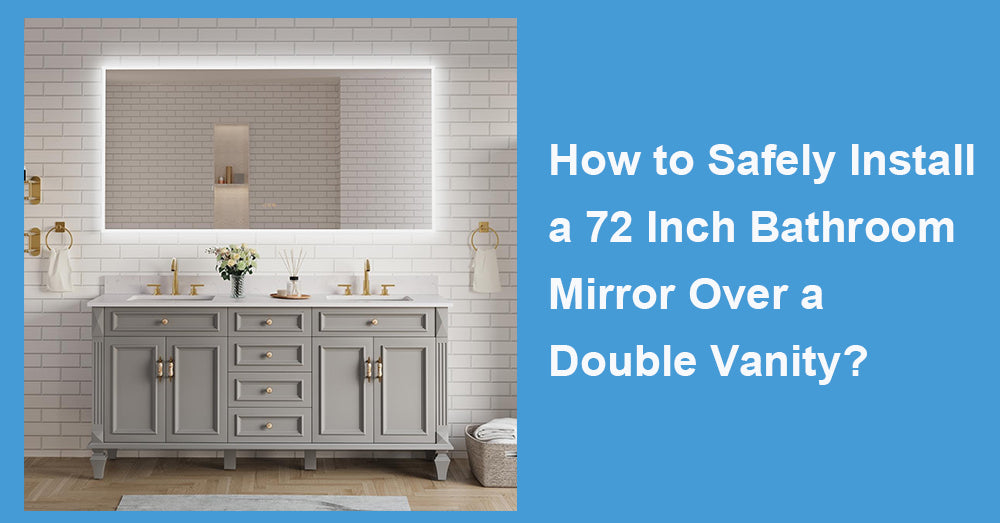
In modern American bathroom design, an oversized 72 inch bathroom mirror paired with a double vanity has become a mainstream feature. This combination not only enhances spatial transparency but also significantly strengthens visual hierarchy and practicality. However, due to the mirror's large size and high weight, improper installation can easily lead to detachment, wall damage, and even safety accidents. Therefore, how to scientifically, safely, and standardly install 72-inch bathroom mirrors has become a highly concerned topic in the home decoration industry.
This article combines the construction standards of the decoration industry, mainstream DIY installation guidelines, and professional construction experience to systematically analyze a safe installation plan for 72-inch double-basin bathroom mirrors.

1. Why do 72-inch bathroom mirrors have higher installation requirements?
Unlike conventional 24-36 inch mirrors, 72 inch bathroom mirrors typically have the following characteristics:
Heavyweight (usually between 44-88 lbs)
Wide force bearing area
High load-bearing requirements for walls
Extremely high requirements for horizontal and vertical accuracy
The decoration industry generally believes that large bathroom mirrors should use a multi-point load-bearing structure, and relying solely on expansion bolts for fixation is unsafe. The professional installation guide clearly states that large bathroom mirrors should be fixed to at least one wall stud position and used in conjunction with load-bearing brackets or French hanging systems.
2. 72-inch bathroom mirror standard installation height and position planning
1. Vertical height standard
According to the recommendation of the Home Decoration Association (NKBA):
The distance between the bottom edge of the mirror and the tabletop is 5-10 inches.
The center height of the mirror is about 55-65 inches above the ground.
The top should avoid interference from lighting fixtures and hanging cabinets.
This height accommodates most adult line-of-sight heights, ensuring comfortable use on both sides of the double basin.
2. Horizontal centering principle
For a dual basin layout, during installation:
Based on the centerline of two water basins
The overall horizontal center of the mirror body
Maintain symmetry between the left and right margins.
Professional construction videos suggest that precise measurement and marking of lines must be carried out before installation to avoid deviation or tilting after installation.
3. Core safety principle: It is necessary to find the wall keel
Why must it be fixed to the Stud?
In American residential buildings, gypsum board itself has almost no load-bearing capacity. If large-sized mirrors are fixed only by expansion pipes, long-term load-bearing will lead to:
Wall cracking
Loose fixing point
The overall risk of mirror dropping increases
Industry standard requirements:
At least one main fixing point must be anchored to a wooden or metal keel.
If a suitable keel position cannot be found, a high-load-bearing metal wall anchor and a decentralized multi-point load-bearing structure must be used to distribute the weight and pressure.
4. Comparison of Three Mainstream Security Installation Solutions
Option 1: French Cleat hanging system (highly recommended)
This is currently the most commonly used solution for high-end bathroom mirrors:
Fix a metal Z-shaped hanging strip on the wall.
Mirror back pre-installed with a matching hanging strip.
The mirror body can be directly "inserted" into the wall support structure.
Advantage:
Large force-bearing area
High installation accuracy
Can be fine-tuned in the later stage
Highest security level
The industry generally believes this solution should be given priority for mirror bodies larger than 72 inches.
Option 2: Bottom load-bearing track+top fixing clip
Suitable for borderless oversized mirrors:
The bottom U-shaped metal track bears the main weight.
The upper metal clip prevents tipping over.
Advantage:
Strong stability
Suitable for a hotel-style large area mirror wall
Option 3: Heavy-duty expansion bolts+multi-point fixation
Suitable for special walls where the keel cannot be located:
Use a metal hollow wall anchor (toggle bolt)
Set at least 4-6 fixed points.
Can be combined with the backboard to enhance support
This scheme is common in DIY scenarios, but requires high construction accuracy.
5. Collaboration between two people is a basic safety principle
The DIY safety regulations explicitly emphasize:
When installing a large bathroom mirror, at least two people must collaborate to complete it.
The reasons include:
The weight of the mirror is large, making it difficult for a single person to lift it stably.
Simultaneous alignment is required for the positioning installation.
Prevent the mirror from slipping and causing rupture or injury.
6. Key points for the coordinated design of lighting and the mirror body
1. Reserved space for lighting fixtures
Before installing a 72-inch bathroom mirror, it is necessary to plan ahead:
Top light strip position
Distance between left and right wall lamps
Prevent lamps from blocking the mirror surface.
2. Trend of integrated LED bathroom mirrors
More and more families are choosing integrated bathroom mirrors with LED lighting and defogging functions, which have the following advantages:
Simplify installation structure
Reduce wiring for external lighting fixtures.
Enhance overall aesthetics
But such products require advanced planning of power lines and junction box locations.
7. Common installation errors of 72-inch bathroom mirrors
Only fix with a plastic expansion tube.
Not using a level caused the mirror to tilt.
Single-person forced installation.
Failure to plan power and light positions in advance
The installation height is either too high or too low, affecting the comfort of use.
These errors often lead to increased rework costs and even cause safety accidents.
8. Industry Trend: Moving from "Can Install" to "Structural Safety+Visual Aesthetics."
With the development of high-end bathroom customization, 72-inch and larger bathroom mirrors are no longer just decorative; they are structural components. The installation standard has also changed from "fixed only" to:
Four in one: structural safety, visual proportion, electrical coordination, and user experience.
Conclusion: Safety is the first design element of high-end bathroom mirrors
The 72-inch double-basin bathroom mirror is not only the visual core of the space but also a frequently used component. Standardized installation not only determines aesthetics but also directly affects home safety.
Whether it is DIY installation or entrusted to a professional construction team, strict adherence to industry standard procedures is necessary to achieve truly:
Safe, durable, beautiful, and comfortable.









































Leave a comment
This site is protected by hCaptcha and the hCaptcha Privacy Policy and Terms of Service apply.