






















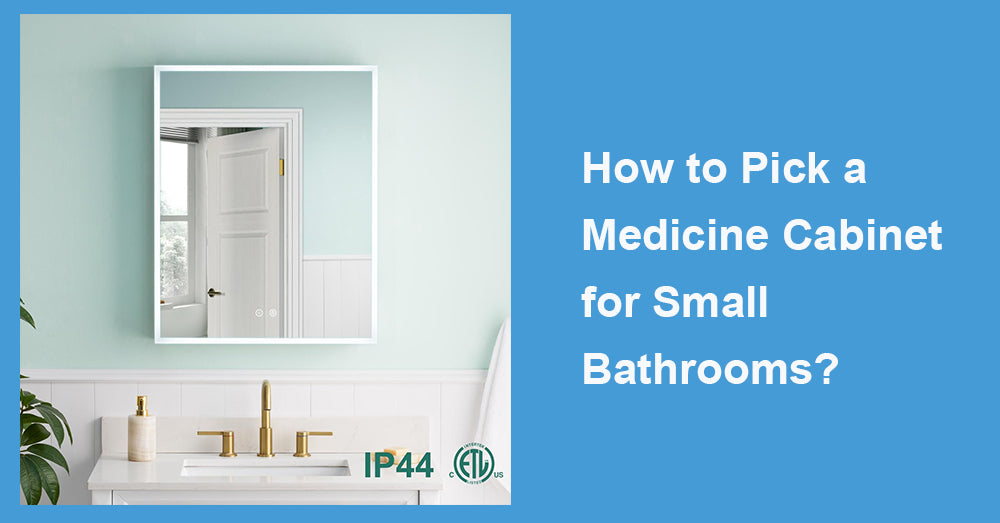
In the renovation process of compact bathrooms, the medicine cabinet is often one of the core components that are most easily underestimated, yet deserve careful planning. Unlike large spaces, every inch of wall space and depth in small bathrooms directly affects the user experience. Industry research shows that in bathrooms with limited space, the choice of a mirror cabinet not only determines storage capacity but also significantly affects the permeability of the space, the smoothness of circulation, and daily use efficiency. Therefore, selecting the right mirror cabinet for a small bathroom is essentially a professional decision about "space management".
1. The core contradiction of a small bathroom: storage needs versus a sense of spatial oppression
Small bathrooms generally face two seemingly contradictory needs: on the one hand, the quantity of toiletries, grooming tools, and cleaning supplies does not significantly decrease as the space becomes smaller; on the other hand, any prominent structure can amplify the sense of spatial oppression. Industry data shows that in compact bathrooms, when the depth of wall-mounted equipment exceeds a specific range, users' subjective perception of narrow space is significantly enhanced.
This is also why when choosing a mirror cabinet for a small bathroom, it is essential to address both issues of "capacity" and "not appearing space-consuming", rather than focusing on only one of them.
2. Dimensional control is the top priority
In a small bathroom, the choice of mirror cabinet size is far more important than its appearance style. The width of standard small washbasins typically ranges from 24 to 36 inches. If the width of the matching mirror cabinet is set close to or slightly narrower than the countertop width, it will visually coordinate better and not disrupt the original proportional relationship.
In terms of height, the mirror cabinet is mostly 20 to 28 inches tall. This range not only meets the visual needs for daily standing use but also avoids creating a sense of oppression in the vertical space. Depth is the most easily overlooked yet crucial parameter. For small bathrooms, it is often better to keep the depth of the mirror cabinet to 4–5 inches, providing basic storage without significantly occupying usable space.
3. The advantages of embedded design in small spaces
When conditions permit, built-in mirror cabinets are often the preferred choice for small bathrooms. By embedding the cabinet into the wall structure, the mirror cabinet's front is almost flush with the wall, significantly reducing its visual presence. Industry experience shows that, under the same external visual effect, the actual usable internal space of built-in mirror cabinets is often superior to that of wall-mounted designs.
Of course, the embedded structure demands higher requirements for wall conditions and construction stages, and planning usually needs to be completed at the early stage of renovation. If this stage is missed and adjustments are forced later, it may increase costs and construction risks.
4. How to avoid "looking bulky" in wall-mounted mirror cabinets
When an embedded solution is not feasible, a wall-mounted mirror cabinet can still be adapted to small bathrooms through design choices. The key lies in controlling the thickness of the cabinet body, the proportion of the frame, and the way the door opens. Narrower frames and simpler exterior lines effectively reduce the sense of bulk.
In terms of opening methods, swing doors remain the mainstream choice. However, in small spaces, the door panel's opening angle and the handle design are critical. Some mirror cabinets use handle-free or concealed-opening mechanisms, which can reduce the risk of bumping and make the front appearance cleaner.
5. The internal structure is more important than whether it can accommodate more
The core objective of the interior design of the small bathroom mirror cabinet is not simply to maximize capacity, but to enhance the unit's utilization efficiency. The adjustable shelf is a convenient feature, as it can be adjusted to accommodate items of varying heights, preventing wasted space.
Industry research shows that in small bathrooms, a well-designed internal partition can significantly improve storage efficiency without increasing the external volume. This improvement is often more effective than simply increasing the depth.
6. The influence of mirror surfaces and lighting on spatial perception
The mirror itself plays a vital role in "amplifying space" in a small bathroom. High-quality mirrors can reflect light more realistically, reduce visual distortion, and make the space appear brighter and more transparent. Multi-layer silver-plated mirrors have more potent antioxidant properties and are less prone to edge issues that affect appearance over the long term.
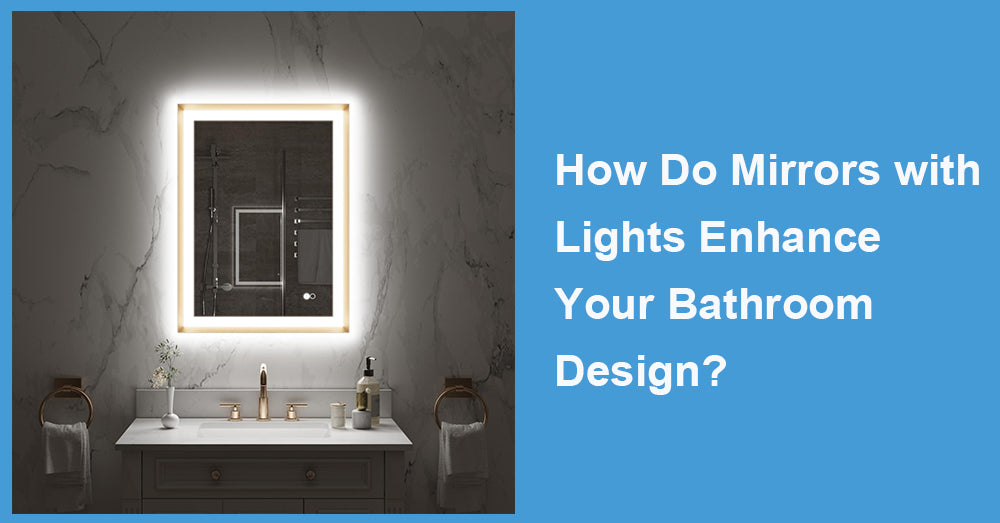
In terms of lighting, mirror cabinets equipped with soft LED light sources are particularly valuable in small bathrooms. Proper light distribution can reduce shadow areas, making the overall space appear more spacious. The color temperature is usually concentrated in the 4000K–5000K range, which is closer to natural light and helps enhance comfort during daily use.
7. Multi-function integration requires "restraint" as a prerequisite
Configurations such as built-in sockets, anti-fog functionality, and sensor lighting can indeed enhance the experience in small bathroom mirror cabinets, but only if these features do not compromise core dimensions and safety. Bathrooms are high-humidity environments, and any electrical integration should prioritize moisture-resistant structures and long-term stability.
For small bathrooms, the selection of functions should follow the principle of "high-frequency priority". Only tasks that are truly used every day are worth occupying limited interior space.

8. View choices from the perspective of long-term use rather than short-term transformation
Mirror cabinets are fixed components with high replacement costs, and once installed, they are difficult to adjust later. Industry data shows that high-quality mirror cabinets, when used and maintained correctly, often have a lifespan of over ten years. Compared to frequently replacing products with unsuitable sizes or insufficient quality, making a rational choice once and for all holds greater long-term value.
From an industry perspective, the successful selection of a small bathroom mirror cabinet does not lie in "accommodating the most items", but rather in achieving a balance between storage, usage, and visual perception within a limited space. This balance is precisely the most professional aspect of compact bathroom renovation.









































Leave a comment
This site is protected by hCaptcha and the hCaptcha Privacy Policy and Terms of Service apply.