






















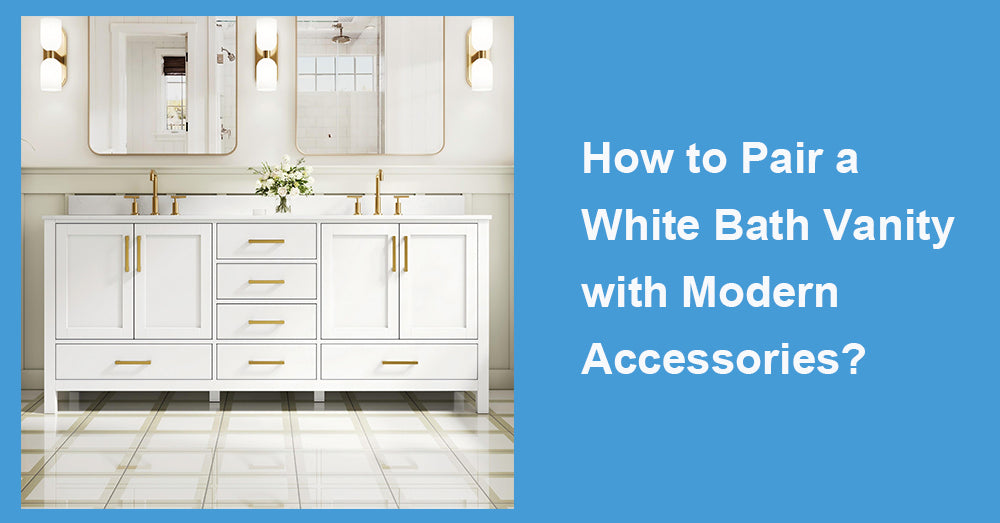
A white bath vanity gives a bathroom one of the easiest foundations for modern styling because it works with both warm and cool finishes without making the room feel visually heavy. Current renovation data still shows strong demand for white: Houzz reports that white accounts for 20% of upgraded vanity colors, while white countertops lead at 48%. At the same time, contemporary and modern bathroom styles continue to gain ground. The key is to avoid treating white as a blank space that needs to be filled. A stronger approach is to introduce a few carefully selected accessories that add contrast, texture, and function.
1. Start With a Consistent Metal Finish
Faucets and cabinet hardware are the easiest accessories to use for defining the vanity style. Matte black creates a sharper architectural look, while brushed nickel feels quieter and satin brass adds warmth.
NKBA’s 2026 Bath Trends Report shows that matte faucet finishes are favored by 54% of surveyed professionals, followed by brushed finishes at 51% and satin at 46%. Polished finishes trail at 39%.
On a 30- or 36-inch vanity, smaller pulls often keep the cabinet visually clean. Wider 48- or 60-inch vanities can support longer linear hardware without feeling oversized.
Industry judgment: modern bathrooms increasingly use restrained metal finishes to frame white cabinetry rather than relying on decorative cabinet details.
2. Pair the Vanity With a Simple Mirror
The mirror should reinforce the proportions of the vanity instead of competing with it.
Kohler recommends choosing a mirror that is narrower than or approximately the same width as the vanity. It also advises allowing at least 3 inches of clearance above the faucet and below surrounding lighting. Popular mirror widths include 24, 34, and 40 inches.
For a 36-inch vanity, a mirror around 30 to 34 inches wide can create balanced margins. Thin black frames add contrast, while brushed metal or frameless mirrors keep the look softer.
Industry judgment: a modern mirror should clarify the vanity zone rather than dominate the entire wall.
3. Use Lighting as a Functional Accessory
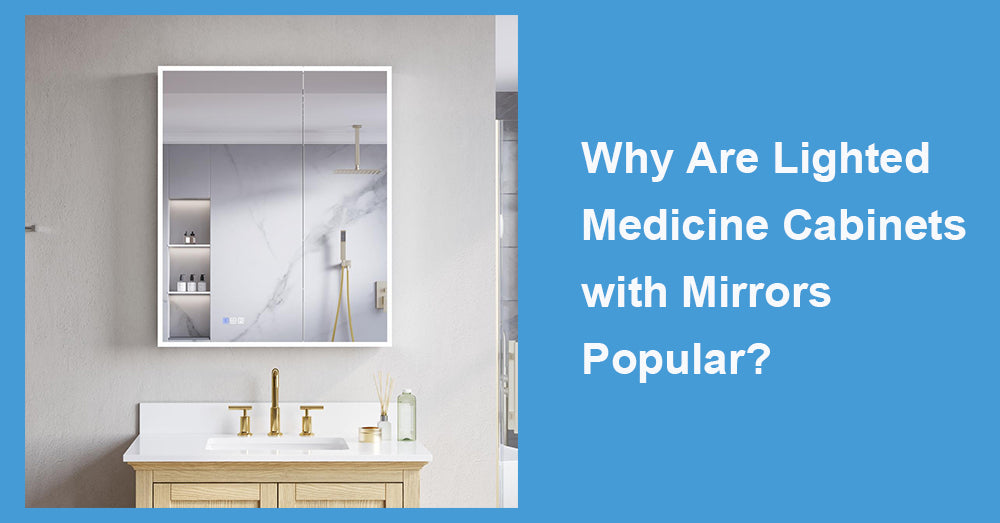
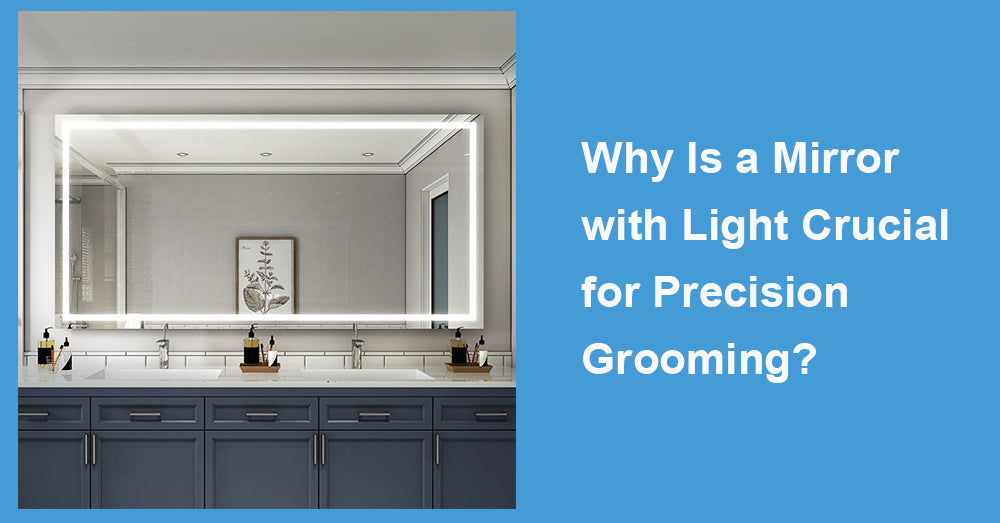
Lighting has become one of the most important parts of contemporary vanity design. Houzz reports that 82% of bathroom renovations include lighting upgrades, while lighted mirrors have risen to 22%.
NKBA data reinforces that direction: 91% of surveyed professionals identify lighting quality as a top bathroom priority, and 92% believe task lighting should always be included in the primary bath.
A pair of slim sconces can work beside a wider mirror, while an integrated lighted mirror may be more practical above a compact 30- or 36-inch vanity.
Industry judgment: lighting should be treated as part of the vanity system, not as an accessory selected after every other finish is finalized.
4. Introduce Warmth Through Wood
A modern white bathroom does not need to be entirely white. Adding natural wood through a mirror frame, stool, floating shelf, or storage tray can keep the space from feeling too clinical.
This direction aligns with broader bathroom trends. NKBA reports that wood-faced vanities are supported by 62% of industry respondents, ahead of painted cabinetry at 53%. Organic and natural design also receives 65% support.
Light oak works particularly well with white cabinetry because it adds warmth without introducing heavy contrast. Walnut can create a more dramatic accent when used in smaller amounts.
Industry judgment: natural texture is becoming one of the easiest ways to make clean modern bathrooms feel more residential.

5. Keep Countertop Accessories Minimal
A white vanity looks most modern when the countertop has enough open space to remain visually calm.
Limit visible accessories to items that are used frequently. A soap dispenser, small tray, folded hand towel, or compact container may be enough. Extra toiletries should move into drawers or a medicine cabinet.
This matters because storage is becoming more customized. NKBA highlights configurable vanity modules, custom organizers, charging stations, and dedicated compartments for makeup, medications, and grooming tools.
On a 24- or 30-inch vanity, countertop editing becomes especially important because the sink already consumes much of the usable surface.
Industry judgment: modern styling increasingly depends on concealed organization rather than adding more decorative objects.
6. Add Color Through Smaller Elements
White cabinetry allows color to be introduced without making a long-term commitment.
Sage towels, muted green accessories, beige tile, or warm tan textiles can soften a white vanity. NKBA’s current research shows that 96% of professionals expect neutrals to dominate bathroom palettes, with off-white at 58%, light brown and tan at 54%, and white at 40%. Sage is also expected to remain influential at 64%.
This makes a white vanity particularly adaptable. Accessories can change as preferences evolve while the cabinet remains relevant.
Industry judgment: the strongest modern color schemes keep permanent fixtures neutral and use smaller replaceable elements for personality.
7. Choose a Faucet That Adds Both Style and Efficiency
The faucet is one of the most visible accessories on a white vanity. Houzz reports that faucets are replaced in 87% of bathroom renovations, making them the most frequently upgraded bathroom feature.
Single-handle and single-hole designs often reinforce a cleaner modern look, although the faucet must match the top’s drilling pattern.
Efficiency can be considered at the same time. EPA states that WaterSense-labeled bathroom sink faucets use no more than 1.5 gallons per minute and can reduce flow by at least 30% compared with the standard 2.2-gallon-per-minute rate without sacrificing performance.
Industry judgment: the best modern accessories increasingly combine visual simplicity with measurable performance.
8. Use Texture Instead of Excess Decoration
Modern does not have to mean flat or cold. Texture can come from ribbed glass, woven baskets, linen towels, matte ceramic accessories, or softly veined stone.
Large-format tile can also provide a quieter background. NKBA reports that 80% of professionals expect large-format flooring to remain popular, while 89% anticipate preferences for fewer or smaller grout lines.
These surfaces allow the white vanity to remain visually clean while preventing the room from feeling unfinished.
Industry judgment: texture is replacing ornament as one of the main ways modern bathrooms create depth.
9. Keep the Overall Palette Controlled
The most successful white vanity combinations usually rely on a limited material palette.
For example, a white bath vanity can be paired with a lightly veined countertop, brushed nickel faucet, light oak mirror, warm white walls, and one muted green accent. Another approach may use matte black fixtures, a frameless mirror, and pale gray tile.
Avoid adding several competing metals, wood tones, and accent colors in a compact bathroom.
NKBA reports that transitional and timeless design leads projected bathroom styles at 70%, followed by organic and natural at 65% and contemporary, modern, and minimalist at 57%.
Industry judgment: modern bathrooms increasingly look sophisticated because fewer materials are coordinated more carefully.
10. Conclusion
Pairing a white bath vanity with modern accessories works best when the vanity remains the calm foundation and the surrounding details provide controlled contrast.
Start with one primary metal finish, choose a mirror that matches the vanity scale, layer useful lighting, and bring in warmth through wood or muted natural colors. Keep countertop accessories limited and use storage to reduce visible clutter.
A 30- or 36-inch vanity benefits from especially restrained styling, while 48- and 60-inch models can accommodate larger mirrors and stronger hardware without feeling crowded.
White continues to work because it leaves room for change. Faucets, mirrors, lighting, towels, and decorative pieces can all be updated later without replacing the cabinet itself. That flexibility is what keeps a well-styled white vanity relevant in modern bathroom design.









































Leave a comment
This site is protected by hCaptcha and the hCaptcha Privacy Policy and Terms of Service apply.