
















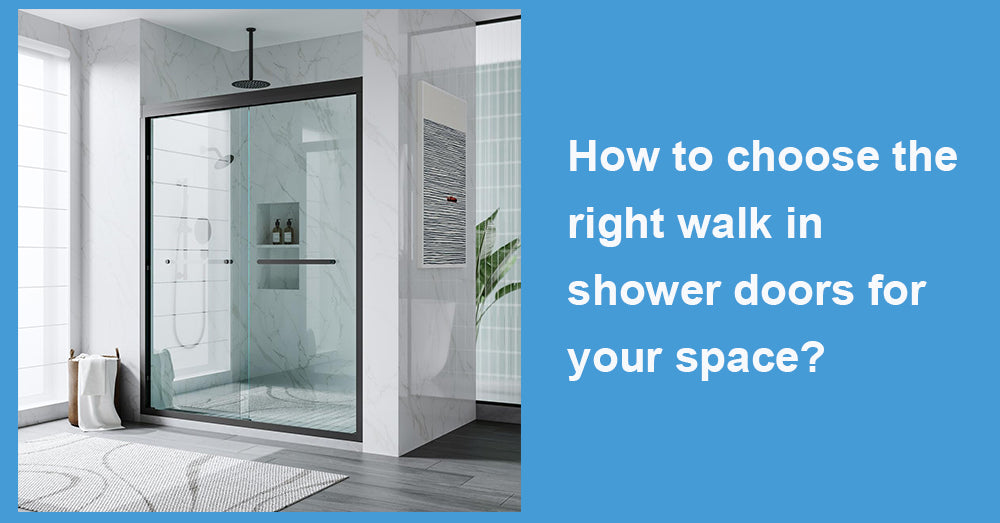
In recent years, the trend of upgrading bathroom space has been accelerating, and the Walk in shower doors has gradually become the mainstream configuration in various residential buildings. From a simpler appearance to a more convenient user experience, the choice of walk-in Shower Doors affects the practicality and visual impact of the space as a whole. However, facing various material, structure, and size standards in the market, choosing a Walk-in Shower Door that is suitable for their own layout has become a core issue for many people when renovating or installing new ones.
1. Accurately measuring spatial dimensions: the key to determining door type selection
Before making a purchase, it is crucial to clarify the dimensions of the shower opening, including width, height, and the range of motion. The width of mainstream walk-in Shower Doors is mainly concentrated in the 22-36-inch range. In comparison, larger doors typically expand to 48 inches or wider, suitable for spacious shower rooms. According to a survey of the residential decoration market, over 68% of modern bathroom renovation projects use doors at least 30 inches wide to ensure comfortable entry and exit (source: Houzz.com).
In terms of height, most walk-in Shower Doors are set at 70-76 inches to better control moisture within the shower area. If the space has a higher floor height or is equipped with a top spray system, some brands also offer styles that can be expanded to 80 inches or more to enhance overall immersion.
2. Material and glass thickness: core indicators affecting safety and service life
Material is one of the most commonly prioritized factors in walk-in Shower Doors, with tempered glass dominating due to its safety and durability. In the user evaluation ranking, tempered glass with thicknesses of 6mm (about 1/4 inch) and 8mm (about 5/16 inch) is the most popular, combining strength and load-bearing performance. According to industry organizations, glass doors with a thickness of 3/8 inch perform better in terms of strength, stability, and account for over 40% of the high-end bathroom product line (source: HomeAdvisor.com).
The surface treatment method of glass also affects later cleaning and maintenance. Many brands have launched waterproof coatings that can reduce the adhesion of water stains, soap stains, and hard-water marks, making daily cleaning easier. If hard water in the residential area is obvious, an anti-fouling coating becomes almost a necessity.
3. Structure type: Which one is more suitable for your bathroom layout?
Walk-in Shower Doors are mainly divided into the following forms, each with its own suitable spatial conditions:
1. Single-piece fixed-panel glass
This is the most common choice in modern minimalist style. It has a simple structure and is suitable for open shower rooms with a width of 36-60 inches. A fixed-glass design reduces mechanical components and maintenance requirements, but it is necessary to ensure sufficient space to prevent water splashing out of the shower area.
2. Hinged Door
Suitable for shower rooms with an opening of 24-36 inches; sufficient front-opening space must be reserved. Its advantage lies in its better sealing, making it suitable for environments that value water vapor control. Market data indicates that hinged doors rank among the top two in user satisfaction among all door types, thanks to their stable structure and smooth opening and closing (source: ConsumerReports.org).
3. Sliding Door
Especially practical in confined spaces, it does not require additional door opening range and is suitable for narrow layouts or areas near bathroom cabinets and toilets. If the opening width exceeds 48 inches, it can further enhance the smoothness and visual extension effect of the sliding door.
4. Double or combination doors (Bi-Fold & Hybrid)
Suitable for small shower rooms, typically opening between 22 and 28 inches. The folding structure can effectively save space, but it requires more durable mechanical components.
4. Hardware Quality: The 'Hidden Factor' that Affects the User Experience
Shower doors' hardware includes hinges, slides, handles, and fasteners, which are typically made of stainless steel or zinc alloy. Stainless steel hardware is widely used in high-end product lines due to its stronger corrosion resistance and longer service life.
Experts note that in humid environments, high-grade stainless steel (such as 304) hardware can extend the overall service life by about 30% (source: Build.com). In addition, the smoothness of the slide rail structure and the stability of the hinge opening and closing will directly affect the daily experience.
In terms of surface treatment, chrome plating, brushed nickel, matte black, and other finishes are popular choices, and users can choose a coordinated finish to match the bathroom's overall style.
5. Whether it is easy to install: the ease of installation determines the maintenance cost in the later stage
Installation requirements are an essential part that many people overlook. Most walk-in Shower Doors support left or right installation, allowing for flexible adaptation to different layouts. But if the walls are not completely vertical or the ground has a slight slope, an adjustable door structure is required; otherwise, uneven gaps or insufficient sealing may occur during installation.
According to data from the decoration industry, Shower Doors with adjustable frames have shown significant performance in reducing installation rework rates, with a decrease of about 20% in related problem complaints (source: Angi.com).
If a frameless structure is chosen, higher requirements will be placed on glass accuracy, installation level, and hardware stability. Although frameless doors can provide a cleaner visual effect, further evaluation is needed regarding budget and construction difficulty.

6. Budget range: graded selection from practical to high-end
The price of walk-in Shower Doors varies significantly depending on glass thickness, hardware material, and design. In mainstream decorating projects, the standard budget often falls between $500 and $1200, while products with a thickness of 3/8 inch or advanced coatings may cost $1500 to $2300 or more.
According to the trend, the frameless structure of high-strength glass combined with simple hardware is rapidly growing, especially in new residential buildings and large bathrooms (source: Statista.com).
Conclusion
The core of choosing Walk in Shower Doors is not only about size or appearance, but also a careful consideration of actual space, usage habits, maintenance costs, and long-term durability. Whether it is a fixed glass design that prioritizes transparency or a hinged door that emphasizes sealing, as long as size measurements evaluation, and structural judgment are done it can bring a comfortable, durable, and overall style-matching shower experience to the bathroom space





















Leave a comment
This site is protected by hCaptcha and the hCaptcha Privacy Policy and Terms of Service apply.