






















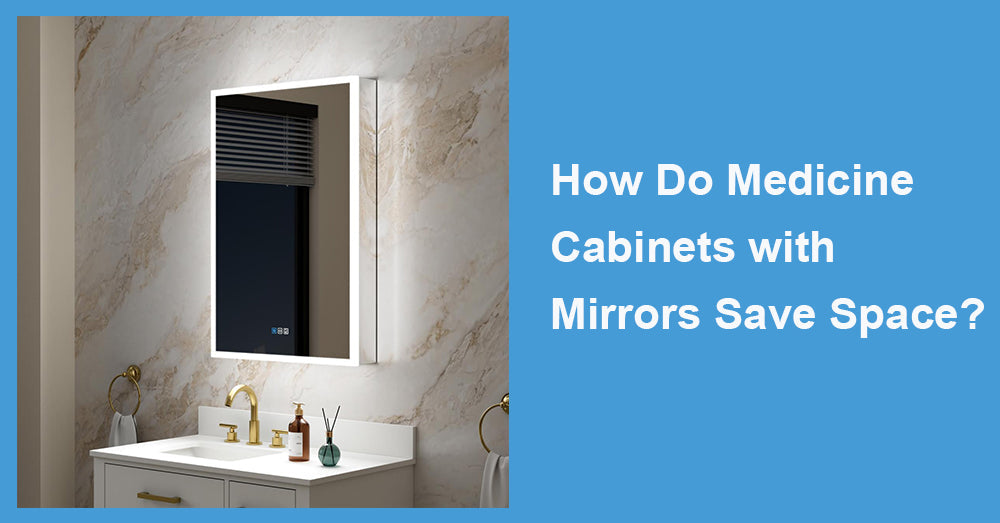
In modern bathroom design, medicine cabinets with mirrors are considered an efficient solution that balances storage and visual functions. Compared to installing wall mirrors and independent storage cabinets separately, this integrated structure transforms the originally "reflective" wall into usable vertical storage space. Especially in bathrooms with an area of less than 100 square feet, the efficiency of wall utilization directly affects the space's cleanliness and comfort. Data shows that in small bathrooms, optimizing the wall storage layout can increase overall storage capacity by about 20% to 30%, and mirror cabinets are the key components for achieving this.
1. Effective utilization of vertical space
The bathroom space is limited, and the floor and countertops are often the first to be occupied. A standard 36-inch vanity countertop typically has an effective placement area of 20 to 24 inches. If all daily necessities are placed on the countertop, it will not only appear cluttered but also affect cleaning efficiency.
Medicine cabinets with mirrors "embed" storage space into the wall. Common sizes include a width of 20 to 30 inches, a height of 26 to 34 inches, and an internal depth of 3.5 to 5 inches. This structure can accommodate toothbrushes, electric shavers, skincare products, and commonly used medicines.
The data show that after adopting the mirror cabinet structure, the average number of items on the countertop is reduced by about 25%, and visual cleanliness is significantly improved.
2. Embedded structure reduces convex depth
Mirror cabinets are usually divided into two types: Surface-Mount and Recessed. The embedded structure uses a 3.5-inch cavity in the wall to level the cabinet with the wall.
Compared to surface-mounted cabinets that typically protrude 4 inches to 5 inches, embedded designs can reduce space occupation by approximately 3 inches or more. In bathrooms with narrow traffic widths, this design that reduces protrusion helps optimize the flow.
Design data shows that reducing wall protrusions by more than 2 inches in spaces with aisle widths below 36 inches can significantly improve walking comfort.
3. Replace additional wall cabinets and standing cabinets
If there were no mirror cabinets, many families would choose to install additional wall cabinets or standing cabinets to increase storage space. This furniture usually occupies additional wall or floor areas.
The depth of an independent cabinet is usually above 12 inches, while the depth of a mirror cabinet is only about 3.5 inches to 5 inches. Taking a 30-inch30-inch-wide mirror cabinet as an example, although its storage capacity is not as large as a standing cabinet, it has the advantage of saving floor space.
Data shows that in bathrooms with an area less than 80 square feet, using mirror cabinets instead of extra standing cabinets can increase the available floor area by more than 10%.
4. Dual mirror layout improves partition efficiency
In a 60-inch double basin structure, a common practice is to install two 24-inch to 30-inch mirror cabinets. Each user has independent storage space, which helps reduce the mixing of items.
Survey data show that in a dual-person shared main bathroom, adopting a double-mirror cabinet structure reduces item mixing by about 30% and significantly improves usage efficiency.
In addition, the dual-mirror layout preserves 8- to 12-inch12-inch wall space, which can be used for installing wall lamps or decorative elements.
5. Reduce visual pressure caused by cluttered countertops
Research in spatial psychology shows that visual clutter can lower ratings of spatial comfort. The mirror cabinet uses hidden storage to centralize the storage of high-frequency small items.
Data shows that after implementing the "hidden storage" design, the space's cleanliness rating increased by about 20%. This change is particularly evident in small bathrooms.
6. Integration with lighting function
Partial medicine cabinets with mirrors feature LED lighting. This not only reduces the installation requirements for individual wall lamps, but also further saves wall space.
The common 36-inch36-inch illuminated mirror cabinet has a brightness of 1200 to 2000 lumens, which is sufficient to meet daily facial lighting needs. In bathrooms with an area less than 80 square feet, additional lighting fixtures can be partially replaced.
7. Storage efficiency and layered design
Internally adjustable shelves are typically spaced between 6-inch and 8-inch intervals. Through layered storage, small items can be arranged vertically to improve utilization.
Data shows that under a reasonable partition design, mirror cabinets with depths ranging from 3.5 inches to 5 inches can accommodate over 20 commonly used small items.
Compared to flat placement on countertops, the vertical layered design increases space utilization by about 15%.
8. Long-term maintenance and practicality
The enclosed structure of the mirror cabinet can reduce direct contact between dust and moisture on items. Maintain ventilation for 15 minutes after showering to help reduce internal humidity.
In an environment with humidity controlled between 40% and 55%, the cabinet's service life is significantly extended.In practical use, the space-saving value of a medicine cabinet with mirror also depends on how daily items are organized and how often the bathroom is shared. For single-user bathrooms, it helps keep essential items within easy reach while maintaining a cleaner countertop. In shared bathrooms, the benefit becomes even more noticeable because enclosed wall storage can reduce overlap between personal items and improve morning routines. This makes the mirror cabinet not only a storage upgrade, but also a planning tool that improves order and usability over time.

9. Conclusion
The reason why medicine cabinets with mirrors can effectively save space is not simply by "increasing storage capacity", but by integrating mirror functions with wall space, achieving vertical utilization and visual optimization. From a 20-inch compact structure to a 60-inch dual zone layout, every inch of the wall can be transformed into an efficient storage area. For bathroom designs that prioritize cleanliness and spatial efficiency, mirror cabinets are not just furniture but also a strategy to enhance space efficiency.










































Leave a comment
This site is protected by hCaptcha and the hCaptcha Privacy Policy and Terms of Service apply.