




















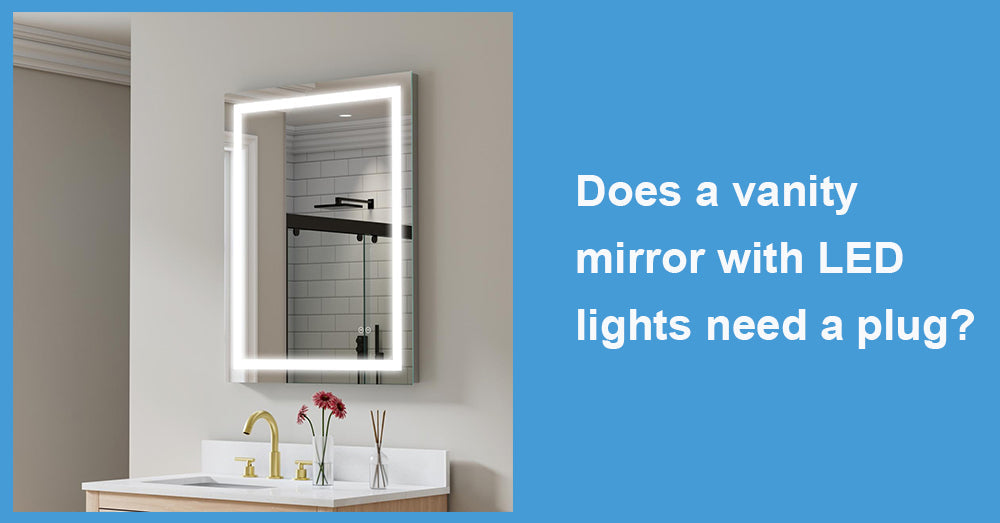
In the North American home decoration and bathroom industry, vanity mirror with led lights has gradually evolved from "high-end optional" to "mainstream configuration". Whether in new residential buildings, renovated apartments, or old house renovation projects, illuminated mirrors have become an essential element in enhancing bathroom functionality and design sense. However, many consumers ask an efficient question when making a purchase: Does a vanity mirror with LED lights need a plug? Or does it have to be wired?
This article will provide in-depth analysis from multiple perspectives, including mainstream product forms, installation methods, regulatory requirements, consumer preferences, and future trends, to help consumers, distributors, and brands better understand the market's development direction for LED vanity mirrors.

1. Mainstream answer: There are both plug and hardwired models available
In the market, dressing mirrors with LED lights are usually divided into two categories:
Plug-in type
This type of product can be directly connected to a wall socket through a standard American plug (120V), and the installation process is relatively simple, without the need for a professional electrician. It is highly popular among DIY users and rental groups.
Hardwired Type
This type of product requires direct connection to household circuits, with wiring and installation completed by electricians. It has a cleaner appearance and no exposed wires, making it more popular in mid to high-end residential and high-end decoration projects.
At present, over 60% of mid- to high-end LED mirror cabinets and dressing mirrors on the market adopt hard-wired designs, while plug-in products are more concentrated in the mid- to low-end, quick-installation, and online retail channels.
2. Why do consumers care about whether they need a plug?
From the user's perspective, this issue mainly focuses on the following aspects:
Installation difficulty
Plug-in products are almost "plug and play", requiring no additional construction and having a low installation threshold; However, hard-wired models require professional electricians, which increases labor costs.
Aesthetics
Hardwiring hides the power cord, making the overall visual more concise and in line with the current trend of minimalism and modern style, which is also why it is more popular in high-end decoration projects.
Security
Consumers are particularly concerned about electrical safety. Hardwired methods are usually paired with GFCI protection circuits, providing higher safety protection in humid environments, while plug-in products can achieve the same level of safety if paired with waterproof sockets.
Post maintenance
Plug-in mirrors are more convenient for later maintenance and replacement, while hard-wired ones require disassembly and reinstallation.
3. The influence of building codes on the power supply mode of LED mirrors
The electrical installation in the bathroom must comply with the NEC (National Electrical Code). It is explicitly stipulated that:
The socket in the bathroom must have a GFCI (leakage protection) function.
Fixed lighting equipment can use hard-wired methods.
The installation location should be away from direct water sources to ensure moisture and water resistance.
Therefore, from a regulatory perspective, both plug-in and hard-wired models are legal and compliant solutions. As long as the product itself passes safety certifications such as UL, ETL, or cETL, it can enter the market for sale.
4. Suggestions for selection in different application scenarios
Renting and short-term use
Plug-in type has more advantages, with convenient installation, detachability, and easy relocation, especially suitable for apartments, student dormitories, and short-term rental housing.
New house decoration or overall renovation
Hardwired models are more in line with the overall design logic, can achieve hidden wiring, make the space cleaner and more unified, and enhance the overall level.
Hotels and commercial projects
Hardwiring has almost become the industry standard, not only for its professional appearance, but also for reducing safety hazards caused by human error in plugging and unplugging.
5. Market trend: moving from "whether there is a plug" to "intelligent power supply system."
In recent years, the penetration rate of smart homes has continued to rise, and LED vanity mirrors have also been constantly upgraded, expanding from simple lighting functions to multi-functional integration such as touch dimming, anti-fog, Bluetooth audio, time and temperature display, and human body sensing night lights.
In terms of power supply methods, the industry is showing the following new trends:
Dual-mode power supply design
More and more brands are launching plug-and-play and hard-wired dual-use products, making installation more flexible and appealing to DIY users while also serving engineering channels.
Low power consumption and energy-saving
By optimizing the LED driving scheme, the power consumption of the mirror lamp is significantly reduced, making long-term use more energy-efficient and environmentally friendly, in line with consumers' growing awareness of energy conservation.
Modular power supply system
Some high-end brands have begun to adopt a modular power box design, which facilitates later maintenance and replacement, and improves the product lifecycle.
6. Product strategy adjustment of channels and brand merchants
From a channel perspective, mainstream platforms such as Wayfair, Home Depot, Lowe's, and Amazon are constantly increasing their requirements for LED vanity mirrors.
Clear instructions on the power supply method must be provided.
Includes detailed installation diagrams and videos;
Emphasize UL/ETL certification and GFCI compatibility instructions.
For brand owners, offering dual-power versions or optional power cord solutions has gradually become a "standard capability" for entering the mid- to high-end market.
7. 5 key points that consumers must pay attention to when making purchases
Does the power supply method comply with the home's existing circuit layout?
Does it support GFCI sockets or hard-wired protection?
Has UL/ETL/cETL certification been obtained
Are the installation instructions clear, and do you provide video guidance?
Does it support replacing after-sales power modules?
8. Conclusion: The plug is not the key; adaptation is the core
Returning to the original question: Does a vanity mirror with LED lights require a plug?
The answer is: not necessarily.
In the market, plug-in and hard-wired coexist, with the core being application scenarios, installation conditions, and personal preferences. With the increasing demand for smart homes and high-end decor, power supply solutions that combine safety, aesthetics, and flexibility are gradually becoming mainstream.
For consumers, choosing the correct power supply method can truly unleash the full value of LED vanity mirrors in lighting, functionality, and aesthetics. For brands and channels, product innovation in power supply systems will be a vital breakthrough to win future markets.



































Leave a comment
This site is protected by hCaptcha and the hCaptcha Privacy Policy and Terms of Service apply.