
















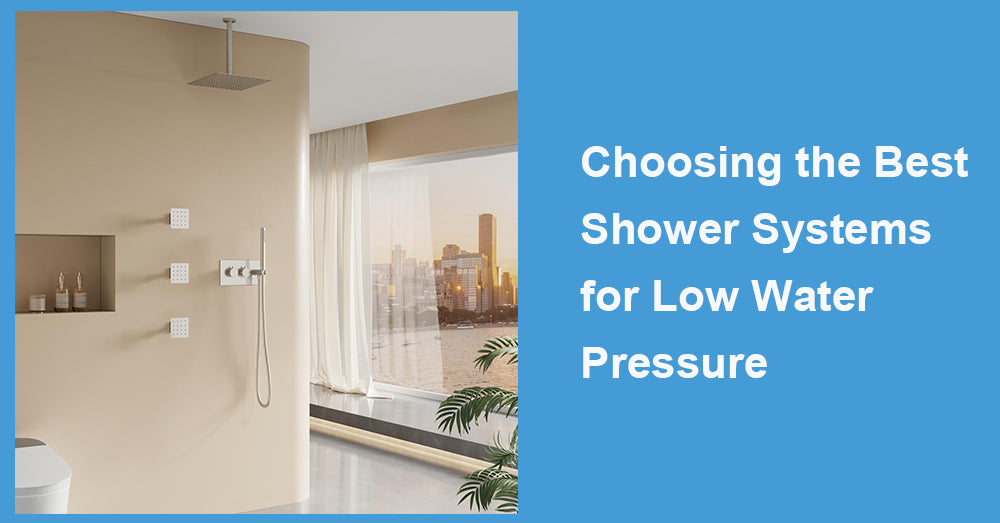
In modern bathroom design, shower systems not only affect the daily bathing experience but also directly affect water pressure, water efficiency, and comfort. However, in many residential areas, low water pressure remains a common problem. Low water pressure can cause uneven, weak water flow and even affect the overall performance of the showerhead. Industry data shows that when the household water supply pressure is below 40 PSI, the water output performance of traditional shower systems will significantly decrease, and the water flow coverage area may decrease by about 30%. Therefore, in conditions of limited water pressure, it is particularly important to choose a suitable shower system structure and nozzle design.
1. Understand the Common Reasons for Low Water Pressure
Before choosing a shower system, it is necessary to understand the reasons for insufficient water pressure. Common factors include long pipeline lengths, small pipe diameters, high floor heights, or outdated water supply systems.
The standard residential water supply pressure is usually between 40 and 60 PSI. When the pressure is below 35-40 PSI, the spray from many ordinary showerheads will significantly weaken.
In addition, pipeline size can also affect water flow efficiency. The common diameter of shower water supply pipes is 1/2-inch. If a smaller diameter is used, the water flow rate may decrease by about 10%-15%.
2. Choose a Showerhead Type Suitable for Low Water Pressure
In low-pressure environments, showerhead design is more important than simple flow rate. Some nozzles enhance the water flow impact through Air Injection technology, making the water pressure feel stronger.
Common types of showerheads suitable for low water pressure environments include:
1. Air Pressurized Showerhead
Air injection technology mixes air with the water flow to form a fuller water column. The data show that this structure can increase perceived water flow intensity by about 20%-30% at the same water pressure.
2. Porous Fine Spray Showerhead
Increasing the number of spray holes and reducing the aperture size can create a more concentrated water flow, thereby increasing spray intensity. The common nozzle diameter is 6-8 inches, suitable for standard shower spaces.
3. Handheld Showerhead Combination
Handheld showerheads usually have a smaller diameter and a more concentrated water flow, making it easier to maintain a steady stream at low water pressure.
3. Traffic Restrictions and Experience
Modern water-saving standards typically limit shower head flow rates to 2.0-2.5 gallons per minute (GPM). Although low flow is beneficial for water conservation, in low-pressure environments, unreasonable design may reduce comfort.
The data show that in environments below 40 PSI, the difference in tactile sensation between the optimized 2.0 GPM showerhead and the standard 2.5 GPM showerhead is not significant, as nozzle structure is the key factor.
Therefore, when choosing a shower system, one should not only focus on flow rates but also consider the showerhead's internal design.
4. Selection of Shower System Structure
A complete shower system typically includes:
Rain shower head
Handheld showerhead
Shower mixing valve
Pipeline and bracket
In low-pressure environments, it is recommended to avoid opening multiple water outlets simultaneously. For example, using both a top spray and a handheld showerhead can disperse the water flow pressure.
Data show that when two nozzles discharge water simultaneously, the flow rate of a single nozzle may decrease by about 40%.
Therefore, systems with diversion valves are more suitable for households with low water pressure and can switch the water outlet mode as needed.
5. The Relationship Between Shower Size and Water Pressure
The size of the showerhead can also affect the water flow performance. In recent years, large top spray heads (12 inches or larger) have become popular but may not perform well in low-water-pressure environments because the water flow is dispersed across more spray holes.
In cases of insufficient water pressure, it is recommended to choose a top spray nozzle with a diameter of 6-8 inches. This size can maintain coverage while ensuring water flow intensity.
Data show that in environments below 40 PSI, the water flow concentration of an 8-inch top spray showerhead is about 25% higher than that of a 12-inch showerhead.
6. Optimization of Installation Height and Angle
Shower heads are typically installed at a distance of approximately 78-84 inches from the ground. Excessive installation can cause water flow to disperse in the air, thereby reducing the impact sensation.
In addition, adjusting the showerhead angle appropriately can improve perceived water pressure. For example, tilting the top spray slightly forward can reduce water flow diffusion.
For handheld showerheads, the hose length is usually 60-72 inches, and the angle and height can be adjusted according to usage habits.
7. Pipeline and Valve Selection
In addition to the nozzle itself, pipeline and valve design also affect water pressure performance. A high-quality constant temperature mixing valve can maintain a stable water flow while reducing pressure fluctuations.
If the bathroom is undergoing a complete renovation, upgrading the water supply pipe diameter may be considered. For example, upgrading from a 3/8-inch pipeline to a 1/2-inch pipeline can increase water flow by about 20%.

8. Maintenance and Long-Term Performance
In low-pressure environments, showerhead nozzle holes are more susceptible to scale buildup. Mineral deposition will further reduce water output.
It is recommended to clean the nozzle every 1-2 months. Soaking in warm water and white vinegar can effectively dissolve scale.
Data shows that regular cleaning of the nozzle can restore approximately 10%-15% of water flow efficiency.
Conclusion
Under low water pressure conditions, choosing the appropriate shower systems is more important than simply increasing the flow rate. By selecting the appropriate nozzle type, optimizing size, using a diversion system, and maintaining unobstructed pipes, the shower experience can be significantly improved.
From the 6-8 inch top spray to the air pressure nozzle, and then to a reasonable installation height, every detail can affect the water flow performance. As long as water pressure conditions are fully considered during the design phase, a comfortable, stable shower experience can be achieved even in environments with low water supply pressure.
















Leave a comment
This site is protected by hCaptcha and the hCaptcha Privacy Policy and Terms of Service apply.