






















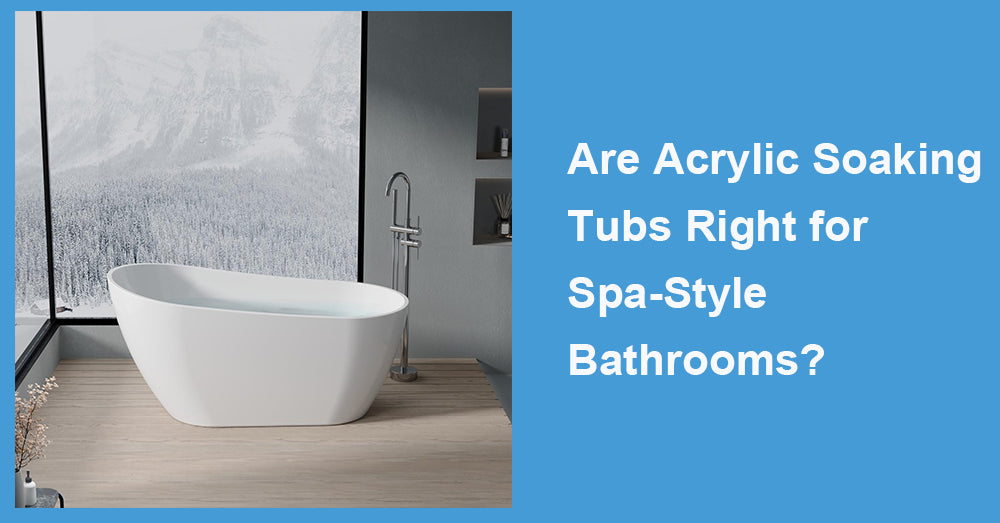
In recent years, bathroom spaces have undergone a significant functional upgrade. From a simple cleaning area, it has gradually evolved into a living space that integrates relaxation, recovery, and private enjoyment, and the "spa-style bathroom" has become an essential trend in the decoration market. In this trend, the choice of a bathtub is no longer just a matter of size and price; it is a core element that directly affects the overall experience. As a product type that has frequently appeared in the market in recent years, whether acrylic soaking tubs are genuinely suitable for creating spa-style bathrooms warrants a systematic industry analysis.
1. The essence of spa-style bathrooms determines higher requirements for bathtubs.
In industry practice, spa-style bathrooms are not simply stacked with high-end configurations, but emphasize the continuity of relaxation and the completeness of spatial experience. These types of bathrooms usually pursue low interference, slow pace, and physical and mental immersion, and the bathtub is the core carrier of this experience.
Compared to traditional functional bathtubs, spa-style bathtubs place greater emphasis on whether the bathing process itself is comfortable, whether it is sufficient to support long-term use, and whether it can form a unified logic with the spatial atmosphere. Therefore, whether the material is gentle, whether the structure is suitable for deep immersion, and whether the visual restraint is sufficient will all become key factors in judging whether the bathtub is "suitable".
2. Industry advantages of acrylic material in terms of tactile and temperature experience
From a material perspective, the advantages of acrylic in hydrotherapy applications are not accidental.
Compared with metal or stone bathtubs, acrylic surfaces are softer and less likely to cause an obvious cold sensation when first touched. This tactile difference is significant in bathrooms that emphasize a relaxing experience.
Meanwhile, acrylic has good insulation performance, with relatively slow water temperature decay, which helps maintain the continuity of the soaking process. For users, this means less interruption and a more stable experience; for the industry, this is precisely the "low interference usage logic" pursued by spa-style bathrooms.
3. The soaking tub structure better meets the needs of hydrotherapy-style baths
Unlike regular bathtubs, the core design of a soaping tub is not about quick bathing but about a deep-soaking experience.
This type of bathtub is usually optimized for depth, tilt angle, and internal space ratio, allowing the body to relax in a more natural posture fully.
In practical applications, acrylic soy tubs are often designed with ergonomics in mind to provide more balanced support for the shoulders, back, waist, and legs. This structural advantage allows it to maintain comfort even after prolonged use, thus being closer to the true essence of the hydrotherapy experience.
4. Design flexibility helps create a stable visual atmosphere for hydrotherapy
The spa-style bathroom emphasizes simplicity, balance, and unity in visual expression, avoiding the visual burden caused by excessive decoration.
Acrylic material itself has good plasticity, which allows the soking tubs to present smooth and soft lines, which is particularly crucial in creating a relaxed atmosphere.
From the perspective of industry design trends, whether it is a standalone layout or a combination with walls, acrylic soaking tubs are more easily coordinated with natural materials, soft lighting, and neutral tones to help establish a stable and soothing visual rhythm in the space.
5. Lightweight features provide more possibilities for spa-style spaces
Compared to cast-iron or natural-stone bathtubs, acrylic soaking tubs have a significant weight advantage. This characteristic is often underestimated in the spatial planning of spa style bathrooms, but it is crucial.
The lightweight structure not only reduces the difficulty of installation and transportation, but also provides designers with higher flexibility in layout, such as placing it by the window, displaying it in the center, or setting the position of the bathtub from a landscape perspective. This flexibility allows the concept of hydrotherapy to be more naturally integrated into different residential conditions without excessive structural limitations.

6. Daily maintenance and long-term use experience are in line with modern spa concepts
A truly mature spa-style bathroom is not just about "looking like a spa center", but about being able to maintain comfort and cleanliness over long-term use.
Acrylic soy tubing is relatively maintenance-friendly, with a surface that is less prone to stubborn water stains, and a milder daily cleaning method that does not require complex or frequent care processes.
From an industry perspective, this low-maintenance feature helps reduce the psychological burden during use, making the bathroom space truly a source of relaxation rather than additional household chores, which is highly in line with the spa concept.
7. From an industry perspective, the reasonable positioning of acrylic soy tubs
Overall, acrylic soy tubs are not meant to pursue flashy luxury, but rather focus more on comfort, a stable experience, and spatial integration.
In spa-style bathrooms, they often play a "quiet but crucial" role, not occupying the visual focus but continuing to affect the user experience.
The industry generally believes that as long as the overall space forms a unified logic in terms of lighting, materials, and layout, acrylic soaking tubs can become one of the core configurations of spa-style bathrooms, rather than a cost-compromising choice.
Conclusion
From material characteristics, structural design, to long-term user experience, acrylic soaking tubs indeed possess the key conditions needed to create a spa-style bathroom. They respond to the dual needs of modern bathrooms for relaxation experience and practicality with a gentle touch, stable insulation performance, and high design adaptability. For users who want to create a continuous spa experience at home, acrylic soaking tubs are not just a material choice, but also a rational solution that fits contemporary lifestyles.









































Leave a comment
This site is protected by hCaptcha and the hCaptcha Privacy Policy and Terms of Service apply.